

120
“ large size, triangular shape, fi ne serrations on the cutting edges, a convex
lingual face, a slightly convex to fl at labial face, and a large v-shaped neck, ”
(Pimiento et al. 2010 ).
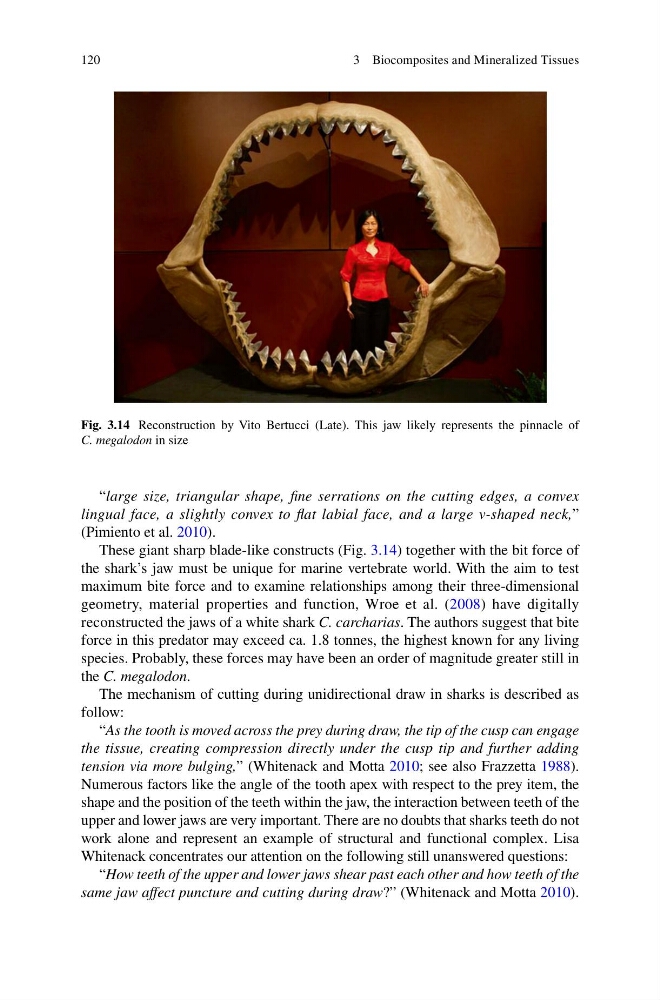
These giant sharp blade-like constructs (Fig. 3.14 ) together with the bit force of
the shark’s jaw must be unique for marine vertebrate world. With the aim to test
maximum bite force and to examine relationships among their three-dimensional
geometry, material properties and function, Wroe et al. ( 2008 ) have digitally
reconstructed the jaws of a white shark C. carcharias . The authors suggest that bite
force in this predator may exceed ca. 1.8 tonnes, the highest known for any living
species. Probably, these forces may have been an order of magnitude greater still in
the C. megalodon .
The mechanism of cutting during unidirectional draw in sharks is described as
follow:
“ As the tooth is moved across the prey during draw, the tip of the cusp can engage
the tissue, creating compression directly under the cusp tip and further adding
tension via more bulging, ” (Whitenack and Motta 2010 ; see also Frazzetta 1988 ).
Numerous factors like the angle of the tooth apex with respect to the prey item, the
shape and the position of the teeth within the jaw, the interaction between teeth of the
upper and lower jaws are very important. There are no doubts that sharks teeth do not
work alone and represent an example of structural and functional complex. Lisa
Whitenack concentrates our attention on the following still unanswered questions:
“ How teeth of the upper and lower jaws shear past each other and how teeth of the
same jaw affect puncture and cutting during draw ?” (Whitenack and Motta 2010 ).
Fig. 3.14 Reconstruction by Vito Bertucci (Late). This jaw likely represents the pinnacle of
C. megalodon in size
3 Biocomposites and Mineralized Tissues
“ large size, triangular shape, fi ne serrations on the cutting edges, a convex
lingual face, a slightly convex to fl at labial face, and a large v-shaped neck, ”
(Pimiento et al. 2010 ).
These giant sharp blade-like constructs (Fig. 3.14 ) together with the bit force of
the shark’s jaw must be unique for marine vertebrate world. With the aim to test
maximum bite force and to examine relationships among their three-dimensional
geometry, material properties and function, Wroe et al. ( 2008 ) have digitally
reconstructed the jaws of a white shark C. carcharias . The authors suggest that bite
force in this predator may exceed ca. 1.8 tonnes, the highest known for any living
species. Probably, these forces may have been an order of magnitude greater still in
the C. megalodon .
The mechanism of cutting during unidirectional draw in sharks is described as
follow:
“ As the tooth is moved across the prey during draw, the tip of the cusp can engage
the tissue, creating compression directly under the cusp tip and further adding
tension via more bulging, ” (Whitenack and Motta 2010 ; see also Frazzetta 1988 ).
Numerous factors like the angle of the tooth apex with respect to the prey item, the
shape and the position of the teeth within the jaw, the interaction between teeth of the
upper and lower jaws are very important. There are no doubts that sharks teeth do not
work alone and represent an example of structural and functional complex. Lisa
Whitenack concentrates our attention on the following still unanswered questions:
“ How teeth of the upper and lower jaws shear past each other and how teeth of the
same jaw affect puncture and cutting during draw ?” (Whitenack and Motta 2010 ).
Fig. 3.14 Reconstruction by Vito Bertucci (Late). This jaw likely represents the pinnacle of
C. megalodon in size
3 Biocomposites and Mineralized Tissues