

119
shark Isurus oxyrinchus, appeared better suited for puncturing and piercing.
Serrated teeth, such as those of the white shark Carcharodon carcharias, appeared
to be more useful for slicing and cutting, although they are more susceptible to
binding of the teeth in prey than the smooth, nonserrated teeth, ” (Whitenack and
Motta 2010 ).
In earlier experiments (Abler 1992 ), it was shown that smooth teeth blades
concentrate a large force on the cutting edge, creating high pressure that “crushes”
the material beneath it, producing the cut.
Of course, the giant teeth of Carcharodon megalodon “as the largest shark to
have ever lived,” (Pimiento et al. 2010 ), attract our attention. It was calculated
based on its tooth crown height (of about 168 mm) that the total length of this
animal reached of more than 16 m (Gottfried et al. 1996 ) and the weight was
between 48,000 and 103,000 kg as estimated by Wroe et al. ( 2008 ). Purdy
( 1996 ) suggested that this huge fi sh was an active predator of large whales.
Furthermore, “this giant shark fi rst immobilized its leviathan prey before feeding,”
(Wroe et al. 2008 ; see for more information Purdy 1996 ). It seems not to be
surprisingly, because the estimated maximums bite force in C. megalodon
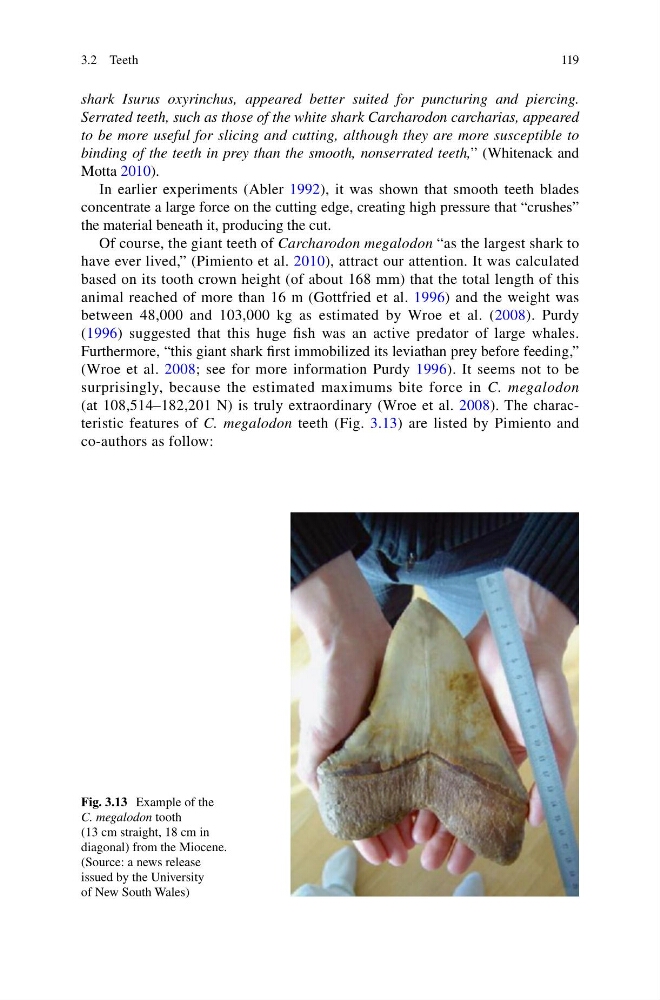
(at 108,514–182,201 N) is truly extraordinary (Wroe et al. 2008 ). The characteristic features of C. megalodon teeth (Fig. 3.13 ) are listed by Pimiento and
co-authors as follow:
Fig. 3.13 Example of the
C. megalodon tooth
(13 cm straight, 18 cm in
diagonal) from the Miocene.
(Source: a news release
issued by the University
of New South Wales)
3.2 Teeth
shark Isurus oxyrinchus, appeared better suited for puncturing and piercing.
Serrated teeth, such as those of the white shark Carcharodon carcharias, appeared
to be more useful for slicing and cutting, although they are more susceptible to
binding of the teeth in prey than the smooth, nonserrated teeth, ” (Whitenack and
Motta 2010 ).
In earlier experiments (Abler 1992 ), it was shown that smooth teeth blades
concentrate a large force on the cutting edge, creating high pressure that “crushes”
the material beneath it, producing the cut.
Of course, the giant teeth of Carcharodon megalodon “as the largest shark to
have ever lived,” (Pimiento et al. 2010 ), attract our attention. It was calculated
based on its tooth crown height (of about 168 mm) that the total length of this
animal reached of more than 16 m (Gottfried et al. 1996 ) and the weight was
between 48,000 and 103,000 kg as estimated by Wroe et al. ( 2008 ). Purdy
( 1996 ) suggested that this huge fi sh was an active predator of large whales.
Furthermore, “this giant shark fi rst immobilized its leviathan prey before feeding,”
(Wroe et al. 2008 ; see for more information Purdy 1996 ). It seems not to be
surprisingly, because the estimated maximums bite force in C. megalodon
(at 108,514–182,201 N) is truly extraordinary (Wroe et al. 2008 ). The characteristic features of C. megalodon teeth (Fig. 3.13 ) are listed by Pimiento and
co-authors as follow:
Fig. 3.13 Example of the
C. megalodon tooth
(13 cm straight, 18 cm in
diagonal) from the Miocene.
(Source: a news release
issued by the University
of New South Wales)
3.2 Teeth