

112
Parrotfi sh are common fi sh found in tropical and sub-tropical waters worldwide,
and are generally associated with the coral reefs upon which they feed. Parrotfi sh
have a specifi c diet of epilithic algae which grows on and within the dead coral
substratum (Carr et al. 2006 ). To help feed on the algae, the parrotfi sh have fi ve
tooth bearing bones. Two anterior tooth bearing bones are used to graze on the
algae or bite into the coral substratum. The resulting material passes to the back of
the throat to the pharyngeal mill made up of two upper tooth bearing bones and one
lower tooth bearing bone. The pharyngeal mill fractures the coral fragments and
liberates nutrients from the algae. Some species of parrotfi sh can process up to
5 tonnes of coral per year per individual (Carr et al. 2006 ).
The mechanical properties of pharyngeal teeth of this fi sh investigated were
hardness, fracture and deformation mechanisms, and wear characteristics.
Hardness results show that the enameloid, the mineralised tissue that makes up
the outer surface of the teeth, is of a similar hardness to human enamel. It has a
microhardness of 315HV, well above the hardness of coral. The fracture and
deformation of teeth showed that the enameloid crystallite bundles deformed by
acting as units and slipping past other bundles. This enabled the deformation to
remain localised so that large deformations could be absorbed and the damage
minimised without reducing the structural integrity of the tooth. The principal
methods used to minimise fracture of enameloid were microcracking, crack
branching and crack defl ection. The microstructure is ideally arranged to counter
tensile forces and to resist abrasion in apical enameloid and basal enameloid
(Carr et al. 2006 ).
Several mechanisms, working together, provide parrotfi sh with good mechanical
properties including toughness, hardness and wear resistance. These mechanisms rely
heavily on the microstructure which is ideally oriented to balance the competing
requirements imposed on the teeth during mastication.
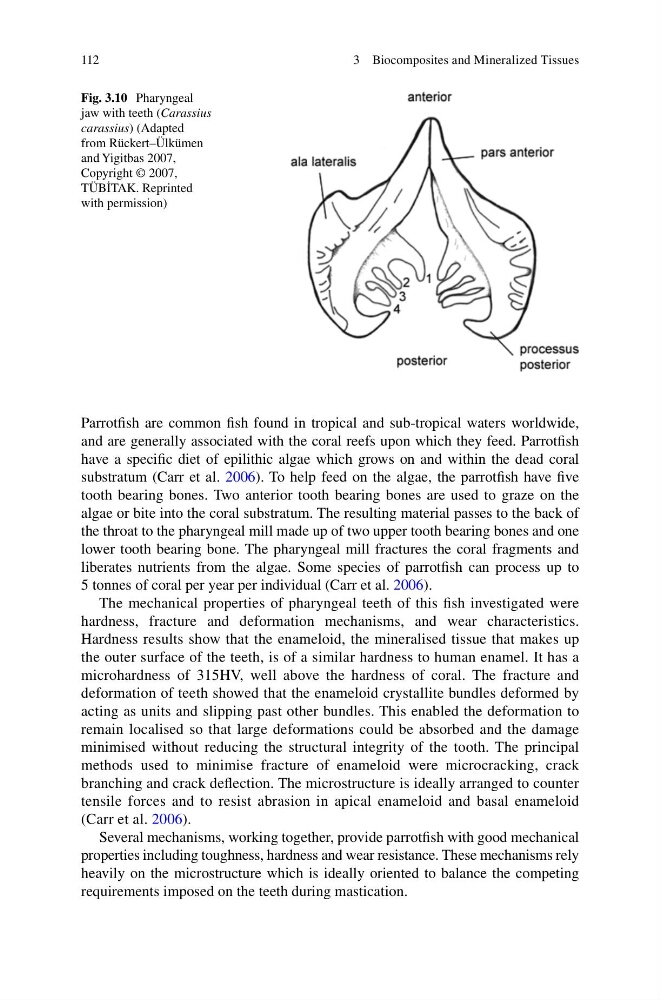
Fig. 3.10 Pharyngeal
jaw with teeth ( Carassius
carassius ) (Adapted
from Rückert–Ülkümen
and Yigitbas 2007,
Copyright © 2007,
TÜBİTAK. Reprinted
with permission)
3 Biocomposites and Mineralized Tissues
Parrotfi sh are common fi sh found in tropical and sub-tropical waters worldwide,
and are generally associated with the coral reefs upon which they feed. Parrotfi sh
have a specifi c diet of epilithic algae which grows on and within the dead coral
substratum (Carr et al. 2006 ). To help feed on the algae, the parrotfi sh have fi ve
tooth bearing bones. Two anterior tooth bearing bones are used to graze on the
algae or bite into the coral substratum. The resulting material passes to the back of
the throat to the pharyngeal mill made up of two upper tooth bearing bones and one
lower tooth bearing bone. The pharyngeal mill fractures the coral fragments and
liberates nutrients from the algae. Some species of parrotfi sh can process up to
5 tonnes of coral per year per individual (Carr et al. 2006 ).
The mechanical properties of pharyngeal teeth of this fi sh investigated were
hardness, fracture and deformation mechanisms, and wear characteristics.
Hardness results show that the enameloid, the mineralised tissue that makes up
the outer surface of the teeth, is of a similar hardness to human enamel. It has a
microhardness of 315HV, well above the hardness of coral. The fracture and
deformation of teeth showed that the enameloid crystallite bundles deformed by
acting as units and slipping past other bundles. This enabled the deformation to
remain localised so that large deformations could be absorbed and the damage
minimised without reducing the structural integrity of the tooth. The principal
methods used to minimise fracture of enameloid were microcracking, crack
branching and crack defl ection. The microstructure is ideally arranged to counter
tensile forces and to resist abrasion in apical enameloid and basal enameloid
(Carr et al. 2006 ).
Several mechanisms, working together, provide parrotfi sh with good mechanical
properties including toughness, hardness and wear resistance. These mechanisms rely
heavily on the microstructure which is ideally oriented to balance the competing
requirements imposed on the teeth during mastication.
Fig. 3.10 Pharyngeal
jaw with teeth ( Carassius
carassius ) (Adapted
from Rückert–Ülkümen
and Yigitbas 2007,
Copyright © 2007,
TÜBİTAK. Reprinted
with permission)
3 Biocomposites and Mineralized Tissues