

111
relative to external skin tubercles, and that neither pharyngeal denticles, nor
teeth, derive from the latter during the evolution of jawed fi shes,” (Johanson and
Smith 2003 ; see also Johanson and Smith 2005 ).
Teeth are found in two main locations in vertebrates: the oral cavity and the pharynx.
Most teleosts (bony fi shes) have four pairs of gill arches that are just posterior to the
bones of the mouth and oral cavity of the individual. Depending on the species,
these arches can possess gill rakers that aid in the fi ltration of fi ne particles from the
water for use as a food source; or for protection of the soft gill tissues. These rakers
usually are attached to the epibranchials, packed structures that comprise a portion
of the gill arches. In several families of fi sh, an interesting modifi cation is seen in
another bone present in the gill arch, the ceratobranchial element of the fi fth arch.
This arch is where the pharyngeal teeth are located in the pharynx, from which they
get their name (Miller 1999 ). Pharyngeal teeth, for example, those found in teleost
fi sh, develop from interactions between endoderm and mesenchyme. Evidence from
the fossil record indicates that pharyngeal teeth were present in jawless vertebrates
and therefore preceded oral teeth (Tucker and Sharpe 2004 ). Pharyngeal and oral
teeth “share the same typical tooth structure: external mineralised layers (made of
enamel or enameloid, and dentine) surrounding a central dental mesenchyme,”
(Debiais-Thibaud et al. 2007 ).
Cypriniformes are known as a highly diverse clade with more than 3,000 species.
All representatives of this group possess “pharyngeal dentition attached to the fi fth
ceratobranchial, and do not develop oral teeth,” (Pasco-Viel et al. 2010 ) (Fig. 3.10 ).
The way pharyngeal teeth come together during the mastication process varies in
different families. In some cyprinids, the teeth interlock laterally and crush food as
it passes toward the alimentary canal. Other fi shes such as cichlids have ventral
pharyngeal plates that are used to crush food against a top plate inside the pharynx
(Miller 1999 ).
Pharyngeal teeth of some fi sh species possess high biomimetic potential for
material scientists. Those from Parrotfi sh Scarus rivulatus are a good example.
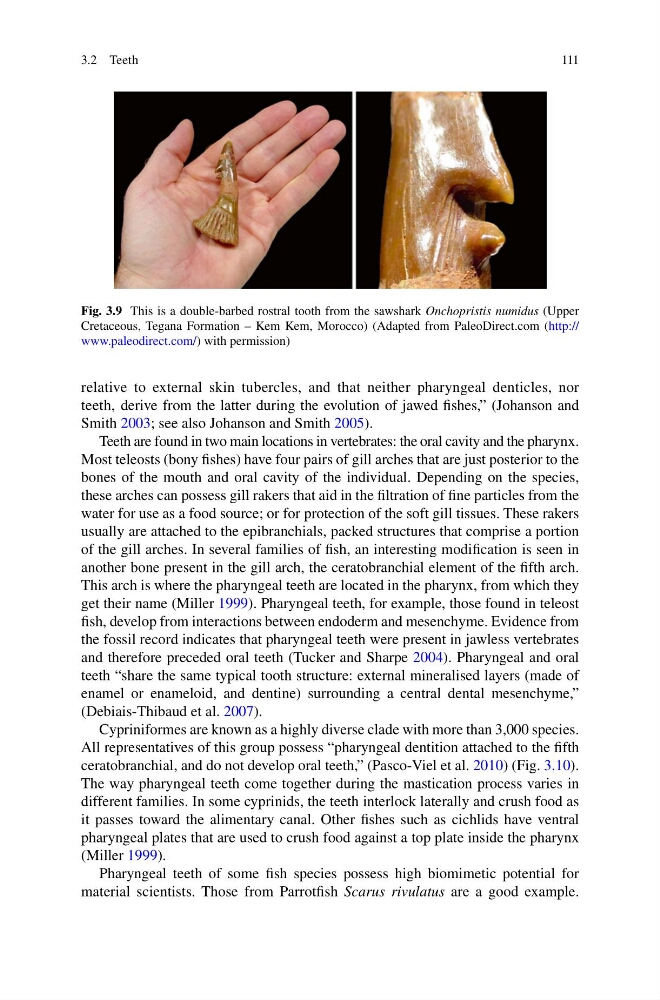
Fig. 3.9 This is a double-barbed rostral tooth from the sawshark Onchopristis numidus (Upper
Cretaceous, Tegana Formation – Kem Kem, Morocco) (Adapted from PaleoDirect.com ( http://
www.paleodirect.com/ ) with permission)
3.2 Teeth
relative to external skin tubercles, and that neither pharyngeal denticles, nor
teeth, derive from the latter during the evolution of jawed fi shes,” (Johanson and
Smith 2003 ; see also Johanson and Smith 2005 ).
Teeth are found in two main locations in vertebrates: the oral cavity and the pharynx.
Most teleosts (bony fi shes) have four pairs of gill arches that are just posterior to the
bones of the mouth and oral cavity of the individual. Depending on the species,
these arches can possess gill rakers that aid in the fi ltration of fi ne particles from the
water for use as a food source; or for protection of the soft gill tissues. These rakers
usually are attached to the epibranchials, packed structures that comprise a portion
of the gill arches. In several families of fi sh, an interesting modifi cation is seen in
another bone present in the gill arch, the ceratobranchial element of the fi fth arch.
This arch is where the pharyngeal teeth are located in the pharynx, from which they
get their name (Miller 1999 ). Pharyngeal teeth, for example, those found in teleost
fi sh, develop from interactions between endoderm and mesenchyme. Evidence from
the fossil record indicates that pharyngeal teeth were present in jawless vertebrates
and therefore preceded oral teeth (Tucker and Sharpe 2004 ). Pharyngeal and oral
teeth “share the same typical tooth structure: external mineralised layers (made of
enamel or enameloid, and dentine) surrounding a central dental mesenchyme,”
(Debiais-Thibaud et al. 2007 ).
Cypriniformes are known as a highly diverse clade with more than 3,000 species.
All representatives of this group possess “pharyngeal dentition attached to the fi fth
ceratobranchial, and do not develop oral teeth,” (Pasco-Viel et al. 2010 ) (Fig. 3.10 ).
The way pharyngeal teeth come together during the mastication process varies in
different families. In some cyprinids, the teeth interlock laterally and crush food as
it passes toward the alimentary canal. Other fi shes such as cichlids have ventral
pharyngeal plates that are used to crush food against a top plate inside the pharynx
(Miller 1999 ).
Pharyngeal teeth of some fi sh species possess high biomimetic potential for
material scientists. Those from Parrotfi sh Scarus rivulatus are a good example.
Fig. 3.9 This is a double-barbed rostral tooth from the sawshark Onchopristis numidus (Upper
Cretaceous, Tegana Formation – Kem Kem, Morocco) (Adapted from PaleoDirect.com ( http://
www.paleodirect.com/ ) with permission)
3.2 Teeth