

100
Mechanical testing revealed the anisotropic nature of right whale trabecular
bone. The results of mechanical testing of trabecular bone indicated that the rostrocaudal axis is 3–4 times stiffer and 4–5 times stronger than the bucco-lingual and
dorso-ventral axes (Campbell-Malone et al. 2008 ). The Young’s modulus for
trabecular bone from the right whale mandible was strikingly similar to values
from the human mandible (!) (374.3 MPa and 373 MPa respectively). This fi nding
indicates that the structural organization of right whale mandibular bone tissue
plays an important role in determining the stiffness and strength of this bone tissue
(Campbell- Malone 2007 ).
Whale bones are surprisingly porous (Fig. 3.3 ) and light, except for the dense ribs
and caudal vertebrae. In paleonthological remains, these “bones can be distinguished
from the other osseous materials by a cancellous, osteoporotic-like structure with
irregularly distributed rounded porosities with diameters reaching up to 500 μm”
(Reiche et al. 2011 ). The porosity of whale bones is also an issue that infl uences the
bones’ mechanical behavior and their subsequent degradation. Only the mandibles
and upper limb bones of whales are beam-like, load-bearing structures; and it is only
these elements that contain substantial amounts of compact bone. The vertebrae and
ribs are composed largely of spongy or trabecular bone with a high porosity. Additional
microscale computed tomography of right whale cortical bone in this transition
zone revealed it to have the porous structure of trabecular bone (albeit lower porosity)
and an average μCT apparent density of 0.501 g/cm
3 (±0.0312). Individual trabeculae
were extremely large, on the order of 1 mm in thickness and plate-like columns of
trabecular bone were also visible (Campbell- Malone 2007 ). The greater porosity
of whale bones means that they have a high storage capacity of oil while the animal
is alive, and that they retain a high proportion of that oil even after the bones have
been macerated to remove the soft tissues.
Signifi cant differences in the composition of bones from different parts of the
whale skeleton have been reported (for review see Higgs et al. 2011a ). For example,
even vertebrae show 30–40 % differences in lipid content between different parts of
the spine however they possess similar structure. Also different cetaceans species
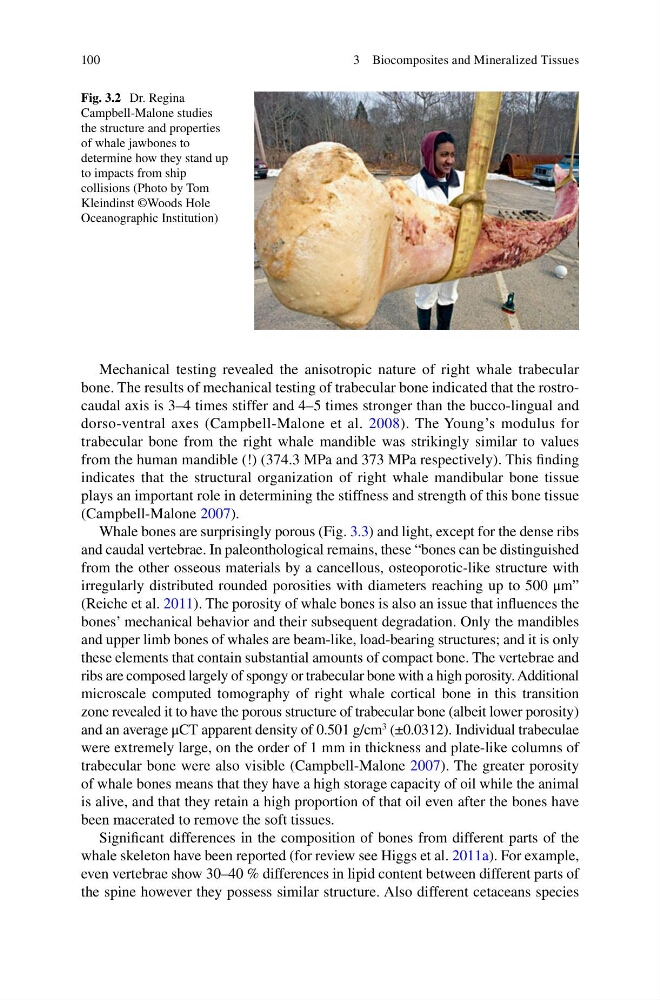
Fig. 3.2 Dr. Regina
Campbell-Malone studies
the structure and properties
of whale jawbones to
determine how they stand up
to impacts from ship
collisions (Photo by Tom
Kleindinst ©Woods Hole
Oceanographic Institution)
3 Biocomposites and Mineralized Tissues
Mechanical testing revealed the anisotropic nature of right whale trabecular
bone. The results of mechanical testing of trabecular bone indicated that the rostrocaudal axis is 3–4 times stiffer and 4–5 times stronger than the bucco-lingual and
dorso-ventral axes (Campbell-Malone et al. 2008 ). The Young’s modulus for
trabecular bone from the right whale mandible was strikingly similar to values
from the human mandible (!) (374.3 MPa and 373 MPa respectively). This fi nding
indicates that the structural organization of right whale mandibular bone tissue
plays an important role in determining the stiffness and strength of this bone tissue
(Campbell- Malone 2007 ).
Whale bones are surprisingly porous (Fig. 3.3 ) and light, except for the dense ribs
and caudal vertebrae. In paleonthological remains, these “bones can be distinguished
from the other osseous materials by a cancellous, osteoporotic-like structure with
irregularly distributed rounded porosities with diameters reaching up to 500 μm”
(Reiche et al. 2011 ). The porosity of whale bones is also an issue that infl uences the
bones’ mechanical behavior and their subsequent degradation. Only the mandibles
and upper limb bones of whales are beam-like, load-bearing structures; and it is only
these elements that contain substantial amounts of compact bone. The vertebrae and
ribs are composed largely of spongy or trabecular bone with a high porosity. Additional
microscale computed tomography of right whale cortical bone in this transition
zone revealed it to have the porous structure of trabecular bone (albeit lower porosity)
and an average μCT apparent density of 0.501 g/cm
3 (±0.0312). Individual trabeculae
were extremely large, on the order of 1 mm in thickness and plate-like columns of
trabecular bone were also visible (Campbell- Malone 2007 ). The greater porosity
of whale bones means that they have a high storage capacity of oil while the animal
is alive, and that they retain a high proportion of that oil even after the bones have
been macerated to remove the soft tissues.
Signifi cant differences in the composition of bones from different parts of the
whale skeleton have been reported (for review see Higgs et al. 2011a ). For example,
even vertebrae show 30–40 % differences in lipid content between different parts of
the spine however they possess similar structure. Also different cetaceans species
Fig. 3.2 Dr. Regina
Campbell-Malone studies
the structure and properties
of whale jawbones to
determine how they stand up
to impacts from ship
collisions (Photo by Tom
Kleindinst ©Woods Hole
Oceanographic Institution)
3 Biocomposites and Mineralized Tissues