

18
G.R. Carvalho et al.
anthropogenically-degraded ecosystems, such as coral reefs (Bellwood et al. 2004,
Shearer and Coffroth 2006). Including marine larvae in estimates of species richness
is crucial, not only in relatively inaccessible or unexplored environments, such as
the deep-sea (Grassle and Maciolek 1992), but also in more intensively documented
coastal waters (Harding 1999, Lindley and Batten 2002).
Larvae, especially those of invertebrates, often represent an inscrutable component in marine fauna inventories (Mariani et al. 2003). Their ecological significance
is still poorly understood, and the importance of larvae in marine food webs has only
been recently highlighted (Bullard et al. 1999, Rosel and Kocher 2002, Metaxas and
Burdett-Coutts 2006). Several factors account for this: small sizes, lack of diagnostic
morphological characters allowing equivocal species identification, multiple larval
stages, phenotypic plasticity, time and expertise required for accurate identification.
When identification characters exist, they may often be restricted to certain geographical areas (reviewed in Rogers 2001). In some cases, the difficulty of rearing
in captivity for reverse taxonomy is a further impediment to larval identification.
Larvae, however, represent a fundamental component of marine ecosystems and a
key step in the life cycle of many marine organisms.
Many molecular approaches have been developed to explore larval biology, and
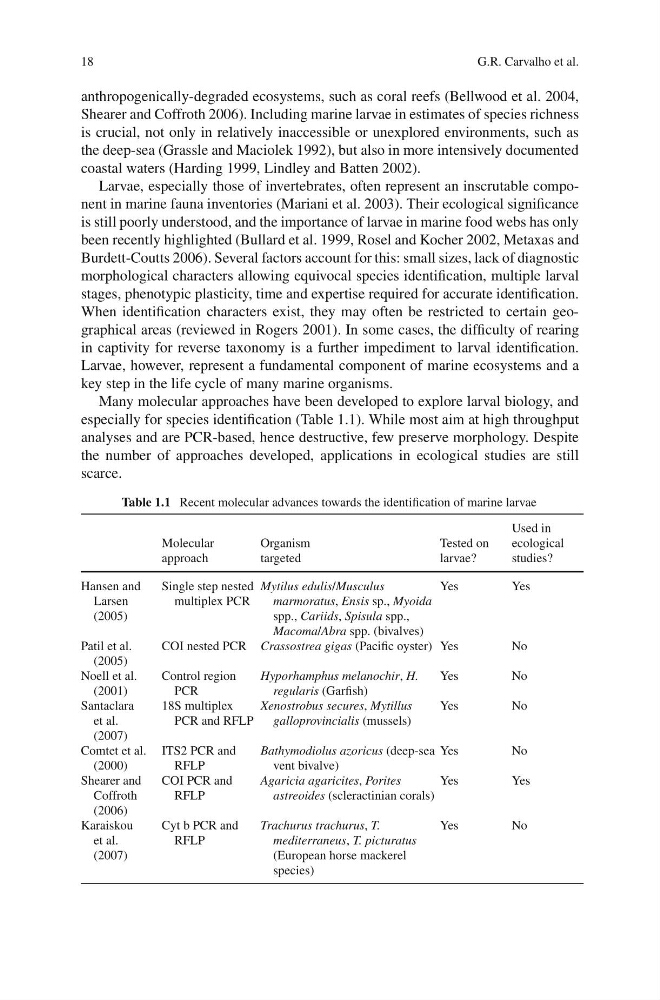
especially for species identification (Table 1.1). While most aim at high throughput
analyses and are PCR-based, hence destructive, few preserve morphology. Despite
the number of approaches developed, applications in ecological studies are still
scarce.
Table 1.1 Recent molecular advances towards the identification of marine larvae
Molecular
approach
Organism
targeted
Tested on
larvae?
Used in
ecological
studies?
Hansen and
Larsen
(2005)
Single step nested
multiplex PCR
Mytilus edulis/Musculus
marmoratus, Ensis sp., Myoida
spp., Cariids, Spisula spp.,
Macoma/Abra spp. (bivalves)
Yes
Yes
Patil et al.
(2005)
COI nested PCR Crassostrea gigas (Pacific oyster) Yes
No
Noell et al.
(2001)
Control region
PCR
Hyporhamphus melanochir, H.
regularis (Garfish)
Yes
No
Santaclara
et al.
(2007)
18S multiplex
PCR and RFLP
Xenostrobus secures, Mytillus
galloprovincialis (mussels)
Yes
No
Comtet et al.
(2000)
ITS2 PCR and
RFLP
Bathymodiolus azoricus (deep-sea
vent bivalve)
Yes
No
Shearer and
Coffroth
(2006)
COI PCR and
RFLP
Agaricia agaricites, Porites
astreoides (scleractinian corals)
Yes
Yes
Karaiskou
et al.
(2007)
Cyt b PCR and
RFLP
Trachurus trachurus, T.
mediterraneus, T. picturatus
(European horse mackerel
species)
Yes
No
G.R. Carvalho et al.
anthropogenically-degraded ecosystems, such as coral reefs (Bellwood et al. 2004,
Shearer and Coffroth 2006). Including marine larvae in estimates of species richness
is crucial, not only in relatively inaccessible or unexplored environments, such as
the deep-sea (Grassle and Maciolek 1992), but also in more intensively documented
coastal waters (Harding 1999, Lindley and Batten 2002).
Larvae, especially those of invertebrates, often represent an inscrutable component in marine fauna inventories (Mariani et al. 2003). Their ecological significance
is still poorly understood, and the importance of larvae in marine food webs has only
been recently highlighted (Bullard et al. 1999, Rosel and Kocher 2002, Metaxas and
Burdett-Coutts 2006). Several factors account for this: small sizes, lack of diagnostic
morphological characters allowing equivocal species identification, multiple larval
stages, phenotypic plasticity, time and expertise required for accurate identification.
When identification characters exist, they may often be restricted to certain geographical areas (reviewed in Rogers 2001). In some cases, the difficulty of rearing
in captivity for reverse taxonomy is a further impediment to larval identification.
Larvae, however, represent a fundamental component of marine ecosystems and a
key step in the life cycle of many marine organisms.
Many molecular approaches have been developed to explore larval biology, and
especially for species identification (Table 1.1). While most aim at high throughput
analyses and are PCR-based, hence destructive, few preserve morphology. Despite
the number of approaches developed, applications in ecological studies are still
scarce.
Table 1.1 Recent molecular advances towards the identification of marine larvae
Molecular
approach
Organism
targeted
Tested on
larvae?
Used in
ecological
studies?
Hansen and
Larsen
(2005)
Single step nested
multiplex PCR
Mytilus edulis/Musculus
marmoratus, Ensis sp., Myoida
spp., Cariids, Spisula spp.,
Macoma/Abra spp. (bivalves)
Yes
Yes
Patil et al.
(2005)
COI nested PCR Crassostrea gigas (Pacific oyster) Yes
No
Noell et al.
(2001)
Control region
PCR
Hyporhamphus melanochir, H.
regularis (Garfish)
Yes
No
Santaclara
et al.
(2007)
18S multiplex
PCR and RFLP
Xenostrobus secures, Mytillus
galloprovincialis (mussels)
Yes
No
Comtet et al.
(2000)
ITS2 PCR and
RFLP
Bathymodiolus azoricus (deep-sea
vent bivalve)
Yes
No
Shearer and
Coffroth
(2006)
COI PCR and
RFLP
Agaricia agaricites, Porites
astreoides (scleractinian corals)
Yes
Yes
Karaiskou
et al.
(2007)
Cyt b PCR and
RFLP
Trachurus trachurus, T.
mediterraneus, T. picturatus
(European horse mackerel
species)
Yes
No