

scientists (zoologists, botanists, meteorologists) that were directed by the chief
scientist Charles Wyville Thompson. During the 713 days long research journey,
133 bottom dredges were hauled to collect samples of deep-sea animals and plants
for analyses of the waters from the surface to the depth of >2,000 m. On board, they
had a total of 7,315 m hemp lines with a circumference of 5–8 cm to collect also the
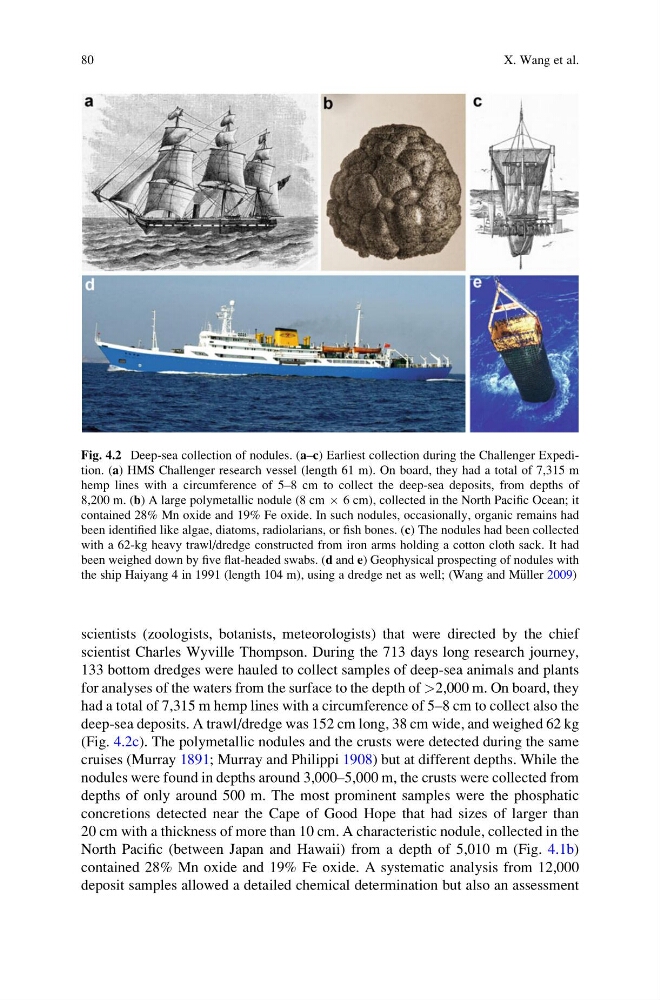
deep-sea deposits. A trawl/dredge was 152 cm long, 38 cm wide, and weighed 62 kg
(Fig. 4.2c). The polymetallic nodules and the crusts were detected during the same
cruises (Murray 1891; Murray and Philippi 1908) but at different depths. While the
nodules were found in depths around 3,000–5,000 m, the crusts were collected from
depths of only around 500 m. The most prominent samples were the phosphatic
concretions detected near the Cape of Good Hope that had sizes of larger than
20 cm with a thickness of more than 10 cm. A characteristic nodule, collected in the
North Pacific (between Japan and Hawaii) from a depth of 5,010 m (Fig. 4.1b)
contained 28% Mn oxide and 19% Fe oxide. A systematic analysis from 12,000
deposit samples allowed a detailed chemical determination but also an assessment
Fig. 4.2 Deep-sea collection of nodules. (a–c) Earliest collection during the Challenger Expedition. (a) HMS Challenger research vessel (length 61 m). On board, they had a total of 7,315 m
hemp lines with a circumference of 5–8 cm to collect the deep-sea deposits, from depths of
8,200 m. (b) A large polymetallic nodule (8 cm  6 cm), collected in the North Pacific Ocean; it
contained 28% Mn oxide and 19% Fe oxide. In such nodules, occasionally, organic remains had
been identified like algae, diatoms, radiolarians, or fish bones. (c) The nodules had been collected
with a 62-kg heavy trawl/dredge constructed from iron arms holding a cotton cloth sack. It had
been weighed down by five flat-headed swabs. (d and e) Geophysical prospecting of nodules with
the ship Haiyang 4 in 1991 (length 104 m), using a dredge net as well; (Wang and M€ uller 2009)
80
X. Wang et al.
scientist Charles Wyville Thompson. During the 713 days long research journey,
133 bottom dredges were hauled to collect samples of deep-sea animals and plants
for analyses of the waters from the surface to the depth of >2,000 m. On board, they
had a total of 7,315 m hemp lines with a circumference of 5–8 cm to collect also the
deep-sea deposits. A trawl/dredge was 152 cm long, 38 cm wide, and weighed 62 kg
(Fig. 4.2c). The polymetallic nodules and the crusts were detected during the same
cruises (Murray 1891; Murray and Philippi 1908) but at different depths. While the
nodules were found in depths around 3,000–5,000 m, the crusts were collected from
depths of only around 500 m. The most prominent samples were the phosphatic
concretions detected near the Cape of Good Hope that had sizes of larger than
20 cm with a thickness of more than 10 cm. A characteristic nodule, collected in the
North Pacific (between Japan and Hawaii) from a depth of 5,010 m (Fig. 4.1b)
contained 28% Mn oxide and 19% Fe oxide. A systematic analysis from 12,000
deposit samples allowed a detailed chemical determination but also an assessment
Fig. 4.2 Deep-sea collection of nodules. (a–c) Earliest collection during the Challenger Expedition. (a) HMS Challenger research vessel (length 61 m). On board, they had a total of 7,315 m
hemp lines with a circumference of 5–8 cm to collect the deep-sea deposits, from depths of
8,200 m. (b) A large polymetallic nodule (8 cm  6 cm), collected in the North Pacific Ocean; it
contained 28% Mn oxide and 19% Fe oxide. In such nodules, occasionally, organic remains had
been identified like algae, diatoms, radiolarians, or fish bones. (c) The nodules had been collected
with a 62-kg heavy trawl/dredge constructed from iron arms holding a cotton cloth sack. It had
been weighed down by five flat-headed swabs. (d and e) Geophysical prospecting of nodules with
the ship Haiyang 4 in 1991 (length 104 m), using a dredge net as well; (Wang and M€ uller 2009)
80
X. Wang et al.