

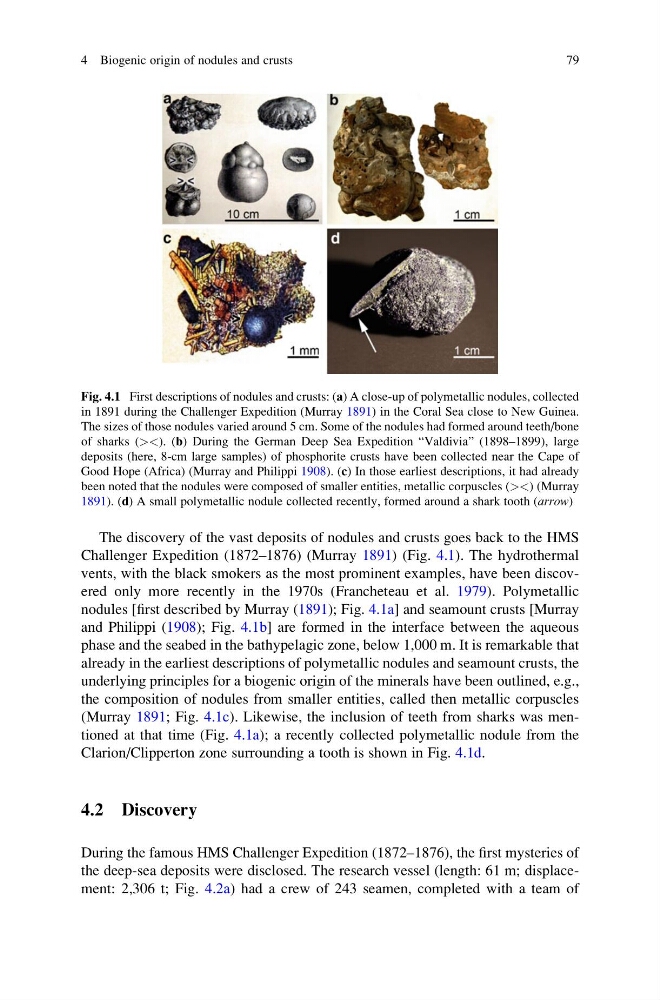
The discovery of the vast deposits of nodules and crusts goes back to the HMS
Challenger Expedition (1872–1876) (Murray 1891) (Fig. 4.1). The hydrothermal
vents, with the black smokers as the most prominent examples, have been discovered only more recently in the 1970s (Francheteau et al. 1979). Polymetallic
nodules [first described by Murray (1891); Fig. 4.1a] and seamount crusts [Murray
and Philippi (1908); Fig. 4.1b] are formed in the interface between the aqueous
phase and the seabed in the bathypelagic zone, below 1,000 m. It is remarkable that
already in the earliest descriptions of polymetallic nodules and seamount crusts, the
underlying principles for a biogenic origin of the minerals have been outlined, e.g.,
the composition of nodules from smaller entities, called then metallic corpuscles
(Murray 1891; Fig. 4.1c). Likewise, the inclusion of teeth from sharks was mentioned at that time (Fig. 4.1a); a recently collected polymetallic nodule from the
Clarion/Clipperton zone surrounding a tooth is shown in Fig. 4.1d.
4.2 Discovery
During the famous HMS Challenger Expedition (1872–1876), the first mysteries of
the deep-sea deposits were disclosed. The research vessel (length: 61 m; displacement: 2,306 t; Fig. 4.2a) had a crew of 243 seamen, completed with a team of
Fig. 4.1 First descriptions of nodules and crusts: (a) A close-up of polymetallic nodules, collected
in 1891 during the Challenger Expedition (Murray 1891) in the Coral Sea close to New Guinea.
The sizes of those nodules varied around 5 cm. Some of the nodules had formed around teeth/bone
of sharks (><). (b) During the German Deep Sea Expedition “Valdivia” (1898–1899), large
deposits (here, 8-cm large samples) of phosphorite crusts have been collected near the Cape of
Good Hope (Africa) (Murray and Philippi 1908). (c) In those earliest descriptions, it had already
been noted that the nodules were composed of smaller entities, metallic corpuscles (><) (Murray
1891). (d) A small polymetallic nodule collected recently, formed around a shark tooth (arrow)
4 Biogenic origin of nodules and crusts
79
Challenger Expedition (1872–1876) (Murray 1891) (Fig. 4.1). The hydrothermal
vents, with the black smokers as the most prominent examples, have been discovered only more recently in the 1970s (Francheteau et al. 1979). Polymetallic
nodules [first described by Murray (1891); Fig. 4.1a] and seamount crusts [Murray
and Philippi (1908); Fig. 4.1b] are formed in the interface between the aqueous
phase and the seabed in the bathypelagic zone, below 1,000 m. It is remarkable that
already in the earliest descriptions of polymetallic nodules and seamount crusts, the
underlying principles for a biogenic origin of the minerals have been outlined, e.g.,
the composition of nodules from smaller entities, called then metallic corpuscles
(Murray 1891; Fig. 4.1c). Likewise, the inclusion of teeth from sharks was mentioned at that time (Fig. 4.1a); a recently collected polymetallic nodule from the
Clarion/Clipperton zone surrounding a tooth is shown in Fig. 4.1d.
4.2 Discovery
During the famous HMS Challenger Expedition (1872–1876), the first mysteries of
the deep-sea deposits were disclosed. The research vessel (length: 61 m; displacement: 2,306 t; Fig. 4.2a) had a crew of 243 seamen, completed with a team of
Fig. 4.1 First descriptions of nodules and crusts: (a) A close-up of polymetallic nodules, collected
in 1891 during the Challenger Expedition (Murray 1891) in the Coral Sea close to New Guinea.
The sizes of those nodules varied around 5 cm. Some of the nodules had formed around teeth/bone
of sharks (><). (b) During the German Deep Sea Expedition “Valdivia” (1898–1899), large
deposits (here, 8-cm large samples) of phosphorite crusts have been collected near the Cape of
Good Hope (Africa) (Murray and Philippi 1908). (c) In those earliest descriptions, it had already
been noted that the nodules were composed of smaller entities, metallic corpuscles (><) (Murray
1891). (d) A small polymetallic nodule collected recently, formed around a shark tooth (arrow)
4 Biogenic origin of nodules and crusts
79