

into an iron -free protein crystal (Crow et al. 2009), or by tryptophan quenching
(Lawson et al. 2009; Bellapadrona et al. 2009). In maxi-ferritin, the two Fe(II)
atoms appear to bind independently to Fe sites 1 and 2, with five ligands that include
water and a “space” for dioxygen Fe binding. The Fe(II) binding sites in eukaryotic
and prokaryotic ferritins are weaker than in BFR (Table 2.3), supporting the
cofactor behavior of iron at BFR active sites (Le Brun et al. 2010). In mini-ferritins,
the 12 active sites are saturated with 12 Fe(II) atoms (Su et al. 2005) except in
proteins that can use dioxygen as the substrate, where 24 Fe(II) bind/cage (Liu et al.
2006). The differential affinities of Fe 1 and Fe 2 sites in mini-ferritins are
illustrated by protein crystal structures where the site occupancy of metals varies
between one and two depending on the protein (Chiancone and Ceci 2010). In
maxi-ferritins, the 24 active sites are saturated with 48 Fe (II), when the formation
of the differic peroxo complex is the reporter (reviewed Liu 2005).
2.3.2 Step ii. O 2 or H 2 O 2 Binding and Formation of Transition
Intermediates
Ferritin catalysis is rapid (msec) and requires stopped flow measurements to
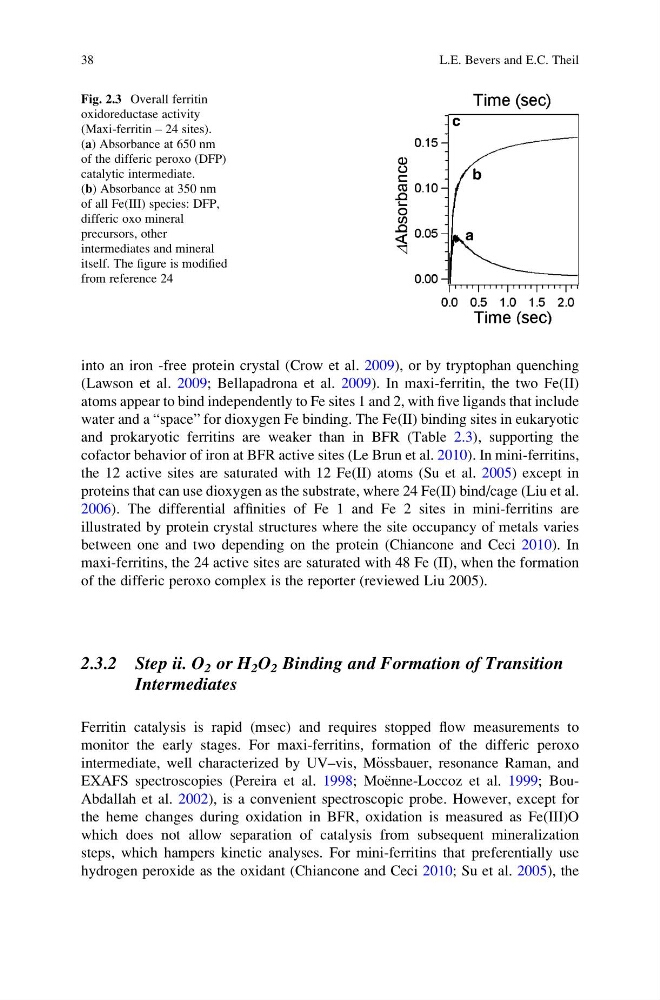
monitor the early stages. For maxi-ferritins, formation of the differic peroxo
intermediate, well characterized by UV–vis, M€ ossbauer, resonance Raman, and
EXAFS spectroscopies (Pereira et al. 1998; Moe ¨nne-Loccoz et al. 1999; BouAbdallah et al. 2002), is a convenient spectroscopic probe. However, except for
the heme changes during oxidation in BFR, oxidation is measured as Fe(III)O
which does not allow separation of catalysis from subsequent mineralization
steps, which hampers kinetic analyses. For mini-ferritins that preferentially use
hydrogen peroxide as the oxidant (Chiancone and Ceci 2010; Su et al. 2005), the
Fig. 2.3 Overall ferritin
oxidoreductase activity
(Maxi-ferritin – 24 sites).
(a) Absorbance at 650 nm
of the differic peroxo (DFP)
catalytic intermediate.
(b) Absorbance at 350 nm
of all Fe(III) species: DFP,
differic oxo mineral
precursors, other
intermediates and mineral
itself. The figure is modified
from reference 24
38
L.E. Bevers and E.C. Theil
(Lawson et al. 2009; Bellapadrona et al. 2009). In maxi-ferritin, the two Fe(II)
atoms appear to bind independently to Fe sites 1 and 2, with five ligands that include
water and a “space” for dioxygen Fe binding. The Fe(II) binding sites in eukaryotic
and prokaryotic ferritins are weaker than in BFR (Table 2.3), supporting the
cofactor behavior of iron at BFR active sites (Le Brun et al. 2010). In mini-ferritins,
the 12 active sites are saturated with 12 Fe(II) atoms (Su et al. 2005) except in
proteins that can use dioxygen as the substrate, where 24 Fe(II) bind/cage (Liu et al.
2006). The differential affinities of Fe 1 and Fe 2 sites in mini-ferritins are
illustrated by protein crystal structures where the site occupancy of metals varies
between one and two depending on the protein (Chiancone and Ceci 2010). In
maxi-ferritins, the 24 active sites are saturated with 48 Fe (II), when the formation
of the differic peroxo complex is the reporter (reviewed Liu 2005).
2.3.2 Step ii. O 2 or H 2 O 2 Binding and Formation of Transition
Intermediates
Ferritin catalysis is rapid (msec) and requires stopped flow measurements to
monitor the early stages. For maxi-ferritins, formation of the differic peroxo
intermediate, well characterized by UV–vis, M€ ossbauer, resonance Raman, and
EXAFS spectroscopies (Pereira et al. 1998; Moe ¨nne-Loccoz et al. 1999; BouAbdallah et al. 2002), is a convenient spectroscopic probe. However, except for
the heme changes during oxidation in BFR, oxidation is measured as Fe(III)O
which does not allow separation of catalysis from subsequent mineralization
steps, which hampers kinetic analyses. For mini-ferritins that preferentially use
hydrogen peroxide as the oxidant (Chiancone and Ceci 2010; Su et al. 2005), the
Fig. 2.3 Overall ferritin
oxidoreductase activity
(Maxi-ferritin – 24 sites).
(a) Absorbance at 650 nm
of the differic peroxo (DFP)
catalytic intermediate.
(b) Absorbance at 350 nm
of all Fe(III) species: DFP,
differic oxo mineral
precursors, other
intermediates and mineral
itself. The figure is modified
from reference 24
38
L.E. Bevers and E.C. Theil