

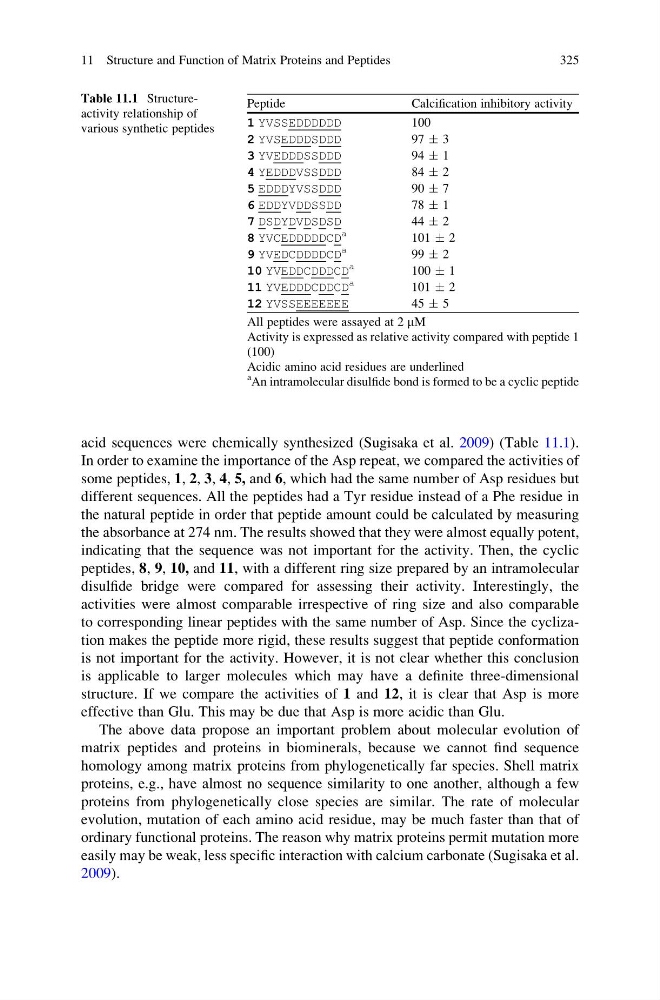
acid sequences were chemically synthesized (Sugisaka et al. 2009) (Table 11.1).
In order to examine the importance of the Asp repeat, we compared the activities of
some peptides, 1, 2, 3, 4, 5, and 6, which had the same number of Asp residues but
different sequences. All the peptides had a Tyr residue instead of a Phe residue in
the natural peptide in order that peptide amount could be calculated by measuring
the absorbance at 274 nm. The results showed that they were almost equally potent,
indicating that the sequence was not important for the activity. Then, the cyclic
peptides, 8, 9, 10, and 11, with a different ring size prepared by an intramolecular
disulfide bridge were compared for assessing their activity. Interestingly, the
activities were almost comparable irrespective of ring size and also comparable
to corresponding linear peptides with the same number of Asp. Since the cyclization makes the peptide more rigid, these results suggest that peptide conformation
is not important for the activity. However, it is not clear whether this conclusion
is applicable to larger molecules which may have a definite three-dimensional
structure. If we compare the activities of 1 and 12, it is clear that Asp is more
effective than Glu. This may be due that Asp is more acidic than Glu.
The above data propose an important problem about molecular evolution of
matrix peptides and proteins in biominerals, because we cannot find sequence
homology among matrix proteins from phylogenetically far species. Shell matrix
proteins, e.g., have almost no sequence similarity to one another, although a few
proteins from phylogenetically close species are similar. The rate of molecular
evolution, mutation of each amino acid residue, may be much faster than that of
ordinary functional proteins. The reason why matrix proteins permit mutation more
easily may be weak, less specific interaction with calcium carbonate (Sugisaka et al.
2009).
Table 11.1 Structureactivity relationship of
various synthetic peptides
Peptide
Calcification inhibitory activity
1 YVSSEDDDDDD
100
2 YVSEDDDSDDD
97 Æ 3
3 YVEDDDSSDDD
94 Æ 1
4 YEDDDVSSDDD
84 Æ 2
5 EDDDYVSSDDD
90 Æ 7
6 EDDYVDDSSDD
78 Æ 1
7 DSDYDVDSDSD
44 Æ 2
8 YVCEDDDDDCD
a
101 Æ 2
9 YVEDCDDDDCD
a
99 Æ 2
10 YVEDDCDDDCD
a
100 Æ 1
11 YVEDDDCDDCD
a
101 Æ 2
12 YVSSEEEEEEE
45 Æ 5
All peptides were assayed at 2 mM
Activity is expressed as relative activity compared with peptide 1
(100)
Acidic amino acid residues are underlined
a
An intramolecular disulfide bond is formed to be a cyclic peptide
11 Structure and Function of Matrix Proteins and Peptides
325
In order to examine the importance of the Asp repeat, we compared the activities of
some peptides, 1, 2, 3, 4, 5, and 6, which had the same number of Asp residues but
different sequences. All the peptides had a Tyr residue instead of a Phe residue in
the natural peptide in order that peptide amount could be calculated by measuring
the absorbance at 274 nm. The results showed that they were almost equally potent,
indicating that the sequence was not important for the activity. Then, the cyclic
peptides, 8, 9, 10, and 11, with a different ring size prepared by an intramolecular
disulfide bridge were compared for assessing their activity. Interestingly, the
activities were almost comparable irrespective of ring size and also comparable
to corresponding linear peptides with the same number of Asp. Since the cyclization makes the peptide more rigid, these results suggest that peptide conformation
is not important for the activity. However, it is not clear whether this conclusion
is applicable to larger molecules which may have a definite three-dimensional
structure. If we compare the activities of 1 and 12, it is clear that Asp is more
effective than Glu. This may be due that Asp is more acidic than Glu.
The above data propose an important problem about molecular evolution of
matrix peptides and proteins in biominerals, because we cannot find sequence
homology among matrix proteins from phylogenetically far species. Shell matrix
proteins, e.g., have almost no sequence similarity to one another, although a few
proteins from phylogenetically close species are similar. The rate of molecular
evolution, mutation of each amino acid residue, may be much faster than that of
ordinary functional proteins. The reason why matrix proteins permit mutation more
easily may be weak, less specific interaction with calcium carbonate (Sugisaka et al.
2009).
Table 11.1 Structureactivity relationship of
various synthetic peptides
Peptide
Calcification inhibitory activity
1 YVSSEDDDDDD
100
2 YVSEDDDSDDD
97 Æ 3
3 YVEDDDSSDDD
94 Æ 1
4 YEDDDVSSDDD
84 Æ 2
5 EDDDYVSSDDD
90 Æ 7
6 EDDYVDDSSDD
78 Æ 1
7 DSDYDVDSDSD
44 Æ 2
8 YVCEDDDDDCD
a
101 Æ 2
9 YVEDCDDDDCD
a
99 Æ 2
10 YVEDDCDDDCD
a
100 Æ 1
11 YVEDDDCDDCD
a
101 Æ 2
12 YVSSEEEEEEE
45 Æ 5
All peptides were assayed at 2 mM
Activity is expressed as relative activity compared with peptide 1
(100)
Acidic amino acid residues are underlined
a
An intramolecular disulfide bond is formed to be a cyclic peptide
11 Structure and Function of Matrix Proteins and Peptides
325