

arthropod cuticle proteins at the central part of the molecule. The N- and C-terminal
parts are rich in acidic amino acid residues, especially aspartate, glutamate, and
phosphoserine, making this peptide highly acidic. The calcification-inhibitory
activity was adopted for evaluation of function. This inhibition assay simply
means that the peptide has an ability to bind to solid calcium carbonate, and it is
presumed that it may regulate calcification by inhibition of crystal growth. Some
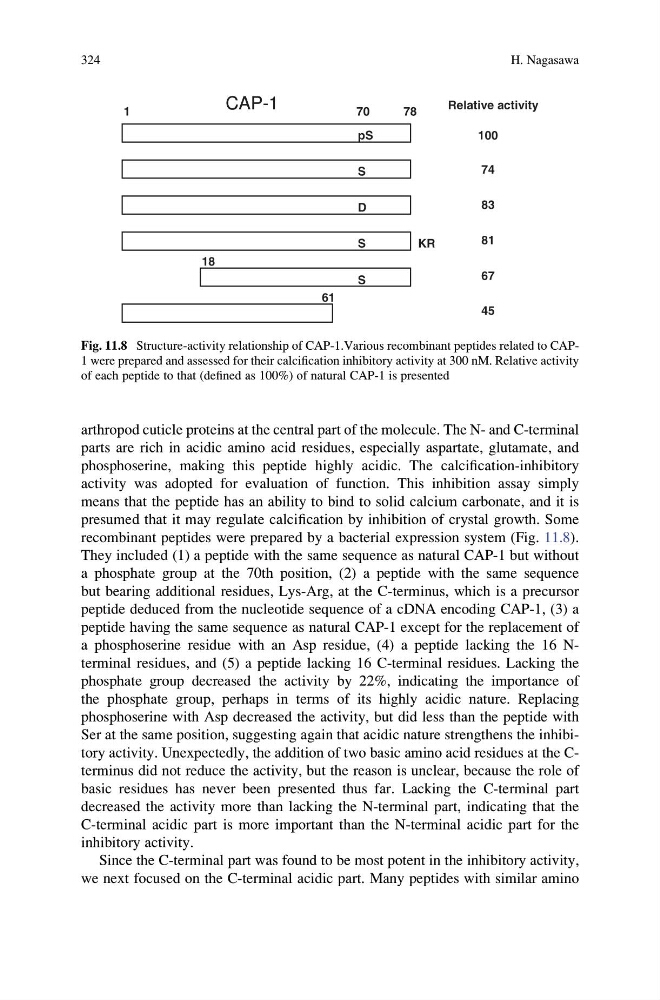
recombinant peptides were prepared by a bacterial expression system (Fig. 11.8).
They included (1) a peptide with the same sequence as natural CAP-1 but without
a phosphate group at the 70th position, (2) a peptide with the same sequence
but bearing additional residues, Lys-Arg, at the C-terminus, which is a precursor
peptide deduced from the nucleotide sequence of a cDNA encoding CAP-1, (3) a
peptide having the same sequence as natural CAP-1 except for the replacement of
a phosphoserine residue with an Asp residue, (4) a peptide lacking the 16 Nterminal residues, and (5) a peptide lacking 16 C-terminal residues. Lacking the
phosphate group decreased the activity by 22%, indicating the importance of
the phosphate group, perhaps in terms of its highly acidic nature. Replacing
phosphoserine with Asp decreased the activity, but did less than the peptide with
Ser at the same position, suggesting again that acidic nature strengthens the inhibitory activity. Unexpectedly, the addition of two basic amino acid residues at the Cterminus did not reduce the activity, but the reason is unclear, because the role of
basic residues has never been presented thus far. Lacking the C-terminal part
decreased the activity more than lacking the N-terminal part, indicating that the
C-terminal acidic part is more important than the N-terminal acidic part for the
inhibitory activity.
Since the C-terminal part was found to be most potent in the inhibitory activity,
we next focused on the C-terminal acidic part. Many peptides with similar amino
1
70
78
pS
S
D
KR
S
100
74
83
81
67
45
Relative activity
18
61
CAP-1
pS
S
D
S
CAP-1
S
Fig. 11.8 Structure-activity relationship of CAP-1.Various recombinant peptides related to CAP1 were prepared and assessed for their calcification inhibitory activity at 300 nM. Relative activity
of each peptide to that (defined as 100%) of natural CAP-1 is presented
324
H. Nagasawa
parts are rich in acidic amino acid residues, especially aspartate, glutamate, and
phosphoserine, making this peptide highly acidic. The calcification-inhibitory
activity was adopted for evaluation of function. This inhibition assay simply
means that the peptide has an ability to bind to solid calcium carbonate, and it is
presumed that it may regulate calcification by inhibition of crystal growth. Some
recombinant peptides were prepared by a bacterial expression system (Fig. 11.8).
They included (1) a peptide with the same sequence as natural CAP-1 but without
a phosphate group at the 70th position, (2) a peptide with the same sequence
but bearing additional residues, Lys-Arg, at the C-terminus, which is a precursor
peptide deduced from the nucleotide sequence of a cDNA encoding CAP-1, (3) a
peptide having the same sequence as natural CAP-1 except for the replacement of
a phosphoserine residue with an Asp residue, (4) a peptide lacking the 16 Nterminal residues, and (5) a peptide lacking 16 C-terminal residues. Lacking the
phosphate group decreased the activity by 22%, indicating the importance of
the phosphate group, perhaps in terms of its highly acidic nature. Replacing
phosphoserine with Asp decreased the activity, but did less than the peptide with
Ser at the same position, suggesting again that acidic nature strengthens the inhibitory activity. Unexpectedly, the addition of two basic amino acid residues at the Cterminus did not reduce the activity, but the reason is unclear, because the role of
basic residues has never been presented thus far. Lacking the C-terminal part
decreased the activity more than lacking the N-terminal part, indicating that the
C-terminal acidic part is more important than the N-terminal acidic part for the
inhibitory activity.
Since the C-terminal part was found to be most potent in the inhibitory activity,
we next focused on the C-terminal acidic part. Many peptides with similar amino
1
70
78
pS
S
D
KR
S
100
74
83
81
67
45
Relative activity
18
61
CAP-1
pS
S
D
S
CAP-1
S
Fig. 11.8 Structure-activity relationship of CAP-1.Various recombinant peptides related to CAP1 were prepared and assessed for their calcification inhibitory activity at 300 nM. Relative activity
of each peptide to that (defined as 100%) of natural CAP-1 is presented
324
H. Nagasawa