

monomers to trimers and higher oligomers which are linked by siloxane (Si–O–Si)
bonds (Iler 1979; Mann 2001). The proximity of the chain ends of the small
oligomers which are more reactive than the monomer allows for the transient
formation of cyclic siloxane species (Fig. 10.1a). The further polycondensation
reaction which may involve an Ostwald ripening process (growth on the expense of
silicic acid released from smaller, more soluble particles) finally leads to the
formation and deposition of larger, less soluble silica particles (Perry 2003; Perry
and Keeling-Tucker 2000).
At neutral pH, the proportion of ionized silicic acid molecules is very small (Perry
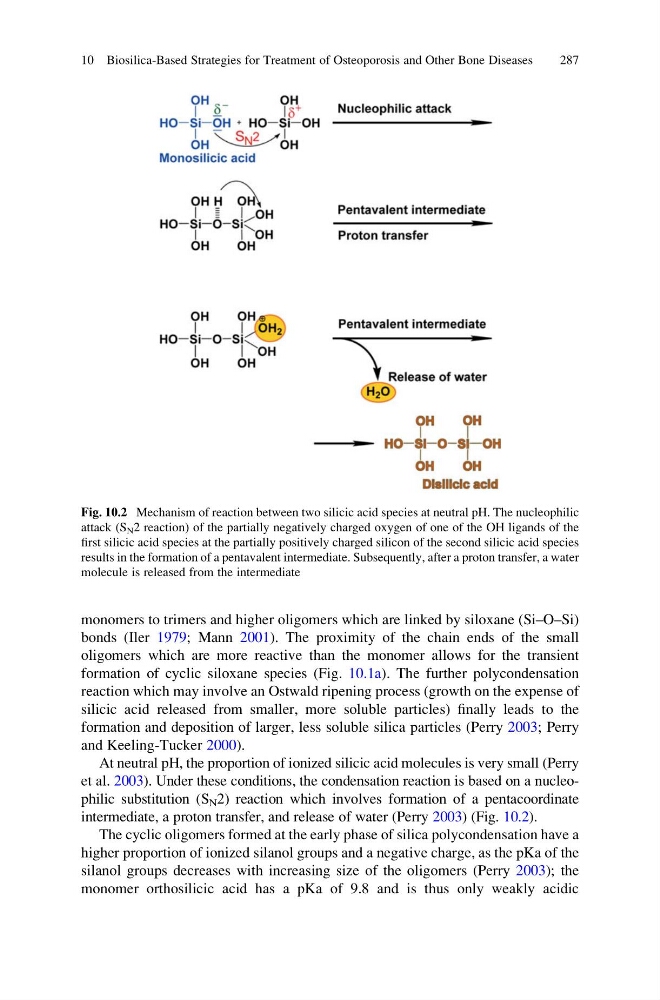
et al. 2003). Under these conditions, the condensation reaction is based on a nucleophilic substitution (S N 2) reaction which involves formation of a pentacoordinate
intermediate, a proton transfer, and release of water (Perry 2003) (Fig. 10.2).
The cyclic oligomers formed at the early phase of silica polycondensation have a
higher proportion of ionized silanol groups and a negative charge, as the pKa of the
silanol groups decreases with increasing size of the oligomers (Perry 2003); the
monomer orthosilicic acid has a pKa of 9.8 and is thus only weakly acidic
Fig. 10.2 Mechanism of reaction between two silicic acid species at neutral pH. The nucleophilic
attack (S N 2 reaction) of the partially negatively charged oxygen of one of the OH ligands of the
first silicic acid species at the partially positively charged silicon of the second silicic acid species
results in the formation of a pentavalent intermediate. Subsequently, after a proton transfer, a water
molecule is released from the intermediate
10 Biosilica-Based Strategies for Treatment of Osteoporosis and Other Bone Diseases
287
bonds (Iler 1979; Mann 2001). The proximity of the chain ends of the small
oligomers which are more reactive than the monomer allows for the transient
formation of cyclic siloxane species (Fig. 10.1a). The further polycondensation
reaction which may involve an Ostwald ripening process (growth on the expense of
silicic acid released from smaller, more soluble particles) finally leads to the
formation and deposition of larger, less soluble silica particles (Perry 2003; Perry
and Keeling-Tucker 2000).
At neutral pH, the proportion of ionized silicic acid molecules is very small (Perry
et al. 2003). Under these conditions, the condensation reaction is based on a nucleophilic substitution (S N 2) reaction which involves formation of a pentacoordinate
intermediate, a proton transfer, and release of water (Perry 2003) (Fig. 10.2).
The cyclic oligomers formed at the early phase of silica polycondensation have a
higher proportion of ionized silanol groups and a negative charge, as the pKa of the
silanol groups decreases with increasing size of the oligomers (Perry 2003); the
monomer orthosilicic acid has a pKa of 9.8 and is thus only weakly acidic
Fig. 10.2 Mechanism of reaction between two silicic acid species at neutral pH. The nucleophilic
attack (S N 2 reaction) of the partially negatively charged oxygen of one of the OH ligands of the
first silicic acid species at the partially positively charged silicon of the second silicic acid species
results in the formation of a pentavalent intermediate. Subsequently, after a proton transfer, a water
molecule is released from the intermediate
10 Biosilica-Based Strategies for Treatment of Osteoporosis and Other Bone Diseases
287