

these processes (reviewed in: Morgan et al. 2008). Since the studies of Carlisle
(1972) and Schwarz and Milne (1972), the close interrelation between silica
metabolism and bone formation in mammals has attracted increasing attention
(reviewed in: Jugdaohsingh 2007).
10.3 Silicon Chemistry
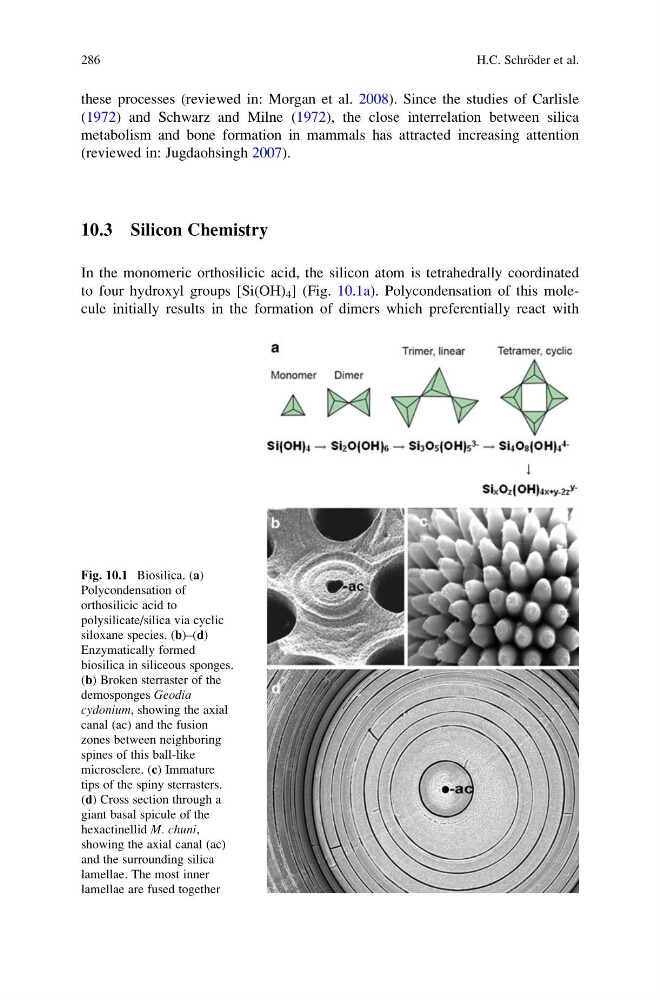
In the monomeric orthosilicic acid, the silicon atom is tetrahedrally coordinated
to four hydroxyl groups [Si(OH) 4 ] (Fig. 10.1a). Polycondensation of this molecule initially results in the formation of dimers which preferentially react with
Fig. 10.1 Biosilica. (a)
Polycondensation of
orthosilicic acid to
polysilicate/silica via cyclic
siloxane species. (b)–(d)
Enzymatically formed
biosilica in siliceous sponges.
(b) Broken sterraster of the
demosponges Geodia
cydonium, showing the axial
canal (ac) and the fusion
zones between neighboring
spines of this ball-like
microsclere. (c) Immature
tips of the spiny sterrasters.
(d) Cross section through a
giant basal spicule of the
hexactinellid M. chuni,
showing the axial canal (ac)
and the surrounding silica
lamellae. The most inner
lamellae are fused together
286
H.C. Schr€ oder et al.
(1972) and Schwarz and Milne (1972), the close interrelation between silica
metabolism and bone formation in mammals has attracted increasing attention
(reviewed in: Jugdaohsingh 2007).
10.3 Silicon Chemistry
In the monomeric orthosilicic acid, the silicon atom is tetrahedrally coordinated
to four hydroxyl groups [Si(OH) 4 ] (Fig. 10.1a). Polycondensation of this molecule initially results in the formation of dimers which preferentially react with
Fig. 10.1 Biosilica. (a)
Polycondensation of
orthosilicic acid to
polysilicate/silica via cyclic
siloxane species. (b)–(d)
Enzymatically formed
biosilica in siliceous sponges.
(b) Broken sterraster of the
demosponges Geodia
cydonium, showing the axial
canal (ac) and the fusion
zones between neighboring
spines of this ball-like
microsclere. (c) Immature
tips of the spiny sterrasters.
(d) Cross section through a
giant basal spicule of the
hexactinellid M. chuni,
showing the axial canal (ac)
and the surrounding silica
lamellae. The most inner
lamellae are fused together
286
H.C. Schr€ oder et al.