

probably because complex calcium ions screened the peptide bonds in the polymer
side chains from water molecules, thereby prohibiting the slow, but gradual disruption of the hydrogen bonds. The introduction of such polymer into a crystallization
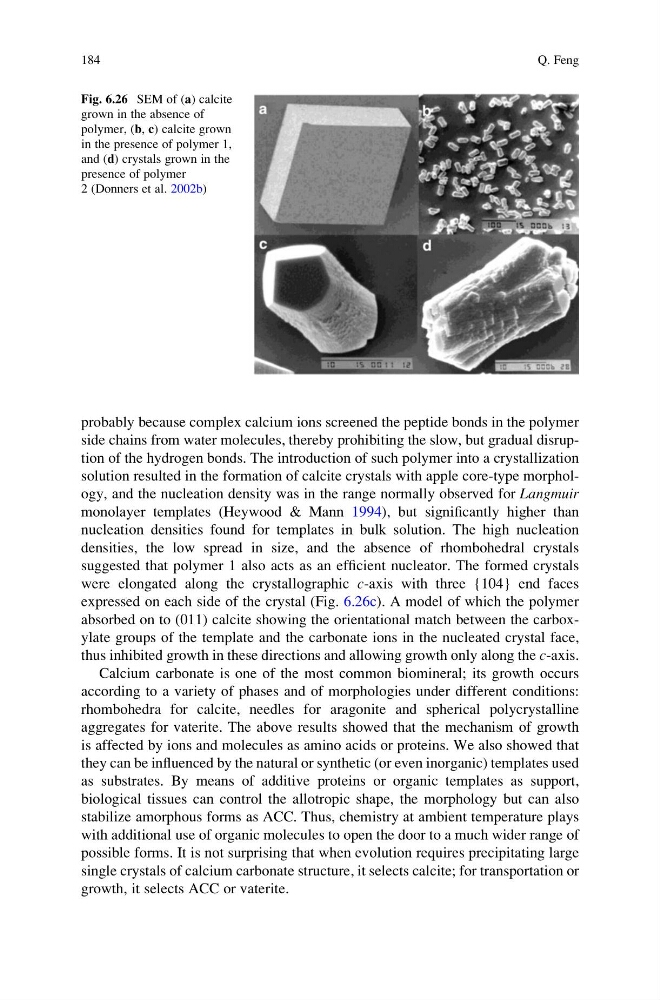
solution resulted in the formation of calcite crystals with apple core-type morphology, and the nucleation density was in the range normally observed for Langmuir
monolayer templates (Heywood & Mann 1994), but significantly higher than
nucleation densities found for templates in bulk solution. The high nucleation
densities, the low spread in size, and the absence of rhombohedral crystals
suggested that polymer 1 also acts as an efficient nucleator. The formed crystals
were elongated along the crystallographic c-axis with three {104} end faces
expressed on each side of the crystal (Fig. 6.26c). A model of which the polymer
absorbed on to (011) calcite showing the orientational match between the carboxylate groups of the template and the carbonate ions in the nucleated crystal face,
thus inhibited growth in these directions and allowing growth only along the c-axis.
Calcium carbonate is one of the most common biomineral; its growth occurs
according to a variety of phases and of morphologies under different conditions:
rhombohedra for calcite, needles for aragonite and spherical polycrystalline
aggregates for vaterite. The above results showed that the mechanism of growth
is affected by ions and molecules as amino acids or proteins. We also showed that
they can be influenced by the natural or synthetic (or even inorganic) templates used
as substrates. By means of additive proteins or organic templates as support,
biological tissues can control the allotropic shape, the morphology but can also
stabilize amorphous forms as ACC. Thus, chemistry at ambient temperature plays
with additional use of organic molecules to open the door to a much wider range of
possible forms. It is not surprising that when evolution requires precipitating large
single crystals of calcium carbonate structure, it selects calcite; for transportation or
growth, it selects ACC or vaterite.
Fig. 6.26 SEM of (a) calcite
grown in the absence of
polymer, (b, c) calcite grown
in the presence of polymer 1,
and (d) crystals grown in the
presence of polymer
2 (Donners et al. 2002b)
184
Q. Feng
side chains from water molecules, thereby prohibiting the slow, but gradual disruption of the hydrogen bonds. The introduction of such polymer into a crystallization
solution resulted in the formation of calcite crystals with apple core-type morphology, and the nucleation density was in the range normally observed for Langmuir
monolayer templates (Heywood & Mann 1994), but significantly higher than
nucleation densities found for templates in bulk solution. The high nucleation
densities, the low spread in size, and the absence of rhombohedral crystals
suggested that polymer 1 also acts as an efficient nucleator. The formed crystals
were elongated along the crystallographic c-axis with three {104} end faces
expressed on each side of the crystal (Fig. 6.26c). A model of which the polymer
absorbed on to (011) calcite showing the orientational match between the carboxylate groups of the template and the carbonate ions in the nucleated crystal face,
thus inhibited growth in these directions and allowing growth only along the c-axis.
Calcium carbonate is one of the most common biomineral; its growth occurs
according to a variety of phases and of morphologies under different conditions:
rhombohedra for calcite, needles for aragonite and spherical polycrystalline
aggregates for vaterite. The above results showed that the mechanism of growth
is affected by ions and molecules as amino acids or proteins. We also showed that
they can be influenced by the natural or synthetic (or even inorganic) templates used
as substrates. By means of additive proteins or organic templates as support,
biological tissues can control the allotropic shape, the morphology but can also
stabilize amorphous forms as ACC. Thus, chemistry at ambient temperature plays
with additional use of organic molecules to open the door to a much wider range of
possible forms. It is not surprising that when evolution requires precipitating large
single crystals of calcium carbonate structure, it selects calcite; for transportation or
growth, it selects ACC or vaterite.
Fig. 6.26 SEM of (a) calcite
grown in the absence of
polymer, (b, c) calcite grown
in the presence of polymer 1,
and (d) crystals grown in the
presence of polymer
2 (Donners et al. 2002b)
184
Q. Feng