

that within these crust minerals, both the diploid forms of the coccolithophores
[heterococcoliths], that propagate asexually by mitotic divisions, and also the
haploid forms, the holococcoliths (Fig. 4.15d–f) which likewise reproduce asexually are found (Geisen et al. 2002). Occasionally, meiotic events occur, allowing
syngamy.
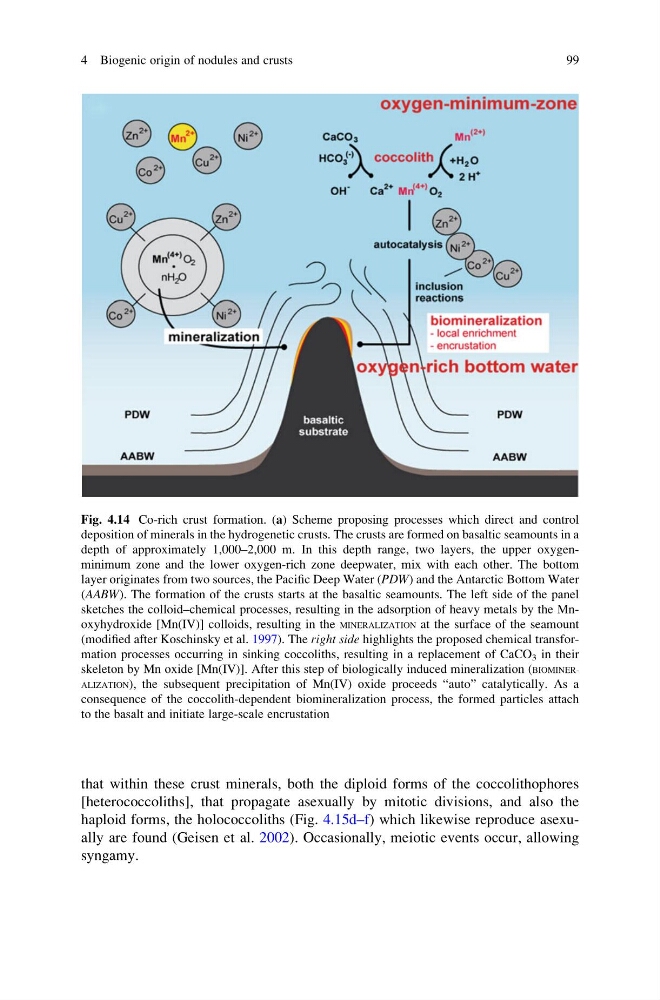
Fig. 4.14 Co-rich crust formation. (a) Scheme proposing processes which direct and control
deposition of minerals in the hydrogenetic crusts. The crusts are formed on basaltic seamounts in a
depth of approximately 1,000–2,000 m. In this depth range, two layers, the upper oxygenminimum zone and the lower oxygen-rich zone deepwater, mix with each other. The bottom
layer originates from two sources, the Pacific Deep Water (PDW) and the Antarctic Bottom Water
(AABW). The formation of the crusts starts at the basaltic seamounts. The left side of the panel
sketches the colloid–chemical processes, resulting in the adsorption of heavy metals by the Mnoxyhydroxide [Mn(IV)] colloids, resulting in the MINERALIZATION at the surface of the seamount
(modified after Koschinsky et al. 1997). The right side highlights the proposed chemical transformation processes occurring in sinking coccoliths, resulting in a replacement of CaCO 3 in their
skeleton by Mn oxide [Mn(IV)]. After this step of biologically induced mineralization (BIOMINERALIZATION), the subsequent precipitation of Mn(IV) oxide proceeds “auto” catalytically. As a
consequence of the coccolith-dependent biomineralization process, the formed particles attach
to the basalt and initiate large-scale encrustation
4 Biogenic origin of nodules and crusts
99
[heterococcoliths], that propagate asexually by mitotic divisions, and also the
haploid forms, the holococcoliths (Fig. 4.15d–f) which likewise reproduce asexually are found (Geisen et al. 2002). Occasionally, meiotic events occur, allowing
syngamy.
Fig. 4.14 Co-rich crust formation. (a) Scheme proposing processes which direct and control
deposition of minerals in the hydrogenetic crusts. The crusts are formed on basaltic seamounts in a
depth of approximately 1,000–2,000 m. In this depth range, two layers, the upper oxygenminimum zone and the lower oxygen-rich zone deepwater, mix with each other. The bottom
layer originates from two sources, the Pacific Deep Water (PDW) and the Antarctic Bottom Water
(AABW). The formation of the crusts starts at the basaltic seamounts. The left side of the panel
sketches the colloid–chemical processes, resulting in the adsorption of heavy metals by the Mnoxyhydroxide [Mn(IV)] colloids, resulting in the MINERALIZATION at the surface of the seamount
(modified after Koschinsky et al. 1997). The right side highlights the proposed chemical transformation processes occurring in sinking coccoliths, resulting in a replacement of CaCO 3 in their
skeleton by Mn oxide [Mn(IV)]. After this step of biologically induced mineralization (BIOMINERALIZATION), the subsequent precipitation of Mn(IV) oxide proceeds “auto” catalytically. As a
consequence of the coccolith-dependent biomineralization process, the formed particles attach
to the basalt and initiate large-scale encrustation
4 Biogenic origin of nodules and crusts
99