

formation (Wang et al. 2009c). Furthermore, it had been proven in thoroughly
performed studies that a variety of phylogenetic distantly related, free-living
bacteria are able to oxidize and metabolize Mn(II) through their multicopper
oxidase-like enzyme(s) (MCO) to Mn(IV) (reviewed in: Tebo et al. 2004). The
MCOs are able to reduce the activation energy required for the oxidation of Mn(II)
to Mn(III) and Mn(IV), and allow the release of an appreciable amount of free
energy (DG À50 kJ/mol) during the oxidation process. MCOs use multiple Cu
atoms as cofactors that are required for the coupled oxidation of a series of
substrates (Tebo et al. 2004). They are thought to play a role in the oxidation of
both organic metal-containing compounds and metal ions, e.g., Fe(II) and Mn(II),
(Solomon et al. 1996). In extensive studies, the group of Tebo (Dick et al. 2006,
2008a, b) succeeded to provide direct evidence for the role of the MCO during Mn
deposition on bacteria, both on enzymic and molecular level.
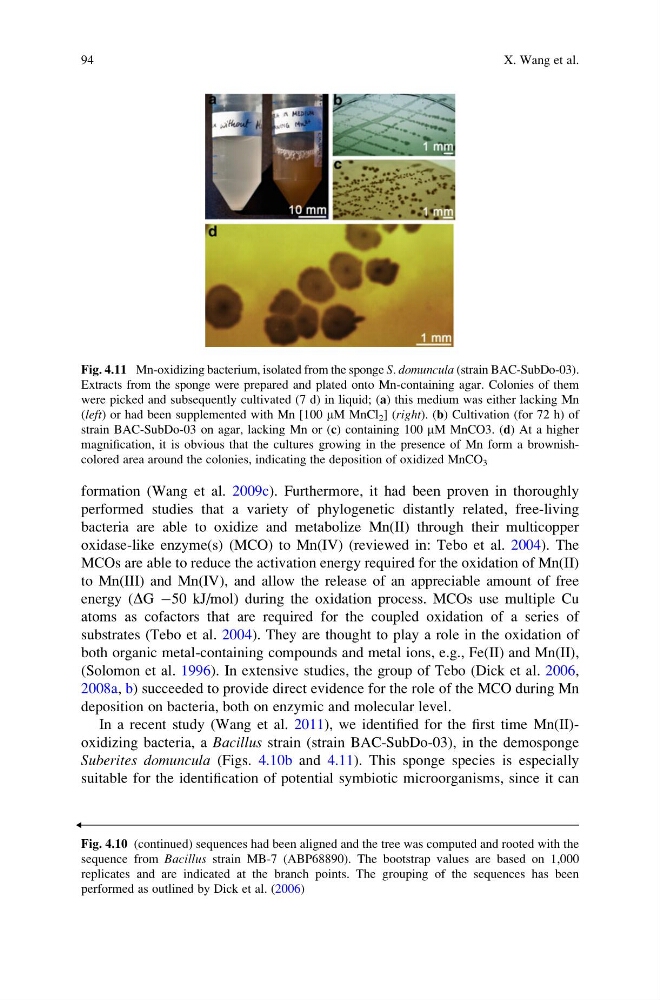
In a recent study (Wang et al. 2011), we identified for the first time Mn(II)oxidizing bacteria, a Bacillus strain (strain BAC-SubDo-03), in the demosponge
Suberites domuncula (Figs. 4.10b and 4.11). This sponge species is especially
suitable for the identification of potential symbiotic microorganisms, since it can
Fig. 4.10 (continued) sequences had been aligned and the tree was computed and rooted with the
sequence from Bacillus strain MB-7 (ABP68890). The bootstrap values are based on 1,000
replicates and are indicated at the branch points. The grouping of the sequences has been
performed as outlined by Dick et al. (2006)
◂
Fig. 4.11 Mn-oxidizing bacterium, isolated from the sponge S. domuncula (strain BAC-SubDo-03).
Extracts from the sponge were prepared and plated onto Mn-containing agar. Colonies of them
were picked and subsequently cultivated (7 d) in liquid; (a) this medium was either lacking Mn
(left) or had been supplemented with Mn [100 mM MnCl 2 ] (right). (b) Cultivation (for 72 h) of
strain BAC-SubDo-03 on agar, lacking Mn or (c) containing 100 mM MnCO3. (d) At a higher
magnification, it is obvious that the cultures growing in the presence of Mn form a brownishcolored area around the colonies, indicating the deposition of oxidized MnCO 3
94
X. Wang et al.
performed studies that a variety of phylogenetic distantly related, free-living
bacteria are able to oxidize and metabolize Mn(II) through their multicopper
oxidase-like enzyme(s) (MCO) to Mn(IV) (reviewed in: Tebo et al. 2004). The
MCOs are able to reduce the activation energy required for the oxidation of Mn(II)
to Mn(III) and Mn(IV), and allow the release of an appreciable amount of free
energy (DG À50 kJ/mol) during the oxidation process. MCOs use multiple Cu
atoms as cofactors that are required for the coupled oxidation of a series of
substrates (Tebo et al. 2004). They are thought to play a role in the oxidation of
both organic metal-containing compounds and metal ions, e.g., Fe(II) and Mn(II),
(Solomon et al. 1996). In extensive studies, the group of Tebo (Dick et al. 2006,
2008a, b) succeeded to provide direct evidence for the role of the MCO during Mn
deposition on bacteria, both on enzymic and molecular level.
In a recent study (Wang et al. 2011), we identified for the first time Mn(II)oxidizing bacteria, a Bacillus strain (strain BAC-SubDo-03), in the demosponge
Suberites domuncula (Figs. 4.10b and 4.11). This sponge species is especially
suitable for the identification of potential symbiotic microorganisms, since it can
Fig. 4.10 (continued) sequences had been aligned and the tree was computed and rooted with the
sequence from Bacillus strain MB-7 (ABP68890). The bootstrap values are based on 1,000
replicates and are indicated at the branch points. The grouping of the sequences has been
performed as outlined by Dick et al. (2006)
◂
Fig. 4.11 Mn-oxidizing bacterium, isolated from the sponge S. domuncula (strain BAC-SubDo-03).
Extracts from the sponge were prepared and plated onto Mn-containing agar. Colonies of them
were picked and subsequently cultivated (7 d) in liquid; (a) this medium was either lacking Mn
(left) or had been supplemented with Mn [100 mM MnCl 2 ] (right). (b) Cultivation (for 72 h) of
strain BAC-SubDo-03 on agar, lacking Mn or (c) containing 100 mM MnCO3. (d) At a higher
magnification, it is obvious that the cultures growing in the presence of Mn form a brownishcolored area around the colonies, indicating the deposition of oxidized MnCO 3
94
X. Wang et al.