

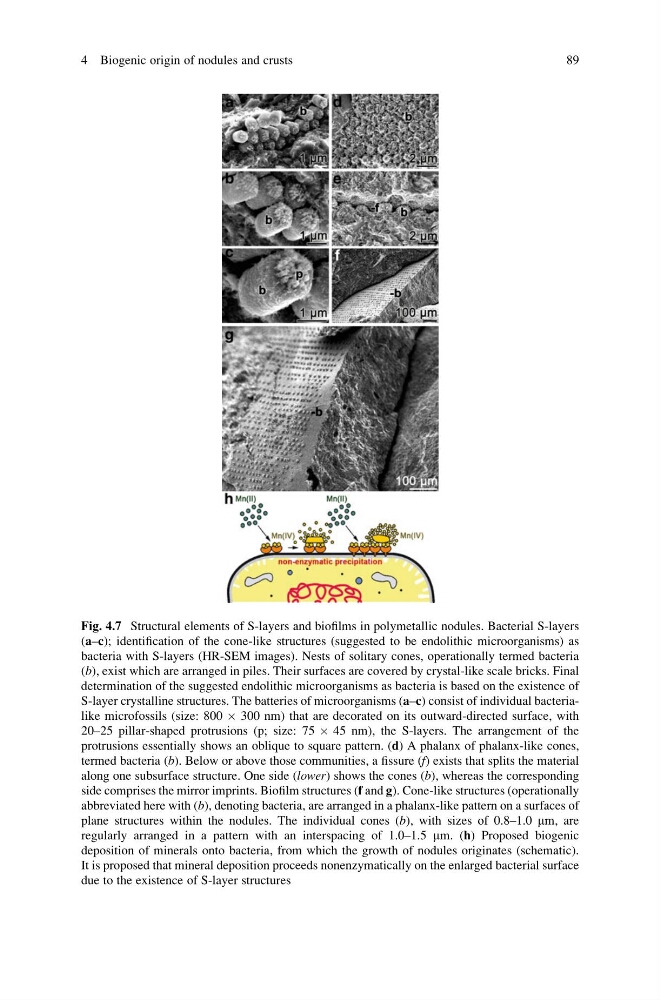
Fig. 4.7 Structural elements of S-layers and biofilms in polymetallic nodules. Bacterial S-layers
(a–c); identification of the cone-like structures (suggested to be endolithic microorganisms) as
bacteria with S-layers (HR-SEM images). Nests of solitary cones, operationally termed bacteria
(b), exist which are arranged in piles. Their surfaces are covered by crystal-like scale bricks. Final
determination of the suggested endolithic microorganisms as bacteria is based on the existence of
S-layer crystalline structures. The batteries of microorganisms (a–c) consist of individual bacterialike microfossils (size: 800 Â 300 nm) that are decorated on its outward-directed surface, with
20–25 pillar-shaped protrusions (p; size: 75 Â 45 nm), the S-layers. The arrangement of the
protrusions essentially shows an oblique to square pattern. (d) A phalanx of phalanx-like cones,
termed bacteria (b). Below or above those communities, a fissure (f) exists that splits the material
along one subsurface structure. One side (lower) shows the cones (b), whereas the corresponding
side comprises the mirror imprints. Biofilm structures (f and g). Cone-like structures (operationally
abbreviated here with (b), denoting bacteria, are arranged in a phalanx-like pattern on a surfaces of
plane structures within the nodules. The individual cones (b), with sizes of 0.8–1.0 mm, are
regularly arranged in a pattern with an interspacing of 1.0–1.5 mm. (h) Proposed biogenic
deposition of minerals onto bacteria, from which the growth of nodules originates (schematic).
It is proposed that mineral deposition proceeds nonenzymatically on the enlarged bacterial surface
due to the existence of S-layer structures
4 Biogenic origin of nodules and crusts
89
(a–c); identification of the cone-like structures (suggested to be endolithic microorganisms) as
bacteria with S-layers (HR-SEM images). Nests of solitary cones, operationally termed bacteria
(b), exist which are arranged in piles. Their surfaces are covered by crystal-like scale bricks. Final
determination of the suggested endolithic microorganisms as bacteria is based on the existence of
S-layer crystalline structures. The batteries of microorganisms (a–c) consist of individual bacterialike microfossils (size: 800 Â 300 nm) that are decorated on its outward-directed surface, with
20–25 pillar-shaped protrusions (p; size: 75 Â 45 nm), the S-layers. The arrangement of the
protrusions essentially shows an oblique to square pattern. (d) A phalanx of phalanx-like cones,
termed bacteria (b). Below or above those communities, a fissure (f) exists that splits the material
along one subsurface structure. One side (lower) shows the cones (b), whereas the corresponding
side comprises the mirror imprints. Biofilm structures (f and g). Cone-like structures (operationally
abbreviated here with (b), denoting bacteria, are arranged in a phalanx-like pattern on a surfaces of
plane structures within the nodules. The individual cones (b), with sizes of 0.8–1.0 mm, are
regularly arranged in a pattern with an interspacing of 1.0–1.5 mm. (h) Proposed biogenic
deposition of minerals onto bacteria, from which the growth of nodules originates (schematic).
It is proposed that mineral deposition proceeds nonenzymatically on the enlarged bacterial surface
due to the existence of S-layer structures
4 Biogenic origin of nodules and crusts
89