

70
Reef Environments
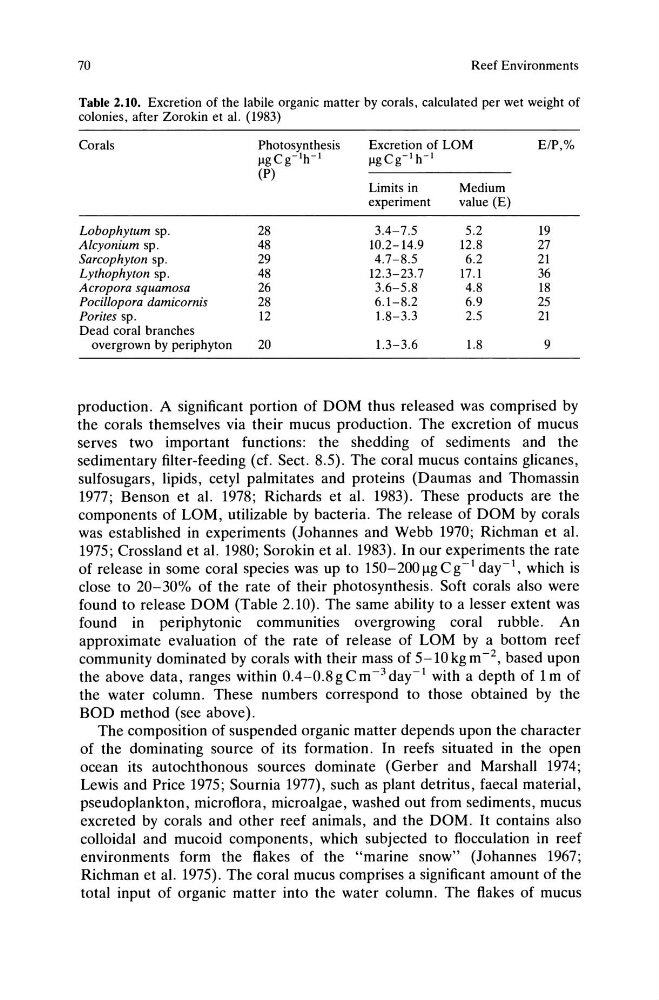
Table 2.10. Excretion of the labile organic matter by corals, calculated per wet weight of
colonies, after Zorokin et al. (1983)
Corals
Photosynthesis
Excretion of LOM
E/P,%
Ilg C g- 1h- 1
Ilg C g- 1h- 1
(P)
Limits in
Medium
experiment
value (E)
Lobophytum sp.
28
3.4-7.5
5.2
19
Alcyonium sp.
48
10.2-14.9
12.8
27
Sarcophyton sp.
29
4.7-8.5
6.2
21
Lythophyton sp.
48
12.3-23.7
17.1
36
Acropora squamosa
26
3.6-5.8
4.8
18
Pocillopora damicornis
28
6.1-8.2
6.9
25
Porites sp.
12
1.8-3.3
2.5
21
Dead coral branches
overgrown by periphyton
20
1.3-3.6
1.8
9
production. A significant portion of DOM thus released was comprised by
the corals themselves via their mucus production. The excretion of mucus
serves two important functions: the shedding of sediments and the
sedimentary filter-feeding (cf. Sect. 8.5). The coral mucus contains glicanes,
sulfosugars, lipids, cetyl palmitates and proteins (Daumas and Thomassin
1977; Benson et al. 1978; Richards et al. 1983). These products are the
components of LOM, utilizable by bacteria. The release of DOM by corals
was established in experiments (Johannes and Webb 1970; Richman et al.
1975; Crossland et al. 1980; Sorokin et al. 1983). In our experiments the rate
of release in some coral species was up to 150-200 Ilg C g-l day-I, which is
close to 20-30% of the rate of their photosynthesis. Soft corals also were
found to release DOM (Table 2.10). The same ability to a lesser extent was
found in periphytonic communities overgrowing coral rubble. An
approximate evaluation of the rate of release of LOM by a bottom reef
community dominated by corals with their mass of 5-1Okgm- 2 , based upon
the above data, ranges within 0.4-0.8 g C m -3 day-l with a depth of 1 m of
the water column. These numbers correspond to those obtained by the
BOD method (see above).
The composition of suspended organic matter depends upon the character
of the dominating source of its formation. In reefs situated in the open
ocean its autochthonous sources dominate (Gerber and Marshall 1974;
Lewis and Price 1975; Sournia 1977), such as plant detritus, faecal material,
pseudoplankton, microflora, microalgae, washed out from sediments, mucus
excreted by corals and other reef animals, and the DOM. It contains also
colloidal and mucoid components, which subjected to flocculation in reef
environments form the flakes of the "marine snow" (Johannes 1967;
Richman et al. 1975). The coral mucus comprises a significant amount of the
total input of organic matter into the water column. The flakes of mucus
Reef Environments
Table 2.10. Excretion of the labile organic matter by corals, calculated per wet weight of
colonies, after Zorokin et al. (1983)
Corals
Photosynthesis
Excretion of LOM
E/P,%
Ilg C g- 1h- 1
Ilg C g- 1h- 1
(P)
Limits in
Medium
experiment
value (E)
Lobophytum sp.
28
3.4-7.5
5.2
19
Alcyonium sp.
48
10.2-14.9
12.8
27
Sarcophyton sp.
29
4.7-8.5
6.2
21
Lythophyton sp.
48
12.3-23.7
17.1
36
Acropora squamosa
26
3.6-5.8
4.8
18
Pocillopora damicornis
28
6.1-8.2
6.9
25
Porites sp.
12
1.8-3.3
2.5
21
Dead coral branches
overgrown by periphyton
20
1.3-3.6
1.8
9
production. A significant portion of DOM thus released was comprised by
the corals themselves via their mucus production. The excretion of mucus
serves two important functions: the shedding of sediments and the
sedimentary filter-feeding (cf. Sect. 8.5). The coral mucus contains glicanes,
sulfosugars, lipids, cetyl palmitates and proteins (Daumas and Thomassin
1977; Benson et al. 1978; Richards et al. 1983). These products are the
components of LOM, utilizable by bacteria. The release of DOM by corals
was established in experiments (Johannes and Webb 1970; Richman et al.
1975; Crossland et al. 1980; Sorokin et al. 1983). In our experiments the rate
of release in some coral species was up to 150-200 Ilg C g-l day-I, which is
close to 20-30% of the rate of their photosynthesis. Soft corals also were
found to release DOM (Table 2.10). The same ability to a lesser extent was
found in periphytonic communities overgrowing coral rubble. An
approximate evaluation of the rate of release of LOM by a bottom reef
community dominated by corals with their mass of 5-1Okgm- 2 , based upon
the above data, ranges within 0.4-0.8 g C m -3 day-l with a depth of 1 m of
the water column. These numbers correspond to those obtained by the
BOD method (see above).
The composition of suspended organic matter depends upon the character
of the dominating source of its formation. In reefs situated in the open
ocean its autochthonous sources dominate (Gerber and Marshall 1974;
Lewis and Price 1975; Sournia 1977), such as plant detritus, faecal material,
pseudoplankton, microflora, microalgae, washed out from sediments, mucus
excreted by corals and other reef animals, and the DOM. It contains also
colloidal and mucoid components, which subjected to flocculation in reef
environments form the flakes of the "marine snow" (Johannes 1967;
Richman et al. 1975). The coral mucus comprises a significant amount of the
total input of organic matter into the water column. The flakes of mucus