

Organic Matter in Reef Waters
69
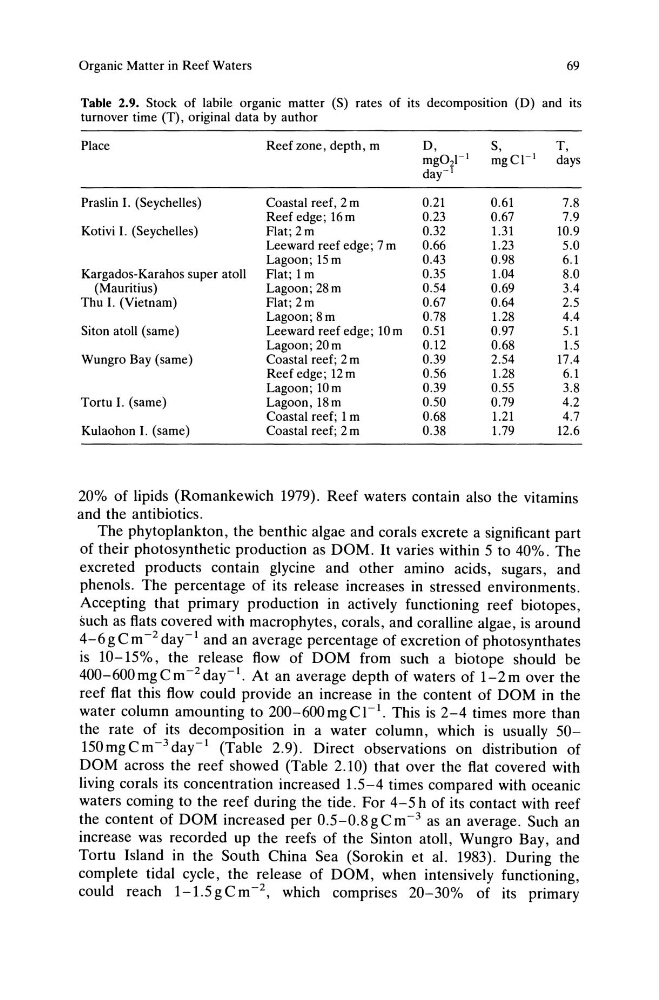
Table 2.9. Stock of labile organic matter (S) rates of its decomposition (D) and its
turnover time (T), original data by author
Place
Reef zone, depth, m
D,
S,
T,
mg0 21 - 1
mgCl- 1 days
day-l
Praslin I. (Seychelles)
Coastal reef, 2 m
0.21
0.61
7.8
Reef edge; 16m
0.23
0.67
7.9
Kotivi I. (Seychelles)
Flat; 2m
0.32
1.31
10.9
Leeward reef edge; 7 m
0.66
1.23
5.0
Lagoon; 15m
0.43
0.98
6.1
Kargados-Karahos super atoll
Flat; 1 m
0.35
1.04
8.0
(Mauritius)
Lagoon; 28m
0.54
0.69
3.4
Thu I. (Vietnam)
Flat; 2 m
0.67
0.64
2.5
Lagoon; 8m
0.78
1.28
4.4
Siton atoll (same)
Leeward reef edge; 10 m
0.51
0.97
5.1
Lagoon; 20m
0.12
0.68
1.5
Wungro Bay (same)
Coastal reef; 2 m
0.39
2.54
17.4
Reef edge; 12 m
0.56
1.28
6.1
Lagoon; 10m
0.39
0.55
3.8
Tortu I. (same)
Lagoon, 18m
0.50
0.79
4.2
Coastal reef; 1 m
0.68
1.21
4.7
Kulaohon I. (same)
Coastal reef; 2 m
0.38
1.79
12.6
20% of lipids (Romankewich 1979). Reef waters contain also the vitamins
and the antibiotics.
The phytoplankton, the benthic algae and corals excrete a significant part
of their photosynthetic production as DaM. It varies within S to 40%. The
excreted products contain glycine and other amino acids, sugars, and
phenols. The percentage of its release increases in stressed environments.
Accepting that primary production in actively functioning reef biotopes,
such as flats covered with macrophytes, corals, and coralline algae, is around
4-6 g C m -2 day-l and an average percentage of excretion of photosynthates
is 1O-1S%, the release flow of DaM from such a biotope should be
400-600mgCm- 2 day-l. At an average depth of waters of I-2m over the
reef flat this flow could provide an increase in the content of DaM in the
water column amounting to 200-600 mg C I-I. This is 2-4 times more than
the rate of its decomposition in a water column, which is usually SOISO mg C m- 3 day-l (Table 2.9). Direct observations on distribution of
DaM across the reef showed (Table 2.10) that over the flat covered with
living corals its concentration increased 1.S-4 times compared with oceanic
waters coming to the reef during the tide. For 4-S h of its contact with reef
the content of DaM increased per 0.S-0.8gCm- 3 as an average. Such an
increase was recorded up the reefs of the Sinton atoll, Wungro Bay, and
Tortu Island in the South China Sea (Sorokin et al. 1983). During the
complete tidal cycle, the release of DaM, when intensively functioning,
could reach 1-1.SgCm- 2 , which comprises 20-30% of its primary
69
Table 2.9. Stock of labile organic matter (S) rates of its decomposition (D) and its
turnover time (T), original data by author
Place
Reef zone, depth, m
D,
S,
T,
mg0 21 - 1
mgCl- 1 days
day-l
Praslin I. (Seychelles)
Coastal reef, 2 m
0.21
0.61
7.8
Reef edge; 16m
0.23
0.67
7.9
Kotivi I. (Seychelles)
Flat; 2m
0.32
1.31
10.9
Leeward reef edge; 7 m
0.66
1.23
5.0
Lagoon; 15m
0.43
0.98
6.1
Kargados-Karahos super atoll
Flat; 1 m
0.35
1.04
8.0
(Mauritius)
Lagoon; 28m
0.54
0.69
3.4
Thu I. (Vietnam)
Flat; 2 m
0.67
0.64
2.5
Lagoon; 8m
0.78
1.28
4.4
Siton atoll (same)
Leeward reef edge; 10 m
0.51
0.97
5.1
Lagoon; 20m
0.12
0.68
1.5
Wungro Bay (same)
Coastal reef; 2 m
0.39
2.54
17.4
Reef edge; 12 m
0.56
1.28
6.1
Lagoon; 10m
0.39
0.55
3.8
Tortu I. (same)
Lagoon, 18m
0.50
0.79
4.2
Coastal reef; 1 m
0.68
1.21
4.7
Kulaohon I. (same)
Coastal reef; 2 m
0.38
1.79
12.6
20% of lipids (Romankewich 1979). Reef waters contain also the vitamins
and the antibiotics.
The phytoplankton, the benthic algae and corals excrete a significant part
of their photosynthetic production as DaM. It varies within S to 40%. The
excreted products contain glycine and other amino acids, sugars, and
phenols. The percentage of its release increases in stressed environments.
Accepting that primary production in actively functioning reef biotopes,
such as flats covered with macrophytes, corals, and coralline algae, is around
4-6 g C m -2 day-l and an average percentage of excretion of photosynthates
is 1O-1S%, the release flow of DaM from such a biotope should be
400-600mgCm- 2 day-l. At an average depth of waters of I-2m over the
reef flat this flow could provide an increase in the content of DaM in the
water column amounting to 200-600 mg C I-I. This is 2-4 times more than
the rate of its decomposition in a water column, which is usually SOISO mg C m- 3 day-l (Table 2.9). Direct observations on distribution of
DaM across the reef showed (Table 2.10) that over the flat covered with
living corals its concentration increased 1.S-4 times compared with oceanic
waters coming to the reef during the tide. For 4-S h of its contact with reef
the content of DaM increased per 0.S-0.8gCm- 3 as an average. Such an
increase was recorded up the reefs of the Sinton atoll, Wungro Bay, and
Tortu Island in the South China Sea (Sorokin et al. 1983). During the
complete tidal cycle, the release of DaM, when intensively functioning,
could reach 1-1.SgCm- 2 , which comprises 20-30% of its primary