

Reef Fishery
417
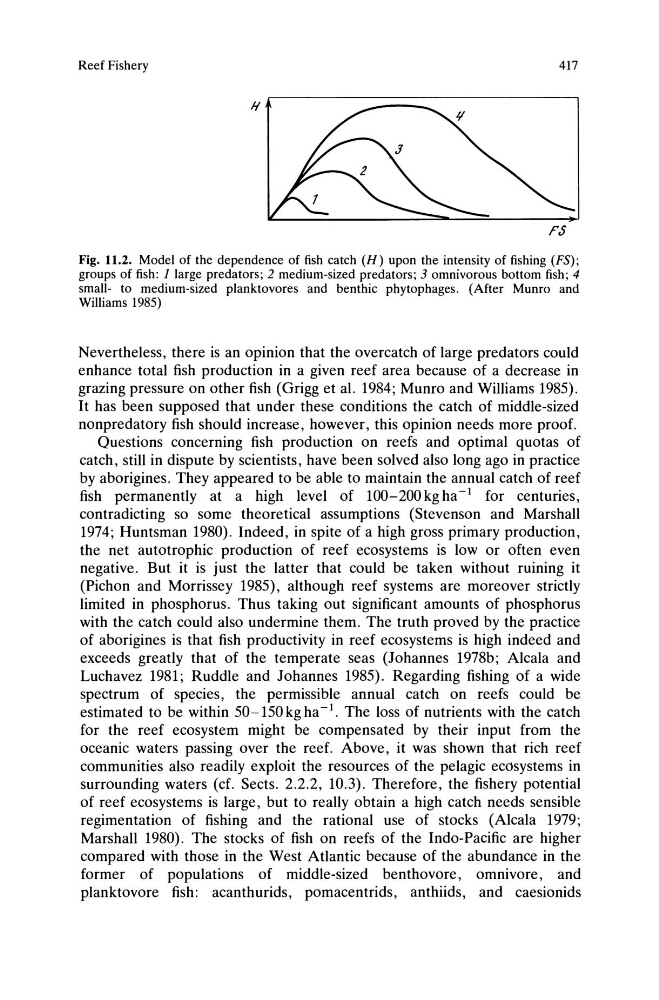
Fig. 11.2. Model of the dependence of fish catch (H) upon the intensity of fishing (FS);
groups of fish: 1 large predators; 2 medium-sized predators; 3 omnivorous bottom fish; 4
small- to medium-sized planktovores and benthic phytophages. (After Munro and
Williams 1985)
Nevertheless, there is an opinion that the overcatch of large predators could
enhance total fish production in a given reef area because of a decrease in
grazing pressure on other fish (Grigg et al. 1984; Munro and Williams 1985).
It has been supposed that under these conditions the catch of middle-sized
nonpredatory fish should increase, however, this opinion needs more proof.
Questions concerning fish production on reefs and optimal quotas of
catch, still in dispute by scientists, have been solved also long ago in practice
by aborigines. They appeared to be able to maintain the annual catch of reef
fish permanently at a high level of 100-200 kg ha -1 for centuries,
contradicting so some theoretical assumptions (Stevenson and Marshall
1974; Huntsman 1980). Indeed, in spite of a high gross primary production,
the net autotrophic production of reef ecosystems is low or often even
negative. But it is just the latter that could be taken without ruining it
(Pichon and Morrissey 1985), although reef systems are moreover strictly
limited in phosphorus. Thus taking out significant amounts of phosphorus
with the catch could also undermine them. The truth proved by the practice
of aborigines is that fish productivity in reef ecosystems is high indeed and
exceeds greatly that of the temperate seas (Johannes 1978b; Alcala and
Luchavez 1981; Ruddle and Johannes 1985). Regarding fishing of a wide
spectrum of species, the permissible annual catch on reefs could be
estimated to be within 50-150 kg ha -1. The loss of nutrients with the catch
for the reef ecosystem might be compensated by their input from the
oceanic waters passing over the reef. Above, it was shown that rich reef
communities also readily exploit the resources of the pelagic ecosystems in
surrounding waters (cf. Sects. 2.2.2, 10.3). Therefore, the fishery potential
of reef ecosystems is large, but to really obtain a high catch needs sensible
regimentation of fishing and the rational use of stocks (Alcala 1979;
Marshall 1980). The stocks of fish on reefs of the Indo-Pacific are higher
compared with those in the West Atlantic because of the abundance in the
former of populations of middle-sized benthovore, omnivore, and
planktovore fish: acanthurids, pomacentrids, anthiids, and caesionids
417
Fig. 11.2. Model of the dependence of fish catch (H) upon the intensity of fishing (FS);
groups of fish: 1 large predators; 2 medium-sized predators; 3 omnivorous bottom fish; 4
small- to medium-sized planktovores and benthic phytophages. (After Munro and
Williams 1985)
Nevertheless, there is an opinion that the overcatch of large predators could
enhance total fish production in a given reef area because of a decrease in
grazing pressure on other fish (Grigg et al. 1984; Munro and Williams 1985).
It has been supposed that under these conditions the catch of middle-sized
nonpredatory fish should increase, however, this opinion needs more proof.
Questions concerning fish production on reefs and optimal quotas of
catch, still in dispute by scientists, have been solved also long ago in practice
by aborigines. They appeared to be able to maintain the annual catch of reef
fish permanently at a high level of 100-200 kg ha -1 for centuries,
contradicting so some theoretical assumptions (Stevenson and Marshall
1974; Huntsman 1980). Indeed, in spite of a high gross primary production,
the net autotrophic production of reef ecosystems is low or often even
negative. But it is just the latter that could be taken without ruining it
(Pichon and Morrissey 1985), although reef systems are moreover strictly
limited in phosphorus. Thus taking out significant amounts of phosphorus
with the catch could also undermine them. The truth proved by the practice
of aborigines is that fish productivity in reef ecosystems is high indeed and
exceeds greatly that of the temperate seas (Johannes 1978b; Alcala and
Luchavez 1981; Ruddle and Johannes 1985). Regarding fishing of a wide
spectrum of species, the permissible annual catch on reefs could be
estimated to be within 50-150 kg ha -1. The loss of nutrients with the catch
for the reef ecosystem might be compensated by their input from the
oceanic waters passing over the reef. Above, it was shown that rich reef
communities also readily exploit the resources of the pelagic ecosystems in
surrounding waters (cf. Sects. 2.2.2, 10.3). Therefore, the fishery potential
of reef ecosystems is large, but to really obtain a high catch needs sensible
regimentation of fishing and the rational use of stocks (Alcala 1979;
Marshall 1980). The stocks of fish on reefs of the Indo-Pacific are higher
compared with those in the West Atlantic because of the abundance in the
former of populations of middle-sized benthovore, omnivore, and
planktovore fish: acanthurids, pomacentrids, anthiids, and caesionids