

416
Destruction and Recovery of Reef Systems, Reef and Man
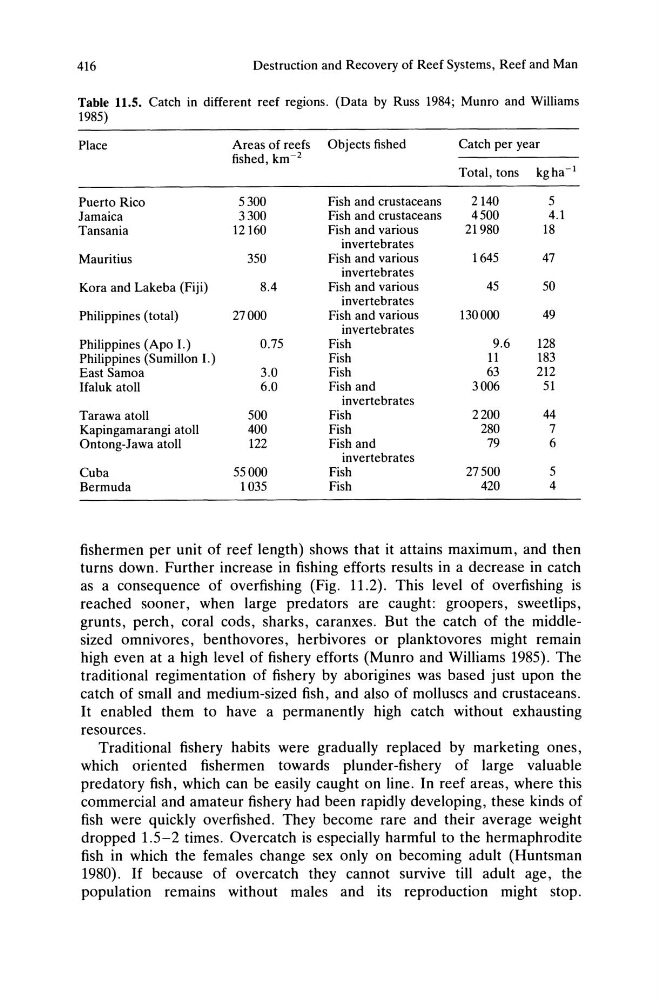
Table 11.5. Catch in different reef regions. (Data by Russ 1984; Munro and Williams
1985)
Place
Areas of reefs
fished, km- 2
Objects fished
Catch per year
Total, tons kgha- 1
Puerto Rico
5300
Fish and crustaceans
2140
5
Jamaica
3300
Fish and crustaceans
4500
4.1
Tansania
12160
Fish and various
21980
18
invertebrates
Mauritius
350
Fish and various
1645
47
invertebrates
Kora and Lakeba (Fiji)
8.4
Fish and various
45
50
invertebrates
Philippines (total)
27000
Fish and various
130000
49
invertebrates
Philippines (Apo I.)
0.75
Fish
9.6
128
Philippines (Sumillon I.)
Fish
11
183
East Samoa
3.0
Fish
63
212
Ifaluk atoll
6.0
Fish and
3006
51
invertebrates
Tarawa atoll
500
Fish
2200
44
Kapingamarangi atoll
400
Fish
280
7
Ontong-Jawa atoll
122
Fish and
79
6
invertebrates
Cuba
55000
Fish
27500
5
Bermuda
1035
Fish
420
4
fishermen per unit of reef length) shows that it attains maximum, and then
turns down. Further increase in fishing efforts results in a decrease in catch
as a consequence of overfishing (Fig. 11.2). This level of overfishing is
reached sooner, when large predators are caught: groopers, sweetlips,
grunts, perch, coral cods, sharks, caranxes. But the catch of the middlesized omnivores, benthovores, herbivores or planktovores might remain
high even at a high level of fishery efforts (Munro and Williams 1985). The
traditional regimentation of fishery by aborigines was based just upon the
catch of small and medium-sized fish, and also of molluscs and crustaceans.
It enabled them to have a permanently high catch without exhausting
resources.
Traditional fishery habits were gradually replaced by marketing ones,
which oriented fishermen towards plunder-fishery of large valuable
predatory fish, which can be easily caught on line. In reef areas, where this
commercial and amateur fishery had been rapidly developing, these kinds of
fish were quickly overfished. They become rare and their average weight
dropped 1.5-2 times. Overcatch is especially harmful to the hermaphrodite
fish in which the females change sex only on becoming adult (Huntsman
1980). If because of overcatch they cannot survive till adult age, the
popUlation remains without males and its reproduction might stop.
Destruction and Recovery of Reef Systems, Reef and Man
Table 11.5. Catch in different reef regions. (Data by Russ 1984; Munro and Williams
1985)
Place
Areas of reefs
fished, km- 2
Objects fished
Catch per year
Total, tons kgha- 1
Puerto Rico
5300
Fish and crustaceans
2140
5
Jamaica
3300
Fish and crustaceans
4500
4.1
Tansania
12160
Fish and various
21980
18
invertebrates
Mauritius
350
Fish and various
1645
47
invertebrates
Kora and Lakeba (Fiji)
8.4
Fish and various
45
50
invertebrates
Philippines (total)
27000
Fish and various
130000
49
invertebrates
Philippines (Apo I.)
0.75
Fish
9.6
128
Philippines (Sumillon I.)
Fish
11
183
East Samoa
3.0
Fish
63
212
Ifaluk atoll
6.0
Fish and
3006
51
invertebrates
Tarawa atoll
500
Fish
2200
44
Kapingamarangi atoll
400
Fish
280
7
Ontong-Jawa atoll
122
Fish and
79
6
invertebrates
Cuba
55000
Fish
27500
5
Bermuda
1035
Fish
420
4
fishermen per unit of reef length) shows that it attains maximum, and then
turns down. Further increase in fishing efforts results in a decrease in catch
as a consequence of overfishing (Fig. 11.2). This level of overfishing is
reached sooner, when large predators are caught: groopers, sweetlips,
grunts, perch, coral cods, sharks, caranxes. But the catch of the middlesized omnivores, benthovores, herbivores or planktovores might remain
high even at a high level of fishery efforts (Munro and Williams 1985). The
traditional regimentation of fishery by aborigines was based just upon the
catch of small and medium-sized fish, and also of molluscs and crustaceans.
It enabled them to have a permanently high catch without exhausting
resources.
Traditional fishery habits were gradually replaced by marketing ones,
which oriented fishermen towards plunder-fishery of large valuable
predatory fish, which can be easily caught on line. In reef areas, where this
commercial and amateur fishery had been rapidly developing, these kinds of
fish were quickly overfished. They become rare and their average weight
dropped 1.5-2 times. Overcatch is especially harmful to the hermaphrodite
fish in which the females change sex only on becoming adult (Huntsman
1980). If because of overcatch they cannot survive till adult age, the
popUlation remains without males and its reproduction might stop.