

Biogeochemical Metabolism of Organic Matter
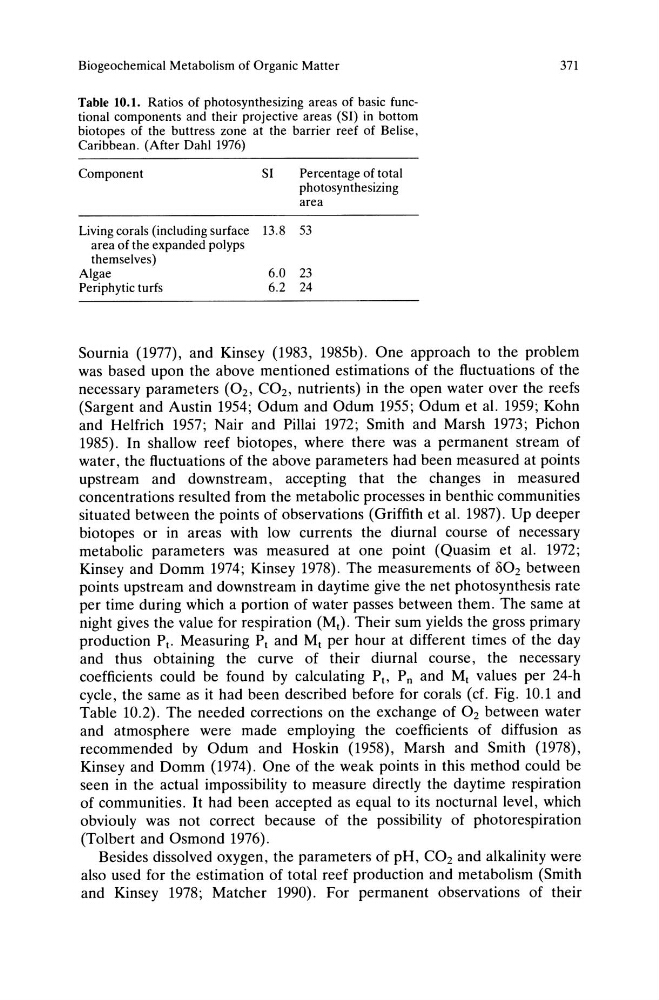
Table 10.1. Ratios of photosynthesizing areas of basic functional components and their projective areas (SI) in bottom
biotopes of the buttress zone at the barrier reef of Belise,
Caribbean. (After Dahl 1976)
Component
SI
Percentage of total
photosynthesizing
area
Living corals (including surface 13.8 53
area of the expanded polyps
themselves)
Algae
6.0 23
Periphytic turfs
6.2 24
371
Sournia (1977), and Kinsey (1983, 1985b). One approach to the problem
was based upon the above mentioned estimations of the fluctuations of the
necessary parameters (02 , COz, nutrients) in the open water over the reefs
(Sargent and Austin 1954; Odum and Odum 1955; Odum et al. 1959; Kohn
and Helfrich 1957; Nair and Pillai 1972; Smith and Marsh 1973; Pichon
1985). In shallow reef biotopes, where there was a permanent stream of
water, the fluctuations of the above parameters had been measured at points
upstream and downstream, accepting that the changes in measured
concentrations resulted from the metabolic processes in benthic communities
situated between the points of observations (Griffith et al. 1987). Up deeper
biotopes or in areas with low currents the diurnal course of necessary
metabolic parameters was measured at one point (Quasim et al. 1972;
Kinsey and Domm 1974; Kinsey 1978). The measurements of 002 between
points upstream and downstream in daytime give the net photosynthesis rate
per time during which a portion of water passes between them. The same at
night gives the value for respiration (Mt). Their sum yields the gross primary
production Pt. Measuring Pt and Mt per hour at different times of the day
and thus obtaining the curve of their diurnal course, the necessary
coefficients could be found by calculating Pt, P nand Mt values per 24-h
cycle, the same as it had been described before for corals (d. Fig. 10.1 and
Table 10.2). The needed corrections on the exchange of O2 between water
and atmosphere were made employing the coefficients of diffusion as
recommended by Odum and Hoskin (1958), Marsh and Smith (1978),
Kinsey and Domm (1974). One of the weak points in this method could be
seen in the actual impossibility to measure directly the daytime respiration
of communities. It had been accepted as equal to its nocturnal level, which
obviouly was not correct because of the possibility of photorespiration
(Tolbert and Osmond 1976).
Besides dissolved oxygen, the parameters of pH, CO2 and alkalinity were
also used for the estimation of total reef production and metabolism (Smith
and Kinsey 1978; Matcher 1990). For permanent observations of their
Table 10.1. Ratios of photosynthesizing areas of basic functional components and their projective areas (SI) in bottom
biotopes of the buttress zone at the barrier reef of Belise,
Caribbean. (After Dahl 1976)
Component
SI
Percentage of total
photosynthesizing
area
Living corals (including surface 13.8 53
area of the expanded polyps
themselves)
Algae
6.0 23
Periphytic turfs
6.2 24
371
Sournia (1977), and Kinsey (1983, 1985b). One approach to the problem
was based upon the above mentioned estimations of the fluctuations of the
necessary parameters (02 , COz, nutrients) in the open water over the reefs
(Sargent and Austin 1954; Odum and Odum 1955; Odum et al. 1959; Kohn
and Helfrich 1957; Nair and Pillai 1972; Smith and Marsh 1973; Pichon
1985). In shallow reef biotopes, where there was a permanent stream of
water, the fluctuations of the above parameters had been measured at points
upstream and downstream, accepting that the changes in measured
concentrations resulted from the metabolic processes in benthic communities
situated between the points of observations (Griffith et al. 1987). Up deeper
biotopes or in areas with low currents the diurnal course of necessary
metabolic parameters was measured at one point (Quasim et al. 1972;
Kinsey and Domm 1974; Kinsey 1978). The measurements of 002 between
points upstream and downstream in daytime give the net photosynthesis rate
per time during which a portion of water passes between them. The same at
night gives the value for respiration (Mt). Their sum yields the gross primary
production Pt. Measuring Pt and Mt per hour at different times of the day
and thus obtaining the curve of their diurnal course, the necessary
coefficients could be found by calculating Pt, P nand Mt values per 24-h
cycle, the same as it had been described before for corals (d. Fig. 10.1 and
Table 10.2). The needed corrections on the exchange of O2 between water
and atmosphere were made employing the coefficients of diffusion as
recommended by Odum and Hoskin (1958), Marsh and Smith (1978),
Kinsey and Domm (1974). One of the weak points in this method could be
seen in the actual impossibility to measure directly the daytime respiration
of communities. It had been accepted as equal to its nocturnal level, which
obviouly was not correct because of the possibility of photorespiration
(Tolbert and Osmond 1976).
Besides dissolved oxygen, the parameters of pH, CO2 and alkalinity were
also used for the estimation of total reef production and metabolism (Smith
and Kinsey 1978; Matcher 1990). For permanent observations of their