

Heterotrophic Feeding of Corals
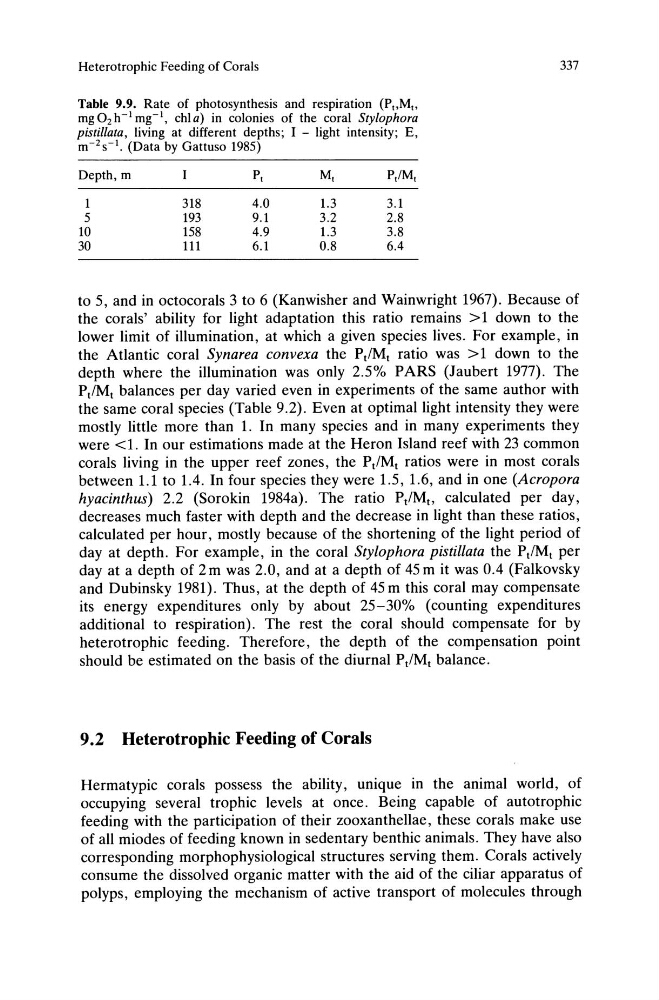
Table 9.9. Rate of photosynthesis and respiration (PI,M I ,
mg02h-lmg-l, chla) in colonies of the coral Stylophora
pistillata, living at different depths; I - light intensity; E,
m- 2 s- 1 • (Data by Gattuso 1985)
Depth, m
PI
MI
PI/MI
1
318
4.0
1.3
3.1
5
193
9.1
3.2
2.8
10
158
4.9
1.3
3.8
30
111
6.1
0.8
6.4
337
to 5, and in octocorals 3 to 6 (Kanwisher and Wainwright 1967). Because of
the corals' ability for light adaptation this ratio remains > 1 down to the
lower limit of illumination, at which a given species lives. For example, in
the Atlantic coral Synarea convexa the PtlMt ratio was >1 down to the
depth where the illumination was only 2.5% PARS (Jaubert 1977). The
PtlMt balances per day varied even in experiments of the same author with
the same coral species (Table 9.2). Even at optimal light intensity they were
mostly little more than 1. In many species and in many experiments they
were <1. In our estimations made at the Heron Island reef with 23 common
corals living in the upper reef zones, the PtlMt ratios were in most corals
between 1.1 to 1.4. In four species they were 1.5, 1.6, and in one (Acropora
hyacinthus) 2.2 (Sorokin 1984a). The ratio Pt/Mt, calculated per day,
decreases much faster with depth and the decrease in light than these ratios,
calculated per hour, mostly because of the shortening of the light period of
day at depth. For example, in the coral Stylophora pistil/ata the PtlMt per
day at a depth of 2 m was 2.0, and at a depth of 45 m it was 0.4 (Falkovsky
and Dubinsky 1981). Thus, at the depth of 45 m this coral may compensate
its energy expenditures only by about 25-30% (counting expenditures
additional to respiration). The rest the coral should compensate for by
heterotrophic feeding. Therefore, the depth of the compensation point
should be estimated on the basis of the diurnal Pt/Mt balance.
9.2 Heterotrophic Feeding of Corals
Hermatypic corals possess the ability, unique in the animal world, of
occupying several trophic levels at once. Being capable of autotrophic
feeding with the participation of their zooxanthellae, these corals make use
of all miodes of feeding known in sedentary benthic animals. They have also
corresponding morphophysiological structures serving them. Corals actively
consume the dissolved organic matter with the aid of the ciliar apparatus of
polyps, employing the mechanism of active transport of molecules through
Table 9.9. Rate of photosynthesis and respiration (PI,M I ,
mg02h-lmg-l, chla) in colonies of the coral Stylophora
pistillata, living at different depths; I - light intensity; E,
m- 2 s- 1 • (Data by Gattuso 1985)
Depth, m
PI
MI
PI/MI
1
318
4.0
1.3
3.1
5
193
9.1
3.2
2.8
10
158
4.9
1.3
3.8
30
111
6.1
0.8
6.4
337
to 5, and in octocorals 3 to 6 (Kanwisher and Wainwright 1967). Because of
the corals' ability for light adaptation this ratio remains > 1 down to the
lower limit of illumination, at which a given species lives. For example, in
the Atlantic coral Synarea convexa the PtlMt ratio was >1 down to the
depth where the illumination was only 2.5% PARS (Jaubert 1977). The
PtlMt balances per day varied even in experiments of the same author with
the same coral species (Table 9.2). Even at optimal light intensity they were
mostly little more than 1. In many species and in many experiments they
were <1. In our estimations made at the Heron Island reef with 23 common
corals living in the upper reef zones, the PtlMt ratios were in most corals
between 1.1 to 1.4. In four species they were 1.5, 1.6, and in one (Acropora
hyacinthus) 2.2 (Sorokin 1984a). The ratio Pt/Mt, calculated per day,
decreases much faster with depth and the decrease in light than these ratios,
calculated per hour, mostly because of the shortening of the light period of
day at depth. For example, in the coral Stylophora pistil/ata the PtlMt per
day at a depth of 2 m was 2.0, and at a depth of 45 m it was 0.4 (Falkovsky
and Dubinsky 1981). Thus, at the depth of 45 m this coral may compensate
its energy expenditures only by about 25-30% (counting expenditures
additional to respiration). The rest the coral should compensate for by
heterotrophic feeding. Therefore, the depth of the compensation point
should be estimated on the basis of the diurnal Pt/Mt balance.
9.2 Heterotrophic Feeding of Corals
Hermatypic corals possess the ability, unique in the animal world, of
occupying several trophic levels at once. Being capable of autotrophic
feeding with the participation of their zooxanthellae, these corals make use
of all miodes of feeding known in sedentary benthic animals. They have also
corresponding morphophysiological structures serving them. Corals actively
consume the dissolved organic matter with the aid of the ciliar apparatus of
polyps, employing the mechanism of active transport of molecules through