

336
Nutrition of Corals
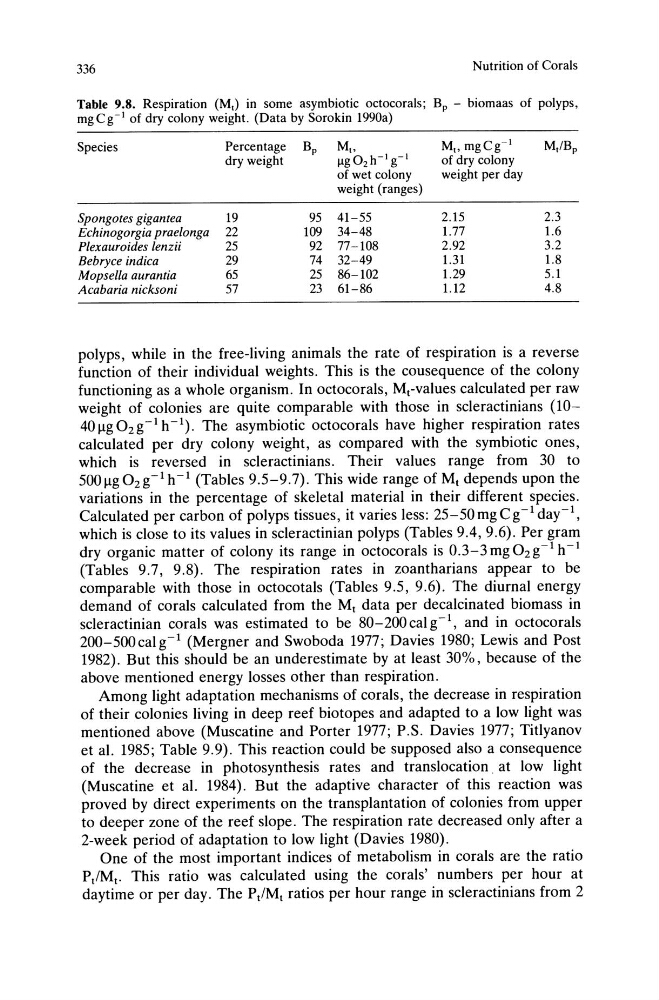
Table 9.S. Respiration (M,) in some asymbiotic octocorals; Bp - biomaas of polyps,
mgCg- 1 of dry colony weight. (Data by Sorokin 1990a)
Species
Percentage
dry weight
Bp
M"
Ilg O 2 h- I g-I
M" mgCg- 1
of dry colony
M.JBp
of wet colony
weight per day
weight (ranges)
Spongotes gigantea
19
95 41-55
2.15
2.3
Echinogorgia praelonga 22
109 34-48
1.77
1.6
Plexauroides lenzii
25
92 77-108
2.92
3.2
Bebryce indica
29
74 32-49
1.31
1.8
Mopsella aurantia
65
25 86-102
1.29
5.1
Acabaria nicksoni
57
23 61-86
1.12
4.8
polyps, while in the free-living animals the rate of respiration is a reverse
function of their individual weights. This is the cousequence of the colony
functioning as a whole organism. In octocorals, Mcvalues calculated per raw
weight of colonies are quite comparable with those in scleractinians (1040 ~g O 2 g -1 h -1). The asymbiotic octo corals have higher respiration rates
calculated per dry colony weight, as compared with the symbiotic ones,
which is reversed in scleractinians. Their values range from 30 to
500 ~g O 2 g-1 h- 1 (Tables 9.5-9.7). This wide range of Mt depends upon the
variations in the percentage of skeletal material in their different species.
Calculated per carbon of polyps tissues, it varies less: 2S-S0mg C g-l day-I,
which is close to its values in scleractinian polyps (Tables 9.4,9.6). Per gram
dry organic matter of colony its range in octocorals is 0.3-3mg02g-1h-1
(Tables 9.7, 9.8). The respiration rates in zoantharians appear to be
comparable with those in octocotals (Tables 9.5, 9.6). The diurnal energy
demand of corals calculated from the Mt data per decalcinated biomass in
scleractinian corals was estimated to be 80-200 cal g -1, and in octocorals
200-S00calg- 1 (Mergner and Swoboda 1977; Davies 1980; Lewis and Post
1982). But this should be an underestimate by at least 30%, because of the
above mentioned energy losses other than respiration.
Among light adaptation mechanisms of corals, the decrease in respiration
of their colonies living in deep reef biotopes and adapted to a low light was
mentioned above (Muscatine and Porter 1977; P.S. Davies 1977; Titlyanov
et al. 1985; Table 9.9). This reaction could be supposed also a consequence
of the decrease in photosynthesis rates and translocation, at low light
(Muscatine et al. 1984). But the adaptive character of this reaction was
proved by direct experiments on the transplantation of colonies from upper
to deeper zone of the reef slope. The respiration rate decreased only after a
2-week period of adaptation to low light (Davies 1980).
One of the most important indices of metabolism in corals are the ratio
Pt/M t . This ratio was calculated using the corals' numbers per hour at
daytime or per day. The Pt/M t ratios per hour range in scleractinians from 2
Nutrition of Corals
Table 9.S. Respiration (M,) in some asymbiotic octocorals; Bp - biomaas of polyps,
mgCg- 1 of dry colony weight. (Data by Sorokin 1990a)
Species
Percentage
dry weight
Bp
M"
Ilg O 2 h- I g-I
M" mgCg- 1
of dry colony
M.JBp
of wet colony
weight per day
weight (ranges)
Spongotes gigantea
19
95 41-55
2.15
2.3
Echinogorgia praelonga 22
109 34-48
1.77
1.6
Plexauroides lenzii
25
92 77-108
2.92
3.2
Bebryce indica
29
74 32-49
1.31
1.8
Mopsella aurantia
65
25 86-102
1.29
5.1
Acabaria nicksoni
57
23 61-86
1.12
4.8
polyps, while in the free-living animals the rate of respiration is a reverse
function of their individual weights. This is the cousequence of the colony
functioning as a whole organism. In octocorals, Mcvalues calculated per raw
weight of colonies are quite comparable with those in scleractinians (1040 ~g O 2 g -1 h -1). The asymbiotic octo corals have higher respiration rates
calculated per dry colony weight, as compared with the symbiotic ones,
which is reversed in scleractinians. Their values range from 30 to
500 ~g O 2 g-1 h- 1 (Tables 9.5-9.7). This wide range of Mt depends upon the
variations in the percentage of skeletal material in their different species.
Calculated per carbon of polyps tissues, it varies less: 2S-S0mg C g-l day-I,
which is close to its values in scleractinian polyps (Tables 9.4,9.6). Per gram
dry organic matter of colony its range in octocorals is 0.3-3mg02g-1h-1
(Tables 9.7, 9.8). The respiration rates in zoantharians appear to be
comparable with those in octocotals (Tables 9.5, 9.6). The diurnal energy
demand of corals calculated from the Mt data per decalcinated biomass in
scleractinian corals was estimated to be 80-200 cal g -1, and in octocorals
200-S00calg- 1 (Mergner and Swoboda 1977; Davies 1980; Lewis and Post
1982). But this should be an underestimate by at least 30%, because of the
above mentioned energy losses other than respiration.
Among light adaptation mechanisms of corals, the decrease in respiration
of their colonies living in deep reef biotopes and adapted to a low light was
mentioned above (Muscatine and Porter 1977; P.S. Davies 1977; Titlyanov
et al. 1985; Table 9.9). This reaction could be supposed also a consequence
of the decrease in photosynthesis rates and translocation, at low light
(Muscatine et al. 1984). But the adaptive character of this reaction was
proved by direct experiments on the transplantation of colonies from upper
to deeper zone of the reef slope. The respiration rate decreased only after a
2-week period of adaptation to low light (Davies 1980).
One of the most important indices of metabolism in corals are the ratio
Pt/M t . This ratio was calculated using the corals' numbers per hour at
daytime or per day. The Pt/M t ratios per hour range in scleractinians from 2