

Ecological Physiology of Photosynthesis in Corals
317
1.0
2
0.75
0.50
+ 0.25
o
- 0.25
o
100
200
300
400
500
J
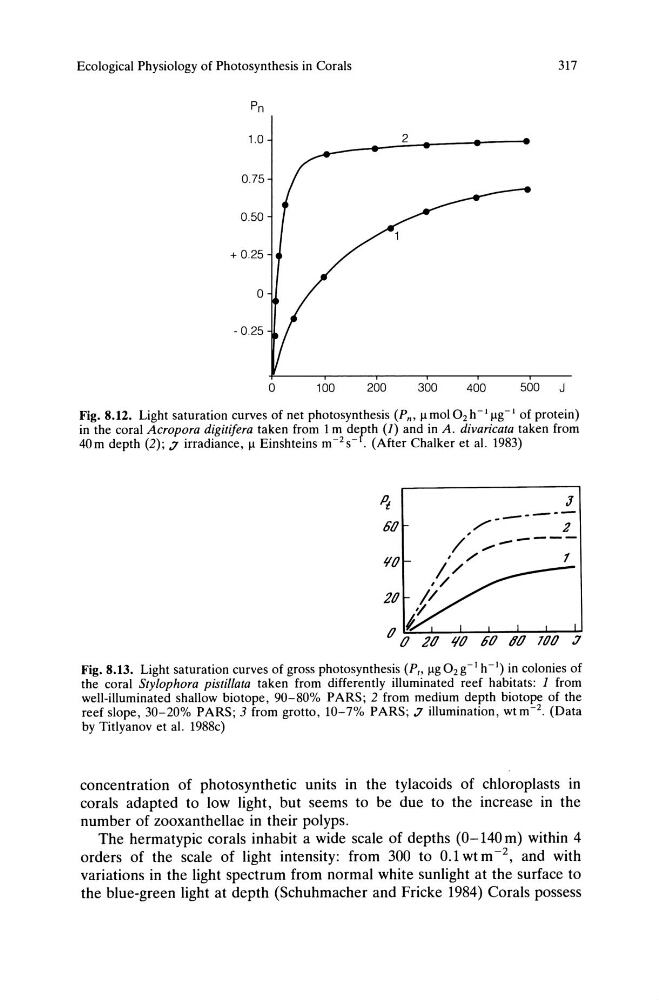
Fig. 8.12. Light saturation curves of net photosynthesis (Pn , Il mol Oz h- 1 J.lg- 1 of protein)
in the coral Acropora digilifera taken from 1 m depth (1) and in A. divaricata taken from
40m depth (2);.7 irradiance, Il Einshteins m-zs- . (After Chalker et al. 1983)
~
oil
J
-----, / -
2
/ "...----, /'
1
j /
, /
'Ill
21l / /
l/
Il 0 21l 'Ill oil dO lUll .7
Fig. 8.13. Light saturation curves of gross photosynthesis (Pr, Ilg Oz g-l h- 1 ) in colonies of
the coral Stylophora pistil/ala taken from differently illuminated reef habitats: 1 from
well-illuminated shallow biotope, 90-80% PARS; 2 from medium depth biotope of the
reef slope, 30-20% PARS; 3 from grotto, 10-7% PARS; .7 illumination, wt m- z . (Data
by Titlyanov et al. 1988c)
concentration of photosynthetic units in the tylacoids of chloroplasts in
corals adapted to low light, but seems to be due to the increase in the
number of zooxanthellae in their polyps.
The hermatypic corals inhabit a wide scale of depths (0-140 m) within 4
orders of the scale of light intensity: from 300 to 0.1 wt m -2, and with
variations in the light spectrum from normal white sunlight at the surface to
the blue-green light at depth (Schuhmacher and Fricke 1984) Corals possess
317
1.0
2
0.75
0.50
+ 0.25
o
- 0.25
o
100
200
300
400
500
J
Fig. 8.12. Light saturation curves of net photosynthesis (Pn , Il mol Oz h- 1 J.lg- 1 of protein)
in the coral Acropora digilifera taken from 1 m depth (1) and in A. divaricata taken from
40m depth (2);.7 irradiance, Il Einshteins m-zs- . (After Chalker et al. 1983)
~
oil
J
-----, / -
2
/ "...----, /'
1
j /
, /
'Ill
21l / /
l/
Il 0 21l 'Ill oil dO lUll .7
Fig. 8.13. Light saturation curves of gross photosynthesis (Pr, Ilg Oz g-l h- 1 ) in colonies of
the coral Stylophora pistil/ala taken from differently illuminated reef habitats: 1 from
well-illuminated shallow biotope, 90-80% PARS; 2 from medium depth biotope of the
reef slope, 30-20% PARS; 3 from grotto, 10-7% PARS; .7 illumination, wt m- z . (Data
by Titlyanov et al. 1988c)
concentration of photosynthetic units in the tylacoids of chloroplasts in
corals adapted to low light, but seems to be due to the increase in the
number of zooxanthellae in their polyps.
The hermatypic corals inhabit a wide scale of depths (0-140 m) within 4
orders of the scale of light intensity: from 300 to 0.1 wt m -2, and with
variations in the light spectrum from normal white sunlight at the surface to
the blue-green light at depth (Schuhmacher and Fricke 1984) Corals possess