

Ecological Physiology of Photosynthesis in Corals
1
Iii
12
8
315
JOO
200
70f)
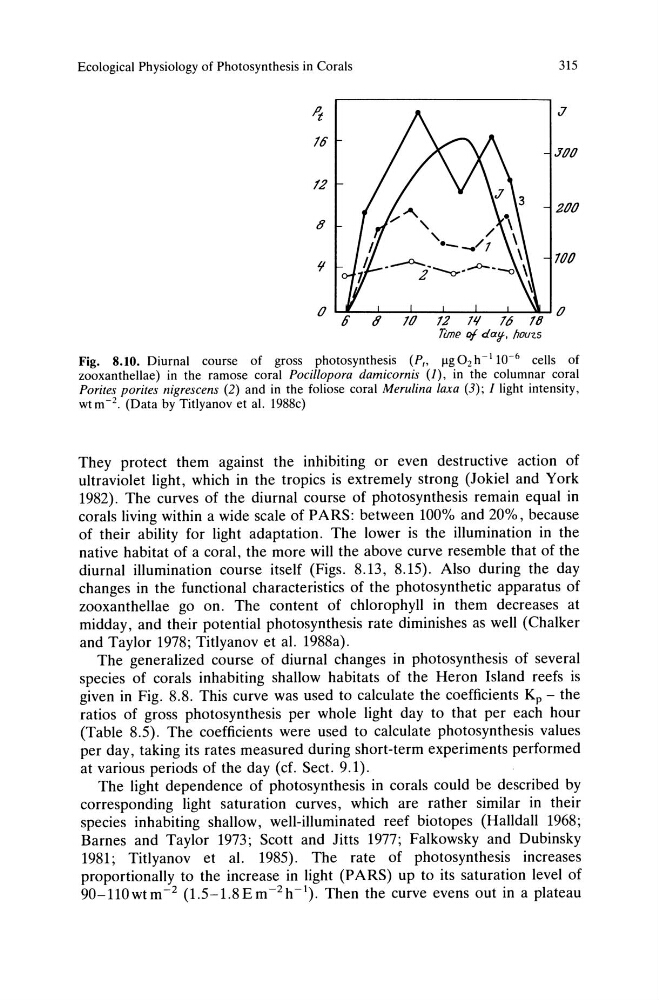
Fig. 8.10. Diurnal course of gross photosynthesis (Pt , Ilg O2 h- 1 10- 6 cells of
zooxanthellae) in the ramose coral Pocillopora damicornis (1), in the columnar coral
Porites porites nigrescens (2) and in the foliose coral Merulina taxa (3); flight intensity,
wtm- 2 • (Data by Titlyanov et al. 1988c)
They protect them against the inhibiting or even destructive action of
ultraviolet light, which in the tropics is extremely strong (Jokiel and York
1982). The curves of the diurnal course of photosynthesis remain equal in
corals living within a wide scale of PARS: between 100% and 20%, because
of their ability for light adaptation. The lower is the illumination in the
native habitat of a coral, the more will the above curve resemble that of the
diurnal illumination course itself (Figs. 8.13, 8.15). Also during the day
changes in the functional characteristics of the photosynthetic apparatus of
zooxanthellae go on. The content of chlorophyll in them decreases at
midday, and their potential photosynthesis rate diminishes as well (Chalker
and Taylor 1978; Titlyanov et al. 1988a).
The generalized course of diurnal changes in photosynthesis of several
species of corals inhabiting shallow habitats of the Heron Island reefs is
given in Fig. 8.8. This curve was used to calculate the coefficients Kp - the
ratios of gross photosynthesis per whole light day to that per each hour
(Table 8.5). The coefficients were used to calculate photosynthesis values
per day, taking its rates measured during short-term experiments performed
at various periods of the day (cf. Sect. 9.1).
The light dependence of photosynthesis in corals could be described by
corresponding light saturation curves, which are rather similar in their
species inhabiting shallow, well-illuminated reef biotopes (Halldall 1968;
Barnes and Taylor 1973; Scott and Jitts 1977; Falkowsky and Dubinsky
1981; Titlyanov et al. 1985). The rate of photosynthesis increases
proportionally to the increase in light (PARS) up to its saturation level of
90-110wtm- 2 (1.5-1.8Em- 2 h- 1 ). Then the curve evens out in a plateau
1
Iii
12
8
315
JOO
200
70f)
Fig. 8.10. Diurnal course of gross photosynthesis (Pt , Ilg O2 h- 1 10- 6 cells of
zooxanthellae) in the ramose coral Pocillopora damicornis (1), in the columnar coral
Porites porites nigrescens (2) and in the foliose coral Merulina taxa (3); flight intensity,
wtm- 2 • (Data by Titlyanov et al. 1988c)
They protect them against the inhibiting or even destructive action of
ultraviolet light, which in the tropics is extremely strong (Jokiel and York
1982). The curves of the diurnal course of photosynthesis remain equal in
corals living within a wide scale of PARS: between 100% and 20%, because
of their ability for light adaptation. The lower is the illumination in the
native habitat of a coral, the more will the above curve resemble that of the
diurnal illumination course itself (Figs. 8.13, 8.15). Also during the day
changes in the functional characteristics of the photosynthetic apparatus of
zooxanthellae go on. The content of chlorophyll in them decreases at
midday, and their potential photosynthesis rate diminishes as well (Chalker
and Taylor 1978; Titlyanov et al. 1988a).
The generalized course of diurnal changes in photosynthesis of several
species of corals inhabiting shallow habitats of the Heron Island reefs is
given in Fig. 8.8. This curve was used to calculate the coefficients Kp - the
ratios of gross photosynthesis per whole light day to that per each hour
(Table 8.5). The coefficients were used to calculate photosynthesis values
per day, taking its rates measured during short-term experiments performed
at various periods of the day (cf. Sect. 9.1).
The light dependence of photosynthesis in corals could be described by
corresponding light saturation curves, which are rather similar in their
species inhabiting shallow, well-illuminated reef biotopes (Halldall 1968;
Barnes and Taylor 1973; Scott and Jitts 1977; Falkowsky and Dubinsky
1981; Titlyanov et al. 1985). The rate of photosynthesis increases
proportionally to the increase in light (PARS) up to its saturation level of
90-110wtm- 2 (1.5-1.8Em- 2 h- 1 ). Then the curve evens out in a plateau