

314
Morphology and Ecological Physiology of Corals
Jf}
2f}
!f}
f}
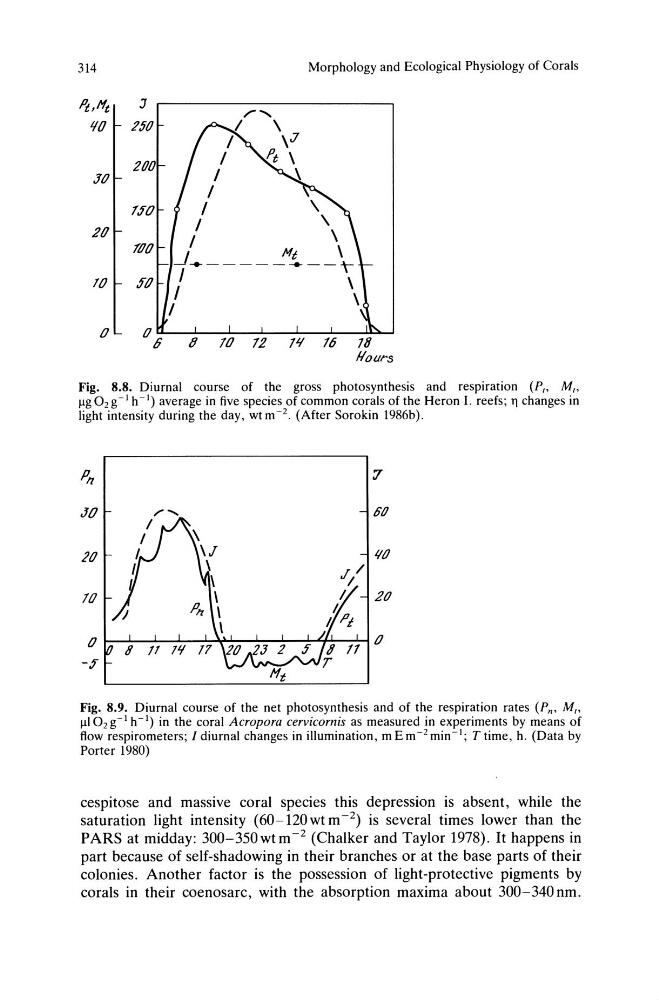
Fig. 8.8. Diurnal course of the gross photosynthesis and respiration (Pi' MI'
~g O2 g-I h -I) average in five species of common corals of the Heron I. reefs; 11 changes in
light intensity during the day, wt m- 2 (After Sorokin 1986b).
7
30
5f}
2f}
'If}
Tf}
2f}
f}1--...J....---L-"-:-....J....¥-J--.J,-,,-.....J,-----,!~~~f}
-,7
Fig. 8.9. Diurnal course of the net photosynthesis and of the respiration rates (Pn , Mi'
~102g-lh-l) in the coral Acropora cervicornis as measured in experiments by means of
flow respirometers; I diurnal changes in illumination. mE m- 2 min-I; T time, h. (Data by
Porter 1980)
cespitose and massive coral species this depression is absent, while the
saturation light intensity (60-120 wt m -2) is several times lower than the
PARS at midday: 300-350wtm- 2 (Chalker and Taylor 1978). It happens in
part because of self-shadowing in their branches or at the base parts of their
colonies. Another factor is the possession of light-protective pigments by
corals in their coenosarc, with the absorption maxima about 300-340 nm.
Morphology and Ecological Physiology of Corals
Jf}
2f}
!f}
f}
Fig. 8.8. Diurnal course of the gross photosynthesis and respiration (Pi' MI'
~g O2 g-I h -I) average in five species of common corals of the Heron I. reefs; 11 changes in
light intensity during the day, wt m- 2 (After Sorokin 1986b).
7
30
5f}
2f}
'If}
Tf}
2f}
f}1--...J....---L-"-:-....J....¥-J--.J,-,,-.....J,-----,!~~~f}
-,7
Fig. 8.9. Diurnal course of the net photosynthesis and of the respiration rates (Pn , Mi'
~102g-lh-l) in the coral Acropora cervicornis as measured in experiments by means of
flow respirometers; I diurnal changes in illumination. mE m- 2 min-I; T time, h. (Data by
Porter 1980)
cespitose and massive coral species this depression is absent, while the
saturation light intensity (60-120 wt m -2) is several times lower than the
PARS at midday: 300-350wtm- 2 (Chalker and Taylor 1978). It happens in
part because of self-shadowing in their branches or at the base parts of their
colonies. Another factor is the possession of light-protective pigments by
corals in their coenosarc, with the absorption maxima about 300-340 nm.