

Feeding of Reef Fish
J
J(}(}%
75
5(}
25
..
. . .
..
. . .
2
. .
. . .
3
. . . .
o ~-L~·~·~ __ ~~-L~L· __ ·~·L-~· __ ·~·L-__
Bu
FI?£
F.5G
1..5
231
1113
ffiIIIIIllIII f'
1·:.;·1 §
1::-::10
"7 r;--;-;'I
L!....!.J 8
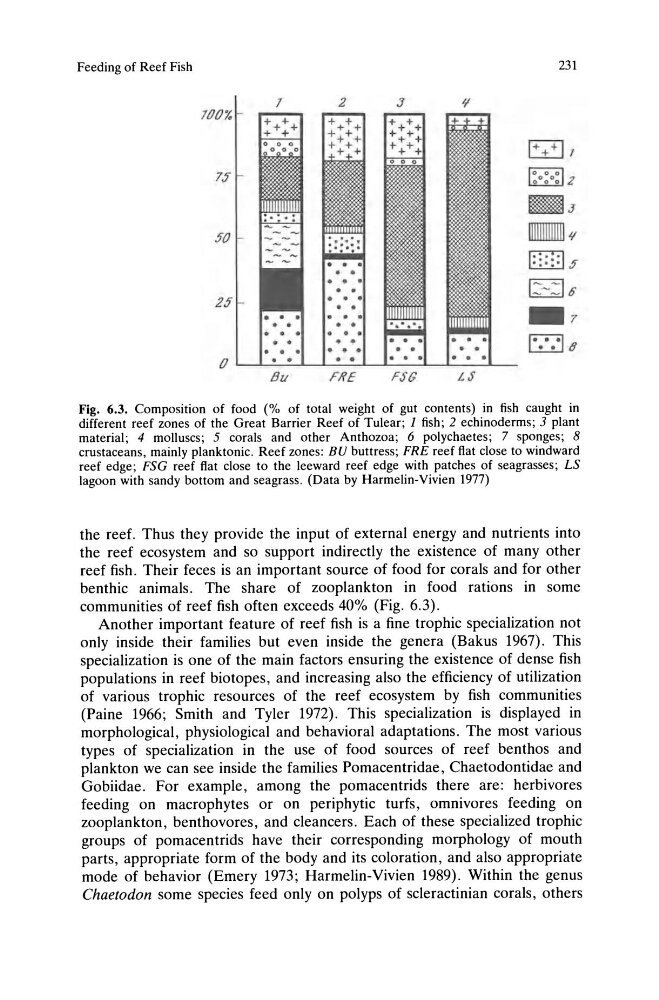
Fig. 6.3. Composition of food (% of total weight of gut contents) in fish caught in
different reef zones of the Great Barrier Reef of Tulear; 1 fish; 2 echinoderms; 3 plant
material ; 4 molluscs; 5 corals and other Anthozoa; 6 polychaetes; 7 sponges; 8
crustaceans, mainly planktonic. Reef zones: BU buttress; FRE reef fiat close to windward
reef edge; FSG reef fiat close to the leeward reef edge with patches of seagrasses; LS
lagoon with sandy bottom and seagrass. (Data by Harmelin-Vivien 1977)
the reef. Thus they provide the input of external energy and nutrients into
the reef ecosystem and so support indirectly the existence of many other
reef fish. Their feces is an important source of food for corals and for other
benthic animals. The share of zooplankton in food rations in some
communities of reef fish often exceeds 40% (Fig. 6.3).
Another important feature of reef fish is a fine trophic specialization not
only inside their families but even inside the genera (Bakus 1967). This
specialization is one of the main factors ensuring the existence of dense fish
populations in reef biotopes, and increasing also the efficiency of utilization
of various trophic resources of the reef ecosystem by fish communities
(Paine 1966; Smith and Tyler 1972). This specialization is displayed in
morphological, physiological and behavioral adaptations. The most various
types of specialization in the use of food sources of reef benthos and
plankton we can see inside the families Pomacentridae, Chaetodontidae and
Gobiidae. For example, among the pomacentrids there are: herbivores
feeding on macrophytes or on periphytic turfs, omnivores feeding on
zooplankton, benthovores, and cIeancers. Each of these specialized trophic
groups of pomacentrids have their corresponding morphology of mouth
parts, appropriate form of the body and its coloration, and also appropriate
mode of behavior (Emery 1973; Harmelin-Vivien 1989). Within the genus
Chaetodon some species feed only on polyps of scIeractinian corals, others
J
J(}(}%
75
5(}
25
..
. . .
..
. . .
2
. .
. . .
3
. . . .
o ~-L~·~·~ __ ~~-L~L· __ ·~·L-~· __ ·~·L-__
Bu
FI?£
F.5G
1..5
231
1113
ffiIIIIIllIII f'
1·:.;·1 §
1::-::10
"7 r;--;-;'I
L!....!.J 8
Fig. 6.3. Composition of food (% of total weight of gut contents) in fish caught in
different reef zones of the Great Barrier Reef of Tulear; 1 fish; 2 echinoderms; 3 plant
material ; 4 molluscs; 5 corals and other Anthozoa; 6 polychaetes; 7 sponges; 8
crustaceans, mainly planktonic. Reef zones: BU buttress; FRE reef fiat close to windward
reef edge; FSG reef fiat close to the leeward reef edge with patches of seagrasses; LS
lagoon with sandy bottom and seagrass. (Data by Harmelin-Vivien 1977)
the reef. Thus they provide the input of external energy and nutrients into
the reef ecosystem and so support indirectly the existence of many other
reef fish. Their feces is an important source of food for corals and for other
benthic animals. The share of zooplankton in food rations in some
communities of reef fish often exceeds 40% (Fig. 6.3).
Another important feature of reef fish is a fine trophic specialization not
only inside their families but even inside the genera (Bakus 1967). This
specialization is one of the main factors ensuring the existence of dense fish
populations in reef biotopes, and increasing also the efficiency of utilization
of various trophic resources of the reef ecosystem by fish communities
(Paine 1966; Smith and Tyler 1972). This specialization is displayed in
morphological, physiological and behavioral adaptations. The most various
types of specialization in the use of food sources of reef benthos and
plankton we can see inside the families Pomacentridae, Chaetodontidae and
Gobiidae. For example, among the pomacentrids there are: herbivores
feeding on macrophytes or on periphytic turfs, omnivores feeding on
zooplankton, benthovores, and cIeancers. Each of these specialized trophic
groups of pomacentrids have their corresponding morphology of mouth
parts, appropriate form of the body and its coloration, and also appropriate
mode of behavior (Emery 1973; Harmelin-Vivien 1989). Within the genus
Chaetodon some species feed only on polyps of scIeractinian corals, others