

Distribution, Communities Structure and Abundance
Table 5.7. The biomass of coral reef macrobenthos
Reef
Biotope
Biomass, gm- 2
wet weight
Virgin I.
Sandy shallows
108-384 a
Bermuda
Sands in lagoon
2.0-6.8
Barrier reef off
Sands in flat and in
34
Moorea I.
coastal lagoon
(average)
Enivetok atoll
Shallows at windward
89-368 b
flat
Namsu I., Vietnam
Rocky littoral zone
834
Thu I., Vietnam
same zone
106
Thu I., Vietnam
Sandy littoral zone
83
Anthoy I., Vietnam
Crude sands in fore-reef
170
zone, 10-12 m depth
Tohtu I., Vietnam
Rubble and crude sand,
3220
same zone
Kondao I.,
Silty sands, same zone
95
Vietnam
Moruroa atoll,
Coral sands
0.04-10.0
Tuamotu
a Calculated using data on carbon content in biomass, including corals.
b Excluding large asteroids and holothurians.
213
Reference
Lee et al. (1975)
Ricard and Salvat
(1972)
Odum and Odum
(1955)
Gulbin et al.
(1987)
Gulbin et al.
(1987)
Gulbin et al.
(1987)
Rostomov (1987)
Rostomov (1987)
Rostomov (1987)
Villiers (1988)
Table 5.8. The numbers (N, sp. 60 cm- 2 ) of basic elements of meiobenthos in coral sands
on the reefs of Tulear (Thomassin et al. 1976)
Element
Nauplii
Harpacticoid copepods
Ostraeods
N
185-326
340-1085
1-28
Element
Nematods
Polychaetes
Total meiobenthos
N
185-326
26-75
1050-2440
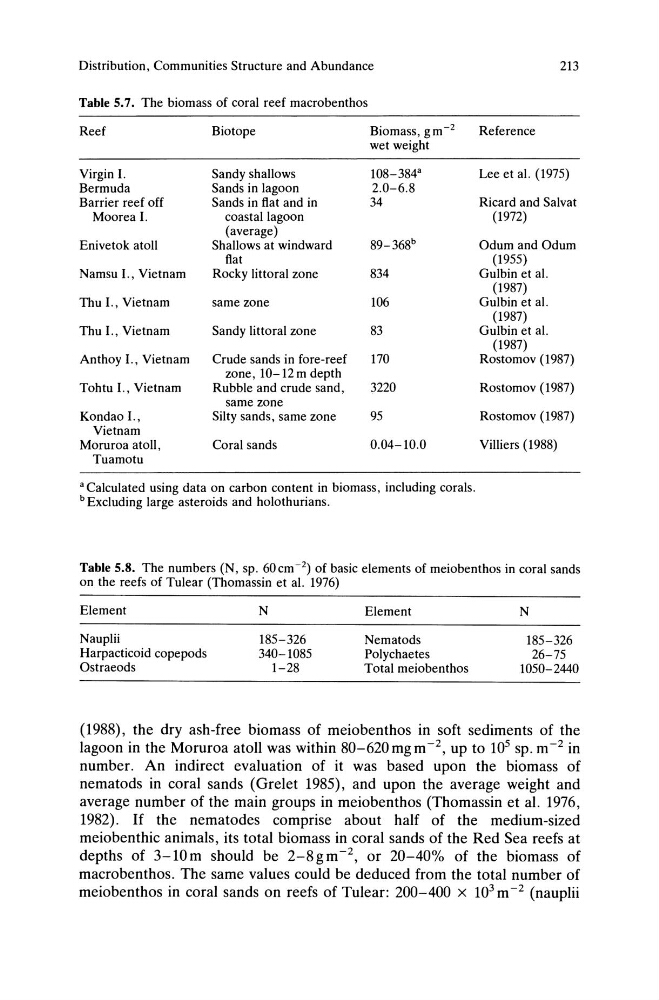
(1988), the dry ash-free biomass of meiobenthos in soft sediments of the
lagoon in the Momroa atoll was within 80-620mgm- 2 , up to 10 5 sp. m- 2 in
number. An indirect evaluation of it was based upon the biomass of
nematods in coral sands (Grelet 1985), and upon the average weight and
average number of the main groups in meiobenthos (Thomassin et al. 1976,
1982). If the nematodes comprise about half of the medium-sized
meiobenthic animals, its total biomass in coral sands of the Red Sea reefs at
depths of 3-lOm should be 2-8gm- 2 , or 20-40% of the biomass of
macrobenthos. The same values could be deduced from the total number of
meiobenthos in coral sands on reefs of Tulear: 200-400 x 10 3 m -2 (nauplii
Table 5.7. The biomass of coral reef macrobenthos
Reef
Biotope
Biomass, gm- 2
wet weight
Virgin I.
Sandy shallows
108-384 a
Bermuda
Sands in lagoon
2.0-6.8
Barrier reef off
Sands in flat and in
34
Moorea I.
coastal lagoon
(average)
Enivetok atoll
Shallows at windward
89-368 b
flat
Namsu I., Vietnam
Rocky littoral zone
834
Thu I., Vietnam
same zone
106
Thu I., Vietnam
Sandy littoral zone
83
Anthoy I., Vietnam
Crude sands in fore-reef
170
zone, 10-12 m depth
Tohtu I., Vietnam
Rubble and crude sand,
3220
same zone
Kondao I.,
Silty sands, same zone
95
Vietnam
Moruroa atoll,
Coral sands
0.04-10.0
Tuamotu
a Calculated using data on carbon content in biomass, including corals.
b Excluding large asteroids and holothurians.
213
Reference
Lee et al. (1975)
Ricard and Salvat
(1972)
Odum and Odum
(1955)
Gulbin et al.
(1987)
Gulbin et al.
(1987)
Gulbin et al.
(1987)
Rostomov (1987)
Rostomov (1987)
Rostomov (1987)
Villiers (1988)
Table 5.8. The numbers (N, sp. 60 cm- 2 ) of basic elements of meiobenthos in coral sands
on the reefs of Tulear (Thomassin et al. 1976)
Element
Nauplii
Harpacticoid copepods
Ostraeods
N
185-326
340-1085
1-28
Element
Nematods
Polychaetes
Total meiobenthos
N
185-326
26-75
1050-2440
(1988), the dry ash-free biomass of meiobenthos in soft sediments of the
lagoon in the Momroa atoll was within 80-620mgm- 2 , up to 10 5 sp. m- 2 in
number. An indirect evaluation of it was based upon the biomass of
nematods in coral sands (Grelet 1985), and upon the average weight and
average number of the main groups in meiobenthos (Thomassin et al. 1976,
1982). If the nematodes comprise about half of the medium-sized
meiobenthic animals, its total biomass in coral sands of the Red Sea reefs at
depths of 3-lOm should be 2-8gm- 2 , or 20-40% of the biomass of
macrobenthos. The same values could be deduced from the total number of
meiobenthos in coral sands on reefs of Tulear: 200-400 x 10 3 m -2 (nauplii