

Distribution, Communities Structure and Abundance
211
actinians are practically not subjected to predators' attacks, the same as
many well-defended vagileanimals, which even do not hide in the daytime
(asteroids, holothurians, some urchins, and nudibranchs). Nevertheless,
some predators learned to consume even defended and poisonous preys.
Thus, some ten species of fish eat the well-defended urchins Diadema, and
the large gastropod Charonia successfully attacks the star Acanthaster
fortified with poisonous thorns. The nudibranchs graze on the poisonous
gorgonaceans.
Shannon's index of species variability in main taxonomic groups of the
macrobenthos is usually high: 1.5-2.5. It is highest in biotopes richest in
various refuges: on reef flats, in rubble, and in rocky littoral zones
(Sheppard 1984). Nevertheless, the dominance in some biotopes of one or
several leading species could also be observed (Rostomov 1987). Regarding
the distribution of the biomass of benthos, generalizations are still difficult,
not only because of the methodological obstacles mentioned above and of a
general lack of data, but also because of the patchiness of its distribution
and the big differences in it by day and at night. The number of different
groups of benthos, such as urchins, brittle stars or gastropods, in different
biotopes of the same reef or in the same biotope of different reefs may
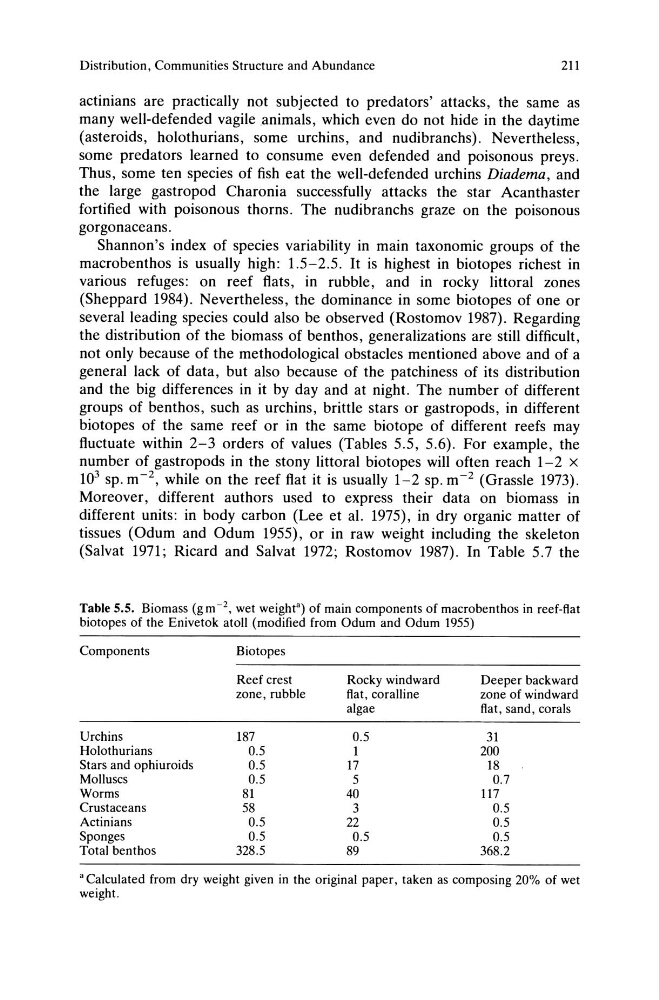
fluctuate within 2-3 orders of values (Tables 5.5, 5.6). For example, the
number of gastropods in the stony littoral biotopes will often reach 1-2 X
10 3 sp. m- 2 , while on the reef flat it is usually 1-2 sp. m- 2 (Grassle 1973).
Moreover, different authors used to express their data on biomass in
different units: in body carbon (Lee et al. 1975), in dry organic matter of
tissues (Odum and Odum 1955), or in raw weight including the skeleton
(Salvat 1971; Ricard and Salvat 1972; Rostomov 1987). In Table 5.7 the
Table 5.5. Biomass (g m -2, wet weight a ) of main components of macrobenthos in reef-flat
biotopes of the Enivetok atoll (modified from Odum and Odum 1955)
Components
Urchins
Holothurians
Stars and ophiuroids
Molluscs
Worms
Crustaceans
Actinians
Sponges
Total benthos
Biotopes
Reef crest
zone, rubble
187
0.5
0.5
0.5
81
58
0.5
0.5
328.5
Rocky windward
flat, coralline
algae
0.5
1
17
5
40
3
22
0.5
89
Deeper backward
zone of windward
flat, sand, corals
31
200
18
0.7
117
0.5
0.5
0.5
368.2
a Calculated from dry weight given in the original paper, taken as composing 20% of wet
weight.
211
actinians are practically not subjected to predators' attacks, the same as
many well-defended vagileanimals, which even do not hide in the daytime
(asteroids, holothurians, some urchins, and nudibranchs). Nevertheless,
some predators learned to consume even defended and poisonous preys.
Thus, some ten species of fish eat the well-defended urchins Diadema, and
the large gastropod Charonia successfully attacks the star Acanthaster
fortified with poisonous thorns. The nudibranchs graze on the poisonous
gorgonaceans.
Shannon's index of species variability in main taxonomic groups of the
macrobenthos is usually high: 1.5-2.5. It is highest in biotopes richest in
various refuges: on reef flats, in rubble, and in rocky littoral zones
(Sheppard 1984). Nevertheless, the dominance in some biotopes of one or
several leading species could also be observed (Rostomov 1987). Regarding
the distribution of the biomass of benthos, generalizations are still difficult,
not only because of the methodological obstacles mentioned above and of a
general lack of data, but also because of the patchiness of its distribution
and the big differences in it by day and at night. The number of different
groups of benthos, such as urchins, brittle stars or gastropods, in different
biotopes of the same reef or in the same biotope of different reefs may
fluctuate within 2-3 orders of values (Tables 5.5, 5.6). For example, the
number of gastropods in the stony littoral biotopes will often reach 1-2 X
10 3 sp. m- 2 , while on the reef flat it is usually 1-2 sp. m- 2 (Grassle 1973).
Moreover, different authors used to express their data on biomass in
different units: in body carbon (Lee et al. 1975), in dry organic matter of
tissues (Odum and Odum 1955), or in raw weight including the skeleton
(Salvat 1971; Ricard and Salvat 1972; Rostomov 1987). In Table 5.7 the
Table 5.5. Biomass (g m -2, wet weight a ) of main components of macrobenthos in reef-flat
biotopes of the Enivetok atoll (modified from Odum and Odum 1955)
Components
Urchins
Holothurians
Stars and ophiuroids
Molluscs
Worms
Crustaceans
Actinians
Sponges
Total benthos
Biotopes
Reef crest
zone, rubble
187
0.5
0.5
0.5
81
58
0.5
0.5
328.5
Rocky windward
flat, coralline
algae
0.5
1
17
5
40
3
22
0.5
89
Deeper backward
zone of windward
flat, sand, corals
31
200
18
0.7
117
0.5
0.5
0.5
368.2
a Calculated from dry weight given in the original paper, taken as composing 20% of wet
weight.