

Bottom Plant Associations
143
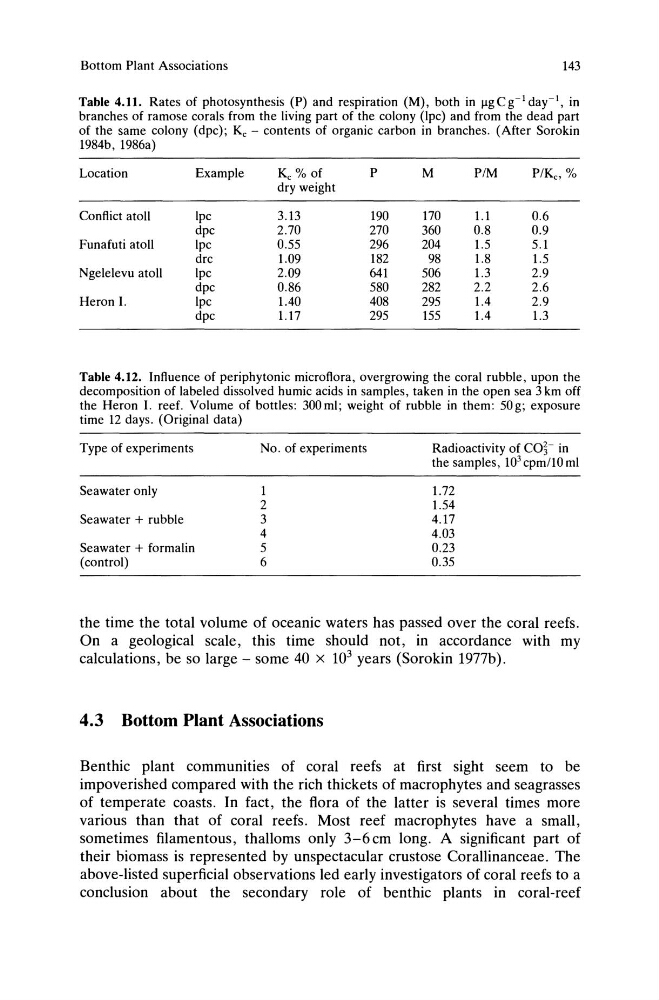
Table 4.11. Rates of photosynthesis (P) and respiration (M), both in IlgCg-lday-l, in
branches of ramose corals from the living part of the colony (Ipc) and from the dead part
of the same colony (dpc); Kc - contents of organic carbon in branches. (After Sorokin
1984b, 1986a)
Location
Example
Kc % of
P
M
P/M
PiKe, %
dry weight
Conflict atoll
lpc
3.13
190
170
1.1
0.6
dpc
2.70
270
360
0.8
0.9
Funafuti atoll
lpc
0.55
296
204
1.5
5.1
drc
1.09
182
98
1.8
1.5
Ngelelevu atoll
lpc
2.09
641
506
1.3
2.9
dpc
0.86
580
282
2.2
2.6
Heron I.
lpc
1.40
408
295
1.4
2.9
dpc
1.17
295
155
1.4
1.3
Table 4.12. Influence of periphytonic microflora, overgrowing the coral rubble, upon the
decomposition of labeled dissolved humic acids in samples, taken in the open sea 3 km off
the Heron I. reef. Volume of bottles: 300 ml; weight of rubble in them: 50 g; exposure
time 12 days. (Original data)
Type of experiments
Seawater only
Seawater + rubble
Seawater + formalin
(control)
No. of experiments
1
2
3
4
5
6
Radioactivity of CO~- in
the samples, 10 3 cpmllO ml
1.72
1.54
4.17
4.03
0.23
0.35
the time the total volume of oceanic waters has passed over the coral reefs.
On a geological scale, this time should not, in accordance with my
calculations, be so large - some 40 x 10 3 years (Sorokin 1977b).
4.3 Bottom Plant Associations
Benthic plant commumtIes of coral reefs at first sight seem to be
impoverished compared with the rich thickets of macrophytes and seagrasses
of temperate coasts. In fact, the flora of the latter is several times more
various than that of coral reefs. Most reef macrophytes have a small,
sometimes filamentous, thalloms only 3-6 cm long. A significant part of
their biomass is represented by unspectacular crustose Corallinanceae. The
above-listed superficial observations led early investigators of coral reefs to a
conclusion about the secondary role of benthic plants in coral-reef
143
Table 4.11. Rates of photosynthesis (P) and respiration (M), both in IlgCg-lday-l, in
branches of ramose corals from the living part of the colony (Ipc) and from the dead part
of the same colony (dpc); Kc - contents of organic carbon in branches. (After Sorokin
1984b, 1986a)
Location
Example
Kc % of
P
M
P/M
PiKe, %
dry weight
Conflict atoll
lpc
3.13
190
170
1.1
0.6
dpc
2.70
270
360
0.8
0.9
Funafuti atoll
lpc
0.55
296
204
1.5
5.1
drc
1.09
182
98
1.8
1.5
Ngelelevu atoll
lpc
2.09
641
506
1.3
2.9
dpc
0.86
580
282
2.2
2.6
Heron I.
lpc
1.40
408
295
1.4
2.9
dpc
1.17
295
155
1.4
1.3
Table 4.12. Influence of periphytonic microflora, overgrowing the coral rubble, upon the
decomposition of labeled dissolved humic acids in samples, taken in the open sea 3 km off
the Heron I. reef. Volume of bottles: 300 ml; weight of rubble in them: 50 g; exposure
time 12 days. (Original data)
Type of experiments
Seawater only
Seawater + rubble
Seawater + formalin
(control)
No. of experiments
1
2
3
4
5
6
Radioactivity of CO~- in
the samples, 10 3 cpmllO ml
1.72
1.54
4.17
4.03
0.23
0.35
the time the total volume of oceanic waters has passed over the coral reefs.
On a geological scale, this time should not, in accordance with my
calculations, be so large - some 40 x 10 3 years (Sorokin 1977b).
4.3 Bottom Plant Associations
Benthic plant commumtIes of coral reefs at first sight seem to be
impoverished compared with the rich thickets of macrophytes and seagrasses
of temperate coasts. In fact, the flora of the latter is several times more
various than that of coral reefs. Most reef macrophytes have a small,
sometimes filamentous, thalloms only 3-6 cm long. A significant part of
their biomass is represented by unspectacular crustose Corallinanceae. The
above-listed superficial observations led early investigators of coral reefs to a
conclusion about the secondary role of benthic plants in coral-reef