

142
Benthic Microflora, Periphyton and Plant Associations
and also their high production and metabolic rates, we may conclude that
they are among the key coral reef communities besides the corals
themselves. It was spectacularly proved by our experiments showing the
equality of the photosynthesis and respiration rates in living ramose corals
and in dead branches of the same coral colonies covered with the periphyton
(Table 4.11).
The periphytonic turfs are one of the main sources of feeding for
herbivorous invertebrates and fish (Harmelin-Vivien et al. 1989). They are
grazed by numerous surgeon-fish, scarides, chaetodontids, as well as by
crabs, shrimps, gastropods, and urchins (Bakus 1967). It is just the high
biomass and production of epilithic algal and bacterial turfs which provide
quick restoration of food sources for these important groups of reef animals,
thus supporting their extremely dense populations, unknown in other coastal
ecosystems. Another important function of periphytonic microflora could be
seen in its role in the decomposition of the stable fraction of DOM in
passing over the reef oceanic waters. Its dense cover over vast surfaces of
reef rocks and rubble acts like the microbial communities in aerotanks of
sewage plants, functioning under optimal conditions of temperature and
oxygen supply. It could be supposed that possibly they could decompose
even a stable fraction of the DOM of oceanic waters, which is not used by
the planktonic microflora. This hypothesis had been forwarded on the basis
of data showing the level of development of periphytonic microflora being
independent of the level of the coral's cover (Table 4.8). Then we have
chequed it by direct experiment (Table 4.12). So it could be supposed that
this function of the periphytonic microflora in coral reefs could have a global
importance for the turnover of organic matter in the world ocean, coral
reefs being a site of microbial biodegradation of the stable fraction of the
DOM in sea water. In this regard it could be supposed that the modern level
of DOM content in it - about 2mg CI- 1 - may be definitely controlled by
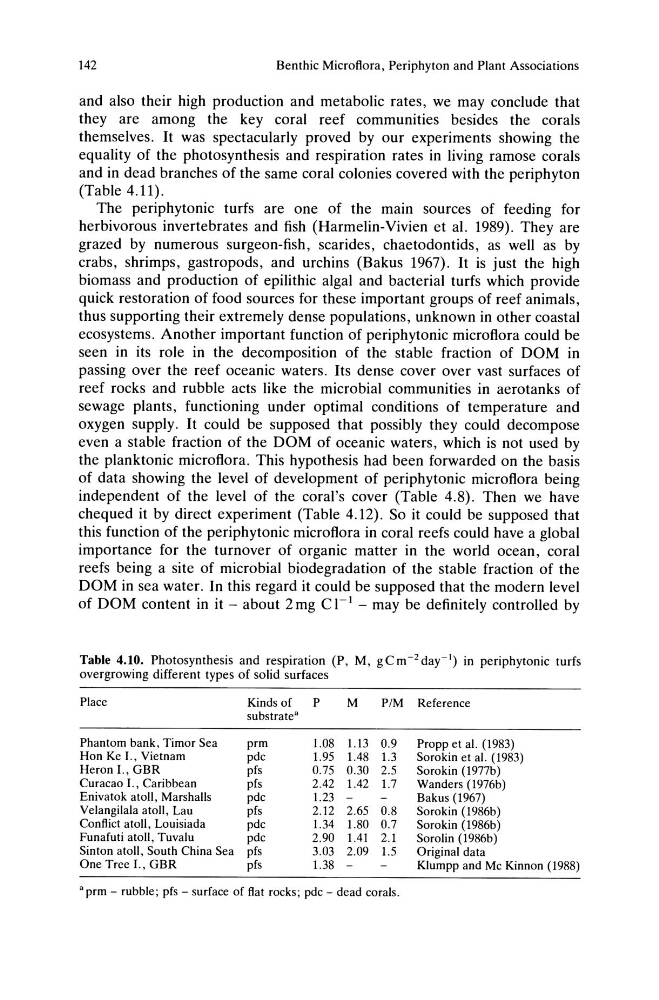
Table 4.10. Photosynthesis and respiration (P, M, gCm- 2 day-l) in periphytonic turfs
overgrowing different types of solid surfaces
Place
Kinds of
P
M
PIM Reference
substrate·
Phantom bank, Timor Sea
prm
1.08 1.13 0.9
Propp et al. (1983)
Hon Ke I., Vietnam
pdc
1.95 1.48 1.3
Sorokin et al. (1983)
Heron I., GBR
pfs
0.75 0.30 2.5
Sorokin (1977b)
Curacao I., Caribbean
pfs
2.42 1.42 1.7
Wanders (I976b)
Enivatok atoll, Marshalls
pdc
1.23 -
Bakus (1967)
Velangilala atoll, Lau
pfs
2.12 2.65 0.8
Sorokin (1986b)
Conflict atoll, Louisiada
pdc
1.34 1.80 0.7
Sorokin (1986b)
Funafuti atoll, Tuvalu
pdc
2.90 1.41 2.1
Sorolin (1986b)
Sinton atoll, South China Sea pfs
3.03 2.09 1.5
Original data
One Tree I., GBR
pfs
1.38 -
Klumpp and Mc Kinnon (1988)
·prm - rubble; pfs - surface of flat rocks; pdc - dead corals.
Benthic Microflora, Periphyton and Plant Associations
and also their high production and metabolic rates, we may conclude that
they are among the key coral reef communities besides the corals
themselves. It was spectacularly proved by our experiments showing the
equality of the photosynthesis and respiration rates in living ramose corals
and in dead branches of the same coral colonies covered with the periphyton
(Table 4.11).
The periphytonic turfs are one of the main sources of feeding for
herbivorous invertebrates and fish (Harmelin-Vivien et al. 1989). They are
grazed by numerous surgeon-fish, scarides, chaetodontids, as well as by
crabs, shrimps, gastropods, and urchins (Bakus 1967). It is just the high
biomass and production of epilithic algal and bacterial turfs which provide
quick restoration of food sources for these important groups of reef animals,
thus supporting their extremely dense populations, unknown in other coastal
ecosystems. Another important function of periphytonic microflora could be
seen in its role in the decomposition of the stable fraction of DOM in
passing over the reef oceanic waters. Its dense cover over vast surfaces of
reef rocks and rubble acts like the microbial communities in aerotanks of
sewage plants, functioning under optimal conditions of temperature and
oxygen supply. It could be supposed that possibly they could decompose
even a stable fraction of the DOM of oceanic waters, which is not used by
the planktonic microflora. This hypothesis had been forwarded on the basis
of data showing the level of development of periphytonic microflora being
independent of the level of the coral's cover (Table 4.8). Then we have
chequed it by direct experiment (Table 4.12). So it could be supposed that
this function of the periphytonic microflora in coral reefs could have a global
importance for the turnover of organic matter in the world ocean, coral
reefs being a site of microbial biodegradation of the stable fraction of the
DOM in sea water. In this regard it could be supposed that the modern level
of DOM content in it - about 2mg CI- 1 - may be definitely controlled by
Table 4.10. Photosynthesis and respiration (P, M, gCm- 2 day-l) in periphytonic turfs
overgrowing different types of solid surfaces
Place
Kinds of
P
M
PIM Reference
substrate·
Phantom bank, Timor Sea
prm
1.08 1.13 0.9
Propp et al. (1983)
Hon Ke I., Vietnam
pdc
1.95 1.48 1.3
Sorokin et al. (1983)
Heron I., GBR
pfs
0.75 0.30 2.5
Sorokin (1977b)
Curacao I., Caribbean
pfs
2.42 1.42 1.7
Wanders (I976b)
Enivatok atoll, Marshalls
pdc
1.23 -
Bakus (1967)
Velangilala atoll, Lau
pfs
2.12 2.65 0.8
Sorokin (1986b)
Conflict atoll, Louisiada
pdc
1.34 1.80 0.7
Sorokin (1986b)
Funafuti atoll, Tuvalu
pdc
2.90 1.41 2.1
Sorolin (1986b)
Sinton atoll, South China Sea pfs
3.03 2.09 1.5
Original data
One Tree I., GBR
pfs
1.38 -
Klumpp and Mc Kinnon (1988)
·prm - rubble; pfs - surface of flat rocks; pdc - dead corals.