

Periphytonic Overgrowth
137
microbenthic animals are present. The microftora in periphytonic communities contains the attached filamentous or chain-forming bacteria like
Cladotrix, Leptotrix, Crenotrix and the ftexibacteria. Among single-cell
bacteria the prostecobacteria and caulobacteria are numerous, being attached
to the surfaces of algae with the aid of their stalks. The communities of
periphytonic algae include small thalloms of macrophytes 0.5-1.5 cm long,
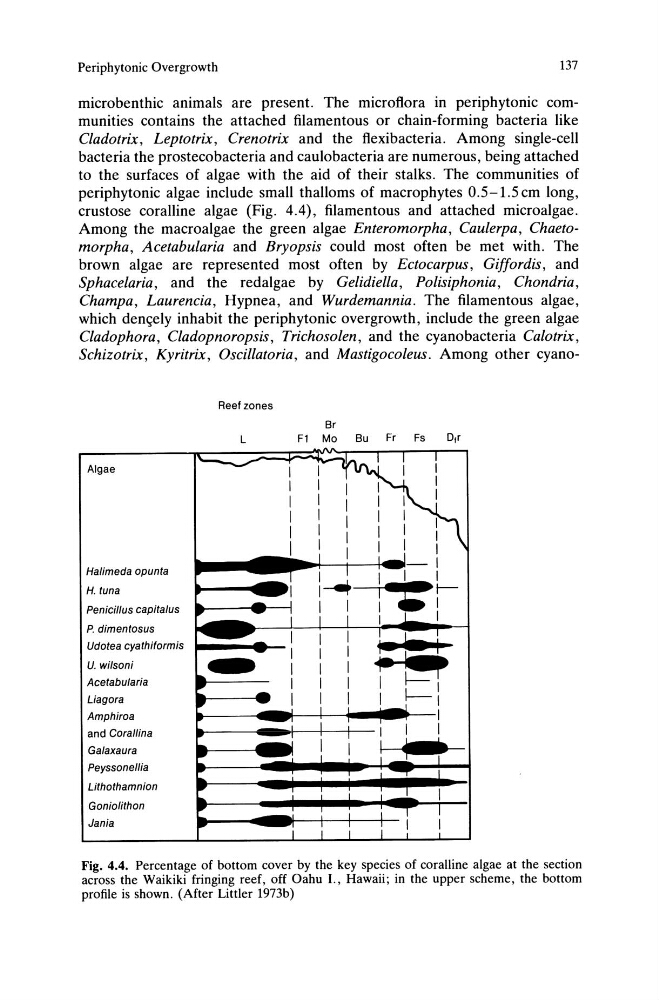
crustose coralline algae (Fig. 4.4), filamentous and attached microalgae.
Among the macro algae the green algae Enteromorpha, Caulerpa, Chaetomorpha, Acetabularia and Bryopsis could most often be met with. The
brown algae are represented most often by Ectocarpus, Giffordis, and
Sphacelaria, and the redalgae by Gelidiella, Polisiphonia, Chondria,
Champa, Laurencia, Hypnea, and Wurdemannia. The filamentous algae,
which den<;ely inhabit the periphytonic overgrowth, include the green algae
Cladophora, Cladopnoropsis, Trichosolen, and the cyanobacteria Calotrix,
Schizotrix, Kyritrix, Oscillatoria, and Mastigocoleus. Among other cyanoAlgae
Halimeda opunta
H. tuna
Penicillus capita/us
P. dimentosus
Udotea cyathiformis
U. wi/soni
Acetabu/aria
Liagora
Amphiroa
and Corallina
Ga/axaura
Peyssonellia
Lithothamnion
Goniolithon
Jania
Reef zones
Br
L
F1 Mo
Bu
Fr
Fs
Dfr
Fig. 4.4. Percentage of bottom cover by the key species of coralline algae at the section
across the Waikiki fringing reef, off Oahu I., Hawaii; in the upper scheme, the bottom
profile is shown. (After Littler 1973b)
137
microbenthic animals are present. The microftora in periphytonic communities contains the attached filamentous or chain-forming bacteria like
Cladotrix, Leptotrix, Crenotrix and the ftexibacteria. Among single-cell
bacteria the prostecobacteria and caulobacteria are numerous, being attached
to the surfaces of algae with the aid of their stalks. The communities of
periphytonic algae include small thalloms of macrophytes 0.5-1.5 cm long,
crustose coralline algae (Fig. 4.4), filamentous and attached microalgae.
Among the macro algae the green algae Enteromorpha, Caulerpa, Chaetomorpha, Acetabularia and Bryopsis could most often be met with. The
brown algae are represented most often by Ectocarpus, Giffordis, and
Sphacelaria, and the redalgae by Gelidiella, Polisiphonia, Chondria,
Champa, Laurencia, Hypnea, and Wurdemannia. The filamentous algae,
which den<;ely inhabit the periphytonic overgrowth, include the green algae
Cladophora, Cladopnoropsis, Trichosolen, and the cyanobacteria Calotrix,
Schizotrix, Kyritrix, Oscillatoria, and Mastigocoleus. Among other cyanoAlgae
Halimeda opunta
H. tuna
Penicillus capita/us
P. dimentosus
Udotea cyathiformis
U. wi/soni
Acetabu/aria
Liagora
Amphiroa
and Corallina
Ga/axaura
Peyssonellia
Lithothamnion
Goniolithon
Jania
Reef zones
Br
L
F1 Mo
Bu
Fr
Fs
Dfr
Fig. 4.4. Percentage of bottom cover by the key species of coralline algae at the section
across the Waikiki fringing reef, off Oahu I., Hawaii; in the upper scheme, the bottom
profile is shown. (After Littler 1973b)