

104
Plankton in Coral-Reef Waters
Scatlon 7
Siuit."on 2
stutiOIl 3
~
300
200
100
o Gpm oum!!am o,om oam 77um 6,om oam 1!om
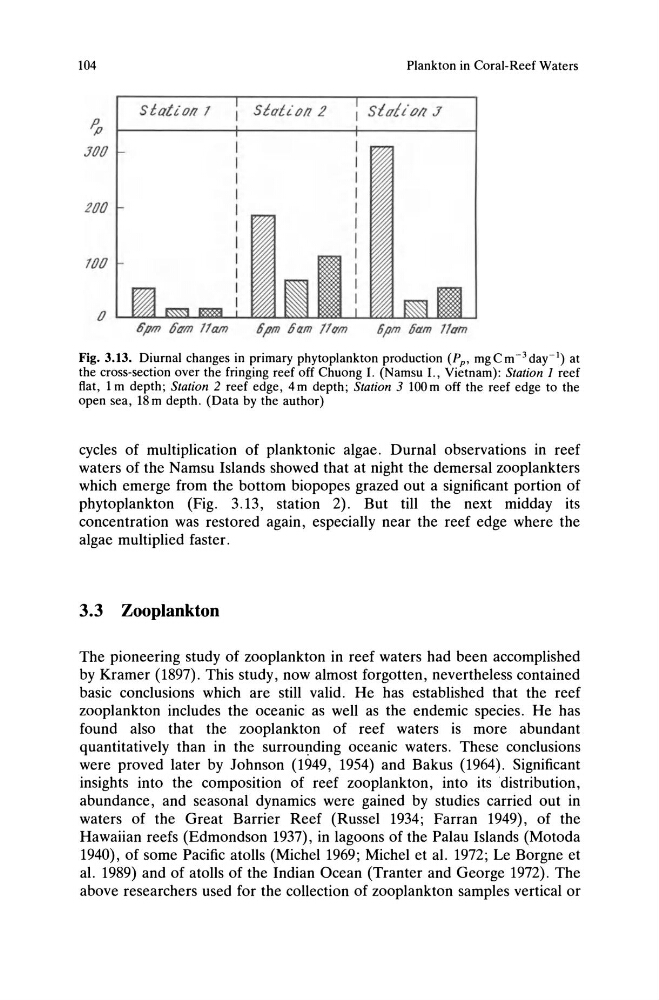
Fig. 3.13. Diurnal changes in primary phytoplankton production (P p , mgCm- 3 day-l) at
the cross-section over the fringing reef off Chuong I. (Namsu I., Vietnam): Station I reef
fiat, 1 m depth; Station 2 reef edge, 4m depth; Station 3 100m off the reef edge to the
open sea, 18 m depth. (Data by the author)
cycles of multiplication of planktonic algae. Dumal observations in reef
waters of the Namsu Islands showed that at night the demersal zooplankters
which emerge from the bottom biopopes grazed out a significant portion of
phytoplankton (Fig. 3.13, station 2). But till the next midday its
concentration was restored again, especially near the reef edge where the
algae multiplied faster.
3.3 Zooplankton
The pioneering study of zooplankton in reef waters had been accomplished
by Kramer (1897). This study, now almost forgotten, nevertheless contained
basic conclusions which are still valid. He has established that the reef
zooplankton includes the oceanic as well as the endemic species. He has
found also that the zooplankton of reef waters is more abundant
quantitatively than in the surroul).ding oceanic waters. These conclusions
were proved later by Johnson (1949, 1954) and Bakus (1964). Significant
insights into the composition of reef zooplankton, into its distribution,
abundance, and seasonal dynamics were gained by studies carried out in
waters of the Great Barrier Reef (Russel 1934; Farran 1949), of the
Hawaiian reefs (Edmondson 1937), in lagoons of the Palau Islands (Motoda
1940), of some Pacific atolls (Michel 1969; Michel et al. 1972; Le Borgne et
al. 1989) and of atolls of the Indian Ocean (Tranter and George 1972). The
above researchers used for the collection of zooplankton samples vertical or
Plankton in Coral-Reef Waters
Scatlon 7
Siuit."on 2
stutiOIl 3
~
300
200
100
o Gpm oum!!am o,om oam 77um 6,om oam 1!om
Fig. 3.13. Diurnal changes in primary phytoplankton production (P p , mgCm- 3 day-l) at
the cross-section over the fringing reef off Chuong I. (Namsu I., Vietnam): Station I reef
fiat, 1 m depth; Station 2 reef edge, 4m depth; Station 3 100m off the reef edge to the
open sea, 18 m depth. (Data by the author)
cycles of multiplication of planktonic algae. Dumal observations in reef
waters of the Namsu Islands showed that at night the demersal zooplankters
which emerge from the bottom biopopes grazed out a significant portion of
phytoplankton (Fig. 3.13, station 2). But till the next midday its
concentration was restored again, especially near the reef edge where the
algae multiplied faster.
3.3 Zooplankton
The pioneering study of zooplankton in reef waters had been accomplished
by Kramer (1897). This study, now almost forgotten, nevertheless contained
basic conclusions which are still valid. He has established that the reef
zooplankton includes the oceanic as well as the endemic species. He has
found also that the zooplankton of reef waters is more abundant
quantitatively than in the surroul).ding oceanic waters. These conclusions
were proved later by Johnson (1949, 1954) and Bakus (1964). Significant
insights into the composition of reef zooplankton, into its distribution,
abundance, and seasonal dynamics were gained by studies carried out in
waters of the Great Barrier Reef (Russel 1934; Farran 1949), of the
Hawaiian reefs (Edmondson 1937), in lagoons of the Palau Islands (Motoda
1940), of some Pacific atolls (Michel 1969; Michel et al. 1972; Le Borgne et
al. 1989) and of atolls of the Indian Ocean (Tranter and George 1972). The
above researchers used for the collection of zooplankton samples vertical or