

Phytoplankton
103
:L---. . . .
(1,5
fl,J
-
fl,9
t
0
IJL----------------I
fl,.7 C
/l,2.7
1Y-Y W-FJI 1!llI-1i X-If .DI-I ff-.DJ
MOIiths
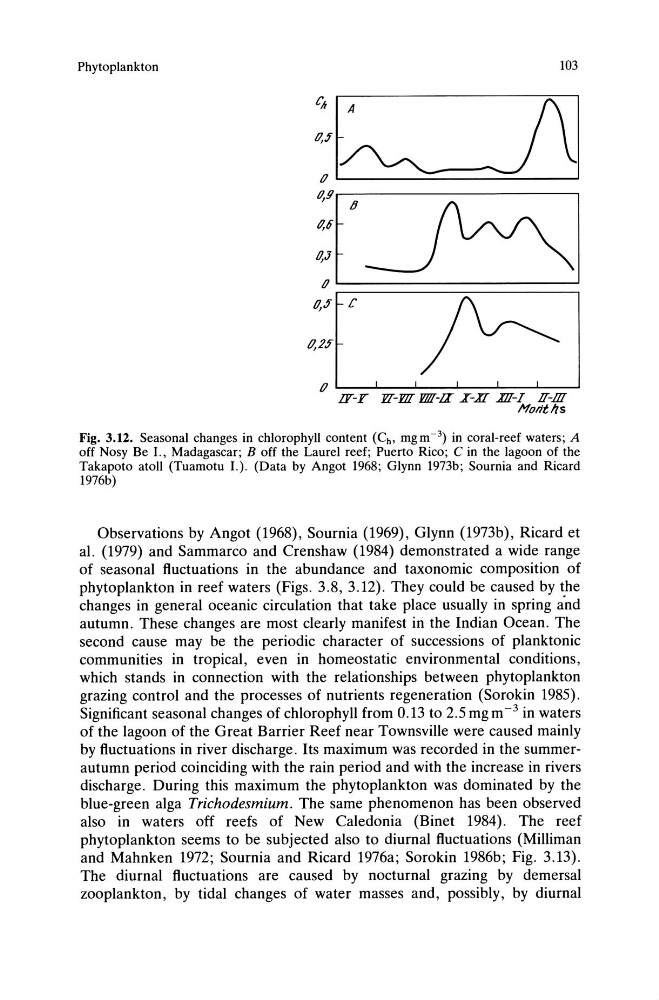
Fig. 3.12. Seasonal changes in chlorophyll content (Ch, mg m- 3 ) in coral-reef waters; A
off Nosy Be I., Madagascar; B off the Laurel reef; Puerto Rico; C in the lagoon of the
Takapoto atoll (Tuamotu I.). (Data by Angot 1968; Glynn 1973b; Sournia and Ricard
1976b)
Observations by Angot (1968), Sournia (1969), Glynn (1973b), Ricard et
al. (1979) and Sammarco and Crenshaw (1984) demonstrated a wide range
of seasonal fluctuations in the abundance and taxonomic composition of
phytoplankton in reef waters (Figs. 3.8, 3.12). They could be caused by the
changes in general oceanic circulation that take place usually in spring a·nd
autumn. These changes are most clearly manifest in the Indian Ocean. The
second cause may be the periodic character of successions of planktonic
communities in tropical, even in homeostatic environmental conditions,
which stands in connection with the relationships between phytoplankton
grazing control and the processes of nutrients regeneration (Sorokin 1985).
Significant seasonal changes of chlorophyll from 0.13 to 2.5 mg m -3 in waters
of the lagoon of the Great Barrier Reef near Townsville were caused mainly
by fluctuations in river discharge. Its maximum was recorded in the summerautumn period coinciding with the rain period and with the increase in rivers
discharge. During this maximum the phytoplankton was dominated by the
blue-green alga Trichodesmium. The same phenomenon has been observed
also in waters off reefs of New Caledonia (Binet 1984). The reef
phytoplankton seems to be SUbjected also to diurnal fluctuations (Milliman
and Mahnken 1972; Sournia and Ricard 1976a; Sorokin 1986b; Fig. 3.13).
The diurnal fluctuations are caused by nocturnal grazing by demersal
zooplankton, by tidal changes of water masses and, possibly, by diurnal
103
:L---. . . .
(1,5
fl,J
-
fl,9
t
0
IJL----------------I
fl,.7 C
/l,2.7
1Y-Y W-FJI 1!llI-1i X-If .DI-I ff-.DJ
MOIiths
Fig. 3.12. Seasonal changes in chlorophyll content (Ch, mg m- 3 ) in coral-reef waters; A
off Nosy Be I., Madagascar; B off the Laurel reef; Puerto Rico; C in the lagoon of the
Takapoto atoll (Tuamotu I.). (Data by Angot 1968; Glynn 1973b; Sournia and Ricard
1976b)
Observations by Angot (1968), Sournia (1969), Glynn (1973b), Ricard et
al. (1979) and Sammarco and Crenshaw (1984) demonstrated a wide range
of seasonal fluctuations in the abundance and taxonomic composition of
phytoplankton in reef waters (Figs. 3.8, 3.12). They could be caused by the
changes in general oceanic circulation that take place usually in spring a·nd
autumn. These changes are most clearly manifest in the Indian Ocean. The
second cause may be the periodic character of successions of planktonic
communities in tropical, even in homeostatic environmental conditions,
which stands in connection with the relationships between phytoplankton
grazing control and the processes of nutrients regeneration (Sorokin 1985).
Significant seasonal changes of chlorophyll from 0.13 to 2.5 mg m -3 in waters
of the lagoon of the Great Barrier Reef near Townsville were caused mainly
by fluctuations in river discharge. Its maximum was recorded in the summerautumn period coinciding with the rain period and with the increase in rivers
discharge. During this maximum the phytoplankton was dominated by the
blue-green alga Trichodesmium. The same phenomenon has been observed
also in waters off reefs of New Caledonia (Binet 1984). The reef
phytoplankton seems to be SUbjected also to diurnal fluctuations (Milliman
and Mahnken 1972; Sournia and Ricard 1976a; Sorokin 1986b; Fig. 3.13).
The diurnal fluctuations are caused by nocturnal grazing by demersal
zooplankton, by tidal changes of water masses and, possibly, by diurnal