

Phytoplankton
95
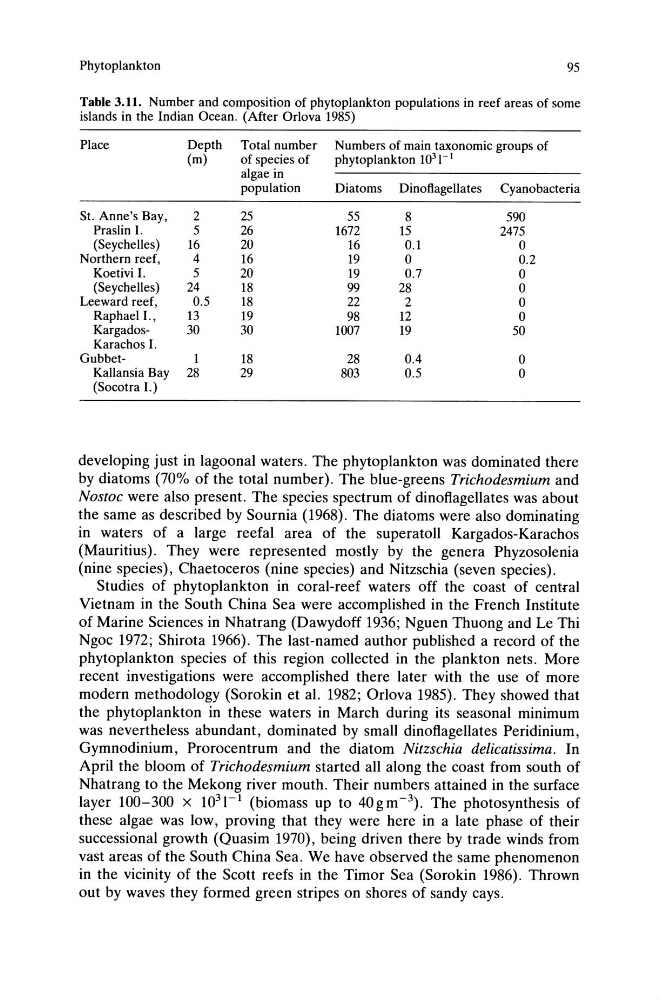
Table 3.11. Number and composition of phytoplankton populations in reef areas of some
islands in the Indian Ocean. (After Orlova 1985)
Place
Depth Total number Numbers of main taxonomic groups of
(m)
of species of
phytoplankton 10 3 1- 1
algae in
population
Diatoms Dinoflagellates Cyanobacteria
St. Anne's Bay,
2
25
55
8
590
Praslin I.
5
26
1672
15
2475
(Seychelles)
16
20
16
0.1
0
Northern reef,
4
16
19
0
0.2
Koetivi I.
5
20
19
0.7
0
(Seychelles)
24
18
99
28
0
Leeward reef,
0.5
18
22
2
0
Raphael I.,
13
19
98
12
0
Kargados30
30
1007
19
50
Karachos I.
Gubbet1
18
28
0.4
0
Kallansia Bay 28
29
803
0.5
0
(Socotra I.)
developing just in lagoonal waters. The phytoplankton was dominated there
by diatoms (70% of the total number). The blue-greens Trichodesmium and
Nostoc were also present. The species spectrum of dinoflagellates was about
the same as described by Sournia (1968). The diatoms were also dominating
in waters of a large reefal area of the superatoll Kargados-Karachos
(Mauritius). They were represented mostly by the genera Phyzosolenia
(nine species), Chaetoceros (nine species) and Nitzschia (seven species).
Studies of phytoplankton in coral-reef waters off the coast of central
Vietnam in the South China Sea were accomplished in the French Institute
of Marine Sciences in Nhatrang (Dawydoff 1936; Nguen Thuong and Le Thi
Ngoc 1972; Shirota 1966). The last-named author published a record of the
phytoplankton species of this region collected in the plankton nets. More
recent investigations were accomplished there later with the use of more
modern methodology (Sorokin et al. 1982; Orlova 1985). They showed that
the phytoplankton in these waters in March during its seasonal minimum
was nevertheless abundant, dominated by small dinoflagellates Peridinium,
Gymnodinium, Prorocentrum and the diatom Nitzschia delicatissima. In
April the bloom of Trichodesmium started all along the coast from south of
Nhatrang to the Mekong river mouth. Their numbers attained in the surface
layer 100-300 x 10 3 1- 1 (biomass up to 40gm- 3 ). The photosynthesis of
these algae was low, proving that they were here in a late phase of their
successional growth (Quasim 1970), being driven there by trade winds from
vast areas of the South China Sea. We have observed the same phenomenon
in the vicinity of the Scott reefs in the Timor Sea (Sorokin 1986). Thrown
out by waves they formed green stripes on shores of sandy cays.
95
Table 3.11. Number and composition of phytoplankton populations in reef areas of some
islands in the Indian Ocean. (After Orlova 1985)
Place
Depth Total number Numbers of main taxonomic groups of
(m)
of species of
phytoplankton 10 3 1- 1
algae in
population
Diatoms Dinoflagellates Cyanobacteria
St. Anne's Bay,
2
25
55
8
590
Praslin I.
5
26
1672
15
2475
(Seychelles)
16
20
16
0.1
0
Northern reef,
4
16
19
0
0.2
Koetivi I.
5
20
19
0.7
0
(Seychelles)
24
18
99
28
0
Leeward reef,
0.5
18
22
2
0
Raphael I.,
13
19
98
12
0
Kargados30
30
1007
19
50
Karachos I.
Gubbet1
18
28
0.4
0
Kallansia Bay 28
29
803
0.5
0
(Socotra I.)
developing just in lagoonal waters. The phytoplankton was dominated there
by diatoms (70% of the total number). The blue-greens Trichodesmium and
Nostoc were also present. The species spectrum of dinoflagellates was about
the same as described by Sournia (1968). The diatoms were also dominating
in waters of a large reefal area of the superatoll Kargados-Karachos
(Mauritius). They were represented mostly by the genera Phyzosolenia
(nine species), Chaetoceros (nine species) and Nitzschia (seven species).
Studies of phytoplankton in coral-reef waters off the coast of central
Vietnam in the South China Sea were accomplished in the French Institute
of Marine Sciences in Nhatrang (Dawydoff 1936; Nguen Thuong and Le Thi
Ngoc 1972; Shirota 1966). The last-named author published a record of the
phytoplankton species of this region collected in the plankton nets. More
recent investigations were accomplished there later with the use of more
modern methodology (Sorokin et al. 1982; Orlova 1985). They showed that
the phytoplankton in these waters in March during its seasonal minimum
was nevertheless abundant, dominated by small dinoflagellates Peridinium,
Gymnodinium, Prorocentrum and the diatom Nitzschia delicatissima. In
April the bloom of Trichodesmium started all along the coast from south of
Nhatrang to the Mekong river mouth. Their numbers attained in the surface
layer 100-300 x 10 3 1- 1 (biomass up to 40gm- 3 ). The photosynthesis of
these algae was low, proving that they were here in a late phase of their
successional growth (Quasim 1970), being driven there by trade winds from
vast areas of the South China Sea. We have observed the same phenomenon
in the vicinity of the Scott reefs in the Timor Sea (Sorokin 1986). Thrown
out by waves they formed green stripes on shores of sandy cays.