

94
Plankton in Coral-Reef Waters
adequate methodology (Orlova 1985). The phytoplankton cells were
concentrated by gentle reverse filtration at large (90mm diameter) 1 Jl
Nucleopore membranes (Sorokin 1986a). The concentrates fixed with a
weak Utremol solution were instantly counted in the shipboard laboratory.
In addition, epifluorescence microscopy was used to count picoplanktonic
cyanobacteria. These studies revealed a real blooms of diatoms, in waters up
the reefs off Socotra and Praslin Islands. The blooms were dominated by the
pennates Nitzschia closterium and N. delicatissima and by the centric
diatoms Chaetoceros affinis and C. compressum. They comprised over 40%
of the total cells numbers, which attained up to 1.8-4.2 X 10 6 1- 1 (biomass
3-9gm- 3 ). The phytocone included there 74 species of diatoms, 20 of
dinoflagellates, 3 of cyanobacteria, and 2 of chrysomonads. Significant
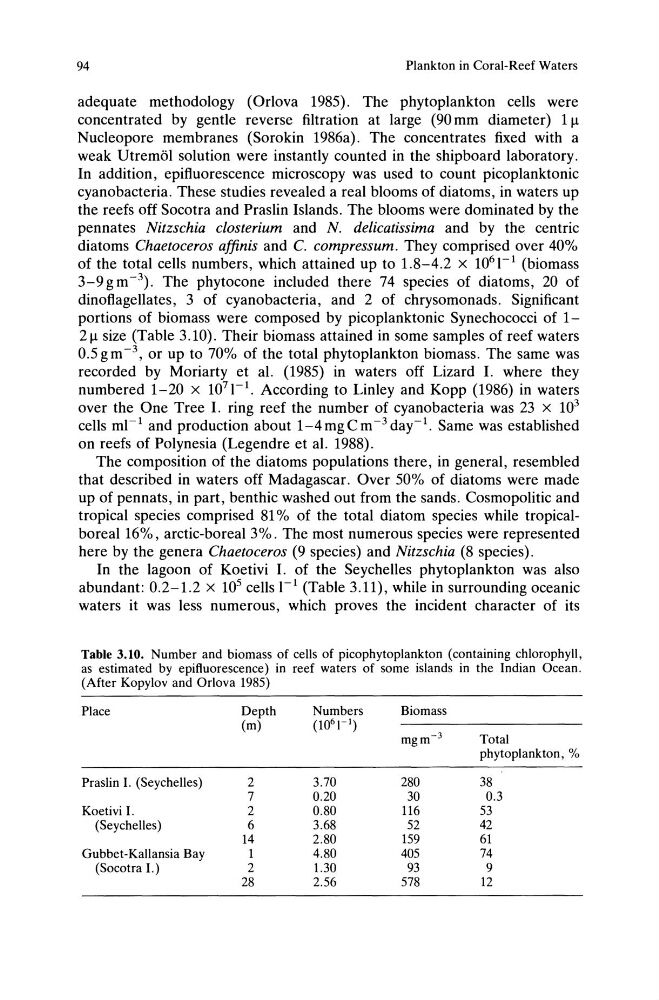
portions of biomass were composed by picoplanktonic Synechococci of 12 Jl size (Table 3.10). Their biomass attained in some samples of reef waters
0.5gm- 3 , or up to 70% of the total phytoplankton biomass. The same was
recorded by Moriarty et al. (1985) in waters off Lizard I. where they
numbered 1-20 X 10 7 1- 1 . According to Linley and Kopp (1986) in waters
over the One Tree I. ring reef the number of cyanobacteria was 23 x 10 3
cells ml- 1 and production about 1-4mgCm- 3 day-1. Same was established
on reefs of Polynesia (Legendre et al. 1988).
The composition of the diatoms populations there, in general, resembled
that described in waters off Madagascar. Over 50% of diatoms were made
up of pennats, in part, benthic washed out from the sands. Cosmopolitic and
tropical species comprised 81 % of the total diatom species while tropicalboreal 16%, arctic-boreal 3%. The most numerous species were represented
here by the genera Chaetoceros (9 species) and Nitzschia (8 species).
In the lagoon of Koetivi I. of the Seychelles phytoplankton was also
abundant: 0.2-1.2 x 10 5 cells 1- 1 (Table 3.11), while in surrounding oceanic
waters it was less numerous, which proves the incident character of its
Table 3.10. Number and biomass of cells of picophytoplankton (containing chlorophyll,
as estimated by epifluorescence) in reef waters of some islands in the Indian Ocean.
(After Kopylov and Orlova 1985)
Place
Depth
Numbers
Biomass
(m)
(10 6 1- 1 )
mgm- 3
Total
phytoplankton, %
Praslin I. (Seychelles)
2
3.70
280
38
7
0.20
30
0.3
Koetivi I.
2
0.80
116
53
(Seychelles)
6
3.68
52
42
14
2.80
159
61
Gubbet-Kallansia Bay
1
4.80
405
74
(Socotra I.)
2
1.30
93
9
28
2.56
578
12
Plankton in Coral-Reef Waters
adequate methodology (Orlova 1985). The phytoplankton cells were
concentrated by gentle reverse filtration at large (90mm diameter) 1 Jl
Nucleopore membranes (Sorokin 1986a). The concentrates fixed with a
weak Utremol solution were instantly counted in the shipboard laboratory.
In addition, epifluorescence microscopy was used to count picoplanktonic
cyanobacteria. These studies revealed a real blooms of diatoms, in waters up
the reefs off Socotra and Praslin Islands. The blooms were dominated by the
pennates Nitzschia closterium and N. delicatissima and by the centric
diatoms Chaetoceros affinis and C. compressum. They comprised over 40%
of the total cells numbers, which attained up to 1.8-4.2 X 10 6 1- 1 (biomass
3-9gm- 3 ). The phytocone included there 74 species of diatoms, 20 of
dinoflagellates, 3 of cyanobacteria, and 2 of chrysomonads. Significant
portions of biomass were composed by picoplanktonic Synechococci of 12 Jl size (Table 3.10). Their biomass attained in some samples of reef waters
0.5gm- 3 , or up to 70% of the total phytoplankton biomass. The same was
recorded by Moriarty et al. (1985) in waters off Lizard I. where they
numbered 1-20 X 10 7 1- 1 . According to Linley and Kopp (1986) in waters
over the One Tree I. ring reef the number of cyanobacteria was 23 x 10 3
cells ml- 1 and production about 1-4mgCm- 3 day-1. Same was established
on reefs of Polynesia (Legendre et al. 1988).
The composition of the diatoms populations there, in general, resembled
that described in waters off Madagascar. Over 50% of diatoms were made
up of pennats, in part, benthic washed out from the sands. Cosmopolitic and
tropical species comprised 81 % of the total diatom species while tropicalboreal 16%, arctic-boreal 3%. The most numerous species were represented
here by the genera Chaetoceros (9 species) and Nitzschia (8 species).
In the lagoon of Koetivi I. of the Seychelles phytoplankton was also
abundant: 0.2-1.2 x 10 5 cells 1- 1 (Table 3.11), while in surrounding oceanic
waters it was less numerous, which proves the incident character of its
Table 3.10. Number and biomass of cells of picophytoplankton (containing chlorophyll,
as estimated by epifluorescence) in reef waters of some islands in the Indian Ocean.
(After Kopylov and Orlova 1985)
Place
Depth
Numbers
Biomass
(m)
(10 6 1- 1 )
mgm- 3
Total
phytoplankton, %
Praslin I. (Seychelles)
2
3.70
280
38
7
0.20
30
0.3
Koetivi I.
2
0.80
116
53
(Seychelles)
6
3.68
52
42
14
2.80
159
61
Gubbet-Kallansia Bay
1
4.80
405
74
(Socotra I.)
2
1.30
93
9
28
2.56
578
12