

estuarine waters or intra-sediment pore waters, are
authigenic minerals, and those formed by alteration of
preexisting authigenic minerals or of sand grains are diagenetic minerals.
Dissolution of carbonates and precipitation of pyrite
are the main chemical process on and under beaches.
Dissolution of carbonates is a feature of chemical processes in estuaries (Abril et al., 2003). Under beaches,
with acidic groundwaters, carbonate shells (composed of
calcite, Mg calcite, or aragonite, or mixtures of these minerals) are corroded. They pass through various stages of
corrosion (from lustrous shell, to shells lacking luster, to
pitted shells) to ultimately dissolve away. The changing
chemistry of the phreatic zone and vadose zone during
high and low tides can result in the precipitation of minerals. In highly evaporative climates, with evaporation
effected by solar radiation and/or winds, the surface of
the beach wetted with saline pellicular water can evaporate
to precipitate halite which forms a surface crust,
termed salcrete (Yasso, 1966). Under a beach, particularly
in tropical estuaries, depending on ionic concentrations,
minerals such as aragonite, Mg calcite, and calcite may
precipitate interstitially and cement the sand to varying
degrees (cf., Bathurst, 1975), though carbonates can
also precipitate in beach sand of temperate climates
(Arrieta et al., 2011). In environments with alternating
pH and with an appropriate Fe content and Eh in the
groundwaters, Fe minerals can precipitate (Boyle et al.,
1977). Authigenic minerals in freshwater environments
in beaches under deltas and headwaters of estuaries
include iron minerals and carbonate minerals, while those
under beaches in marine salinities towards the ocean part
of the estuary can be carbonate minerals. Mineral precipitation is manifest in beach sediments as lithification, color
changes, mottling, or nodule development. Some of the
biogeochemistry of estuaries and their sediments are
described by Bianchi (2007).
Authigenic mineral precipitation can result from
organic matter decomposition (Berner, 1981), with the
mineral species related to sedimentary setting and location
in the estuary. The main minerals precipitated are carbonates, sulfides, phosphates, and amorphous silica (Suess,
1979). The precipitation of minerals in the beach sand
can result in the local development of diagenetic structures
such as color mottling due to pyrite or to iron oxides, thin
ferricrete sheets, ferricrete nodules, and carbonate
nodules.
Freshwater through-flow on a beach changes the groundwater salinity from the prevailing marine or brackish salinity
to lower salinity concentrations. This affects macrobiota
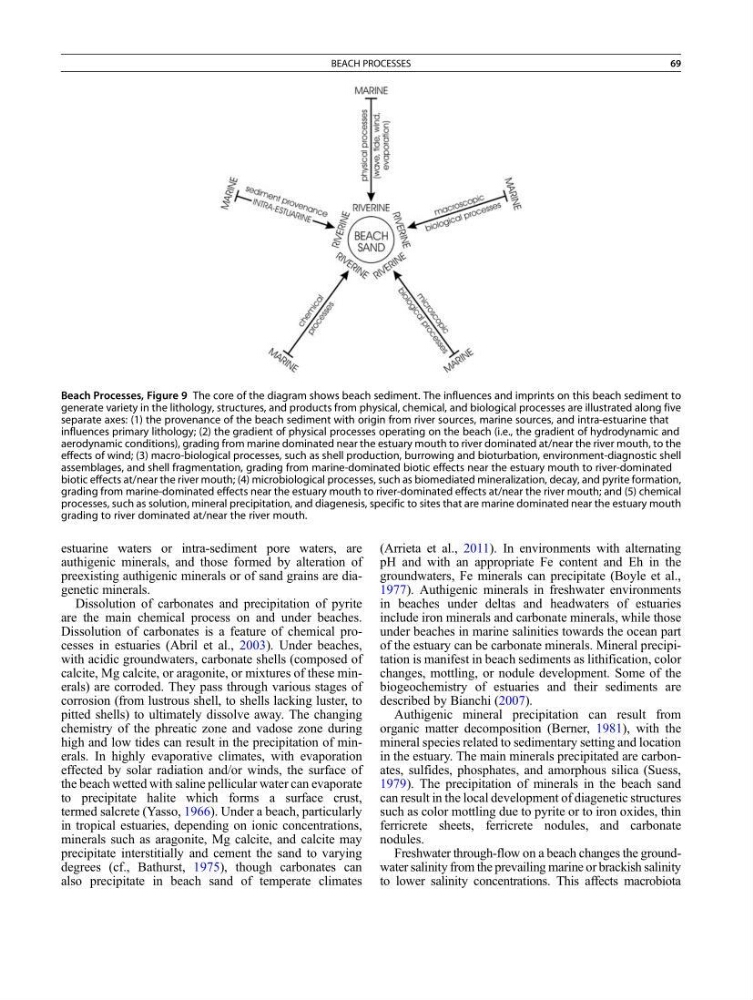
Beach Processes, Figure 9 The core of the diagram shows beach sediment. The influences and imprints on this beach sediment to
generate variety in the lithology, structures, and products from physical, chemical, and biological processes are illustrated along five
separate axes: (1) the provenance of the beach sediment with origin from river sources, marine sources, and intra-estuarine that
influences primary lithology; (2) the gradient of physical processes operating on the beach (i.e., the gradient of hydrodynamic and
aerodynamic conditions), grading from marine dominated near the estuary mouth to river dominated at/near the river mouth, to the
effects of wind; (3) macro-biological processes, such as shell production, burrowing and bioturbation, environment-diagnostic shell
assemblages, and shell fragmentation, grading from marine-dominated biotic effects near the estuary mouth to river-dominated
biotic effects at/near the river mouth; (4) microbiological processes, such as biomediated mineralization, decay, and pyrite formation,
grading from marine-dominated effects near the estuary mouth to river-dominated effects at/near the river mouth; and (5) chemical
processes, such as solution, mineral precipitation, and diagenesis, specific to sites that are marine dominated near the estuary mouth
grading to river dominated at/near the river mouth.
BEACH PROCESSES
69
authigenic minerals, and those formed by alteration of
preexisting authigenic minerals or of sand grains are diagenetic minerals.
Dissolution of carbonates and precipitation of pyrite
are the main chemical process on and under beaches.
Dissolution of carbonates is a feature of chemical processes in estuaries (Abril et al., 2003). Under beaches,
with acidic groundwaters, carbonate shells (composed of
calcite, Mg calcite, or aragonite, or mixtures of these minerals) are corroded. They pass through various stages of
corrosion (from lustrous shell, to shells lacking luster, to
pitted shells) to ultimately dissolve away. The changing
chemistry of the phreatic zone and vadose zone during
high and low tides can result in the precipitation of minerals. In highly evaporative climates, with evaporation
effected by solar radiation and/or winds, the surface of
the beach wetted with saline pellicular water can evaporate
to precipitate halite which forms a surface crust,
termed salcrete (Yasso, 1966). Under a beach, particularly
in tropical estuaries, depending on ionic concentrations,
minerals such as aragonite, Mg calcite, and calcite may
precipitate interstitially and cement the sand to varying
degrees (cf., Bathurst, 1975), though carbonates can
also precipitate in beach sand of temperate climates
(Arrieta et al., 2011). In environments with alternating
pH and with an appropriate Fe content and Eh in the
groundwaters, Fe minerals can precipitate (Boyle et al.,
1977). Authigenic minerals in freshwater environments
in beaches under deltas and headwaters of estuaries
include iron minerals and carbonate minerals, while those
under beaches in marine salinities towards the ocean part
of the estuary can be carbonate minerals. Mineral precipitation is manifest in beach sediments as lithification, color
changes, mottling, or nodule development. Some of the
biogeochemistry of estuaries and their sediments are
described by Bianchi (2007).
Authigenic mineral precipitation can result from
organic matter decomposition (Berner, 1981), with the
mineral species related to sedimentary setting and location
in the estuary. The main minerals precipitated are carbonates, sulfides, phosphates, and amorphous silica (Suess,
1979). The precipitation of minerals in the beach sand
can result in the local development of diagenetic structures
such as color mottling due to pyrite or to iron oxides, thin
ferricrete sheets, ferricrete nodules, and carbonate
nodules.
Freshwater through-flow on a beach changes the groundwater salinity from the prevailing marine or brackish salinity
to lower salinity concentrations. This affects macrobiota
Beach Processes, Figure 9 The core of the diagram shows beach sediment. The influences and imprints on this beach sediment to
generate variety in the lithology, structures, and products from physical, chemical, and biological processes are illustrated along five
separate axes: (1) the provenance of the beach sediment with origin from river sources, marine sources, and intra-estuarine that
influences primary lithology; (2) the gradient of physical processes operating on the beach (i.e., the gradient of hydrodynamic and
aerodynamic conditions), grading from marine dominated near the estuary mouth to river dominated at/near the river mouth, to the
effects of wind; (3) macro-biological processes, such as shell production, burrowing and bioturbation, environment-diagnostic shell
assemblages, and shell fragmentation, grading from marine-dominated biotic effects near the estuary mouth to river-dominated
biotic effects at/near the river mouth; (4) microbiological processes, such as biomediated mineralization, decay, and pyrite formation,
grading from marine-dominated effects near the estuary mouth to river-dominated effects at/near the river mouth; and (5) chemical
processes, such as solution, mineral precipitation, and diagenesis, specific to sites that are marine dominated near the estuary mouth
grading to river dominated at/near the river mouth.
BEACH PROCESSES
69