

assemblages that are infaunal under the beach, the
composition of microbiota, and some of the geochemical
interactions. As described earlier, freshwater through-flow
can occur along a broad interface or can be channelized.
If freshwater seepage is in a broad front, its chemical effects
will be along the interface of beach and upland, and will be
shore-parallel. If channelized, the effects will be in specific
locations along the beach. If the freshwater derives from
upslope peat beds (as described earlier), the seepage will
be more acidic than prevailing beach groundwaters and will
result in dissolution of the more susceptible shells, alteration
of macrofauna composition, and alteration of microbiota
composition. These alteration effects will be along a broad
front along the upper part of the beach or, if seepage is
channelized, in local patches.
Freshwater may also flow over the beach and, by this
process, the freshwater affects the hydrochemistry and
geochemistry at the sites of entry onto the beach and sites
of infiltration into the beach sand. Under the beach,
organic matter can vary in content from scattered detritus
to peat beds but, under aerial conditions and/or throughflow of freshwater, can oxidize. In time, in such situations,
organic matter in upper parts of the beach is depleted by
oxidation.
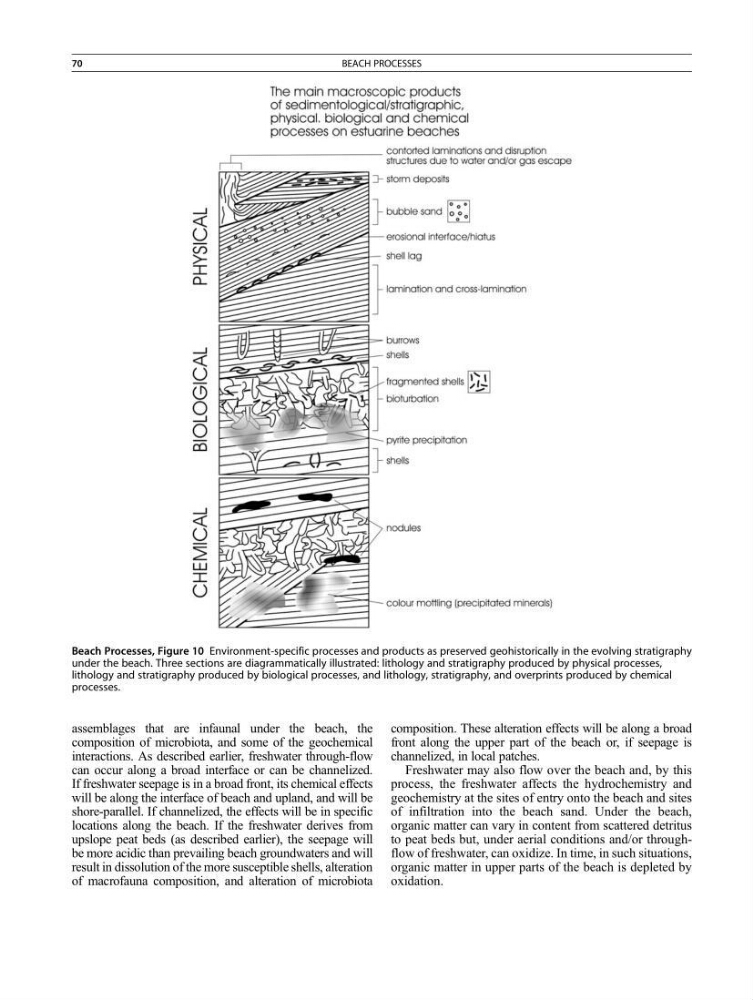
Beach Processes, Figure 10 Environment-specific processes and products as preserved geohistorically in the evolving stratigraphy
under the beach. Three sections are diagrammatically illustrated: lithology and stratigraphy produced by physical processes,
lithology and stratigraphy produced by biological processes, and lithology, stratigraphy, and overprints produced by chemical
processes.
70
BEACH PROCESSES
composition of microbiota, and some of the geochemical
interactions. As described earlier, freshwater through-flow
can occur along a broad interface or can be channelized.
If freshwater seepage is in a broad front, its chemical effects
will be along the interface of beach and upland, and will be
shore-parallel. If channelized, the effects will be in specific
locations along the beach. If the freshwater derives from
upslope peat beds (as described earlier), the seepage will
be more acidic than prevailing beach groundwaters and will
result in dissolution of the more susceptible shells, alteration
of macrofauna composition, and alteration of microbiota
composition. These alteration effects will be along a broad
front along the upper part of the beach or, if seepage is
channelized, in local patches.
Freshwater may also flow over the beach and, by this
process, the freshwater affects the hydrochemistry and
geochemistry at the sites of entry onto the beach and sites
of infiltration into the beach sand. Under the beach,
organic matter can vary in content from scattered detritus
to peat beds but, under aerial conditions and/or throughflow of freshwater, can oxidize. In time, in such situations,
organic matter in upper parts of the beach is depleted by
oxidation.
Beach Processes, Figure 10 Environment-specific processes and products as preserved geohistorically in the evolving stratigraphy
under the beach. Three sections are diagrammatically illustrated: lithology and stratigraphy produced by physical processes,
lithology and stratigraphy produced by biological processes, and lithology, stratigraphy, and overprints produced by chemical
processes.
70
BEACH PROCESSES