

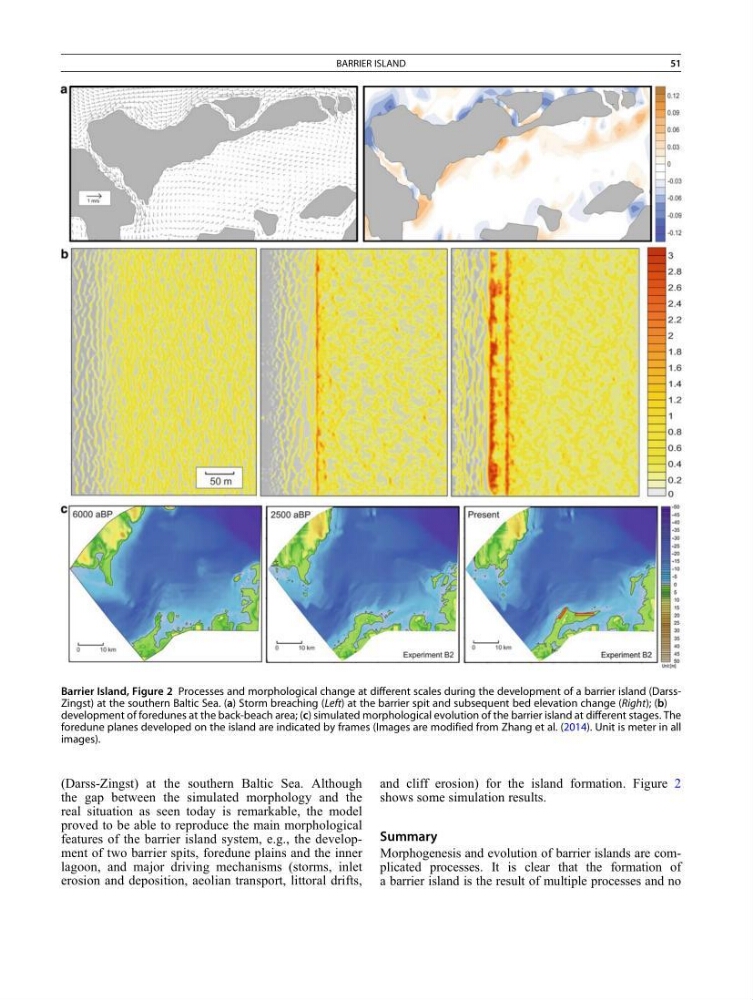
(Darss-Zingst) at the southern Baltic Sea. Although
the gap between the simulated morphology and the
real situation as seen today is remarkable, the model
proved to be able to reproduce the main morphological
features of the barrier island system, e.g., the development of two barrier spits, foredune plains and the inner
lagoon, and major driving mechanisms (storms, inlet
erosion and deposition, aeolian transport, littoral drifts,
and cliff erosion) for the island formation. Figure 2
shows some simulation results.
Summary
Morphogenesis and evolution of barrier islands are complicated processes. It is clear that the formation of
a barrier island is the result of multiple processes and no
Barrier Island, Figure 2 Processes and morphological change at different scales during the development of a barrier island (DarssZingst) at the southern Baltic Sea. (a) Storm breaching (Left) at the barrier spit and subsequent bed elevation change (Right); (b)
development of foredunes at the back-beach area; (c) simulated morphological evolution of the barrier island at different stages. The
foredune planes developed on the island are indicated by frames (Images are modified from Zhang et al. (2014). Unit is meter in all
images).
BARRIER ISLAND
51
the gap between the simulated morphology and the
real situation as seen today is remarkable, the model
proved to be able to reproduce the main morphological
features of the barrier island system, e.g., the development of two barrier spits, foredune plains and the inner
lagoon, and major driving mechanisms (storms, inlet
erosion and deposition, aeolian transport, littoral drifts,
and cliff erosion) for the island formation. Figure 2
shows some simulation results.
Summary
Morphogenesis and evolution of barrier islands are complicated processes. It is clear that the formation of
a barrier island is the result of multiple processes and no
Barrier Island, Figure 2 Processes and morphological change at different scales during the development of a barrier island (DarssZingst) at the southern Baltic Sea. (a) Storm breaching (Left) at the barrier spit and subsequent bed elevation change (Right); (b)
development of foredunes at the back-beach area; (c) simulated morphological evolution of the barrier island at different stages. The
foredune planes developed on the island are indicated by frames (Images are modified from Zhang et al. (2014). Unit is meter in all
images).
BARRIER ISLAND
51