

accompanied by strong tidal mixing), there is sufficient
energy to mix the different layers in the water column.
Turbulence completely breaks down the vertical salinity
stratification so that the water column becomes vertically
homogeneous (Dyer, 1997).
Hansen and Rattray (1966) generated a “stratification
diagram” to classify the nature of mixing in estuaries and
the sensitivity of the stratification to changing conditions
(see also Prandle, 2009). The physical conditions in this
type of estuary can cause lateral variations in salinity and
current velocity with a well-developed horizontal circulation, or, if the lateral mixing is also intense, the estuary can
become sectionally homogeneous. Pritchard (1955) and
Cameron and Pritchard (1963) subdivided well-mixed
estuaries into laterally inhomogeneous systems (when
the estuary is sufficiently wide, the Coriolis and centrifugal forces cause a horizontal separation of the flow) and
sectionally homogeneous systems (when the width is
smaller and lateral shear may be sufficiently intense to
create laterally homogeneous conditions).
Bibliography
Cameron, W. M., and Pritchard, D. W., 1963. Estuaries. In Hill,
M. N. (ed.), The Sea. New York: Wiley, Vol. 2, pp. 306–324.
Dyer, K. R., 1997. Estuaries: A Physical Introduction, 2nd edn.
New York: Wiley.
Hansen, D. V., and Rattray, M., 1966. New dimensions in estuary
classification. Limnology and Oceanography, 11, 319–325.
Prandle, D., 2009. Estuaries: Dynamics, Mixing, Sedimentation and
Morphology. Cambridge: Cambridge University Press.
Pritchard, D. W., 1955. Estuarine circulation patterns. Proceedings
of the American Society of Civil Engineers, 81(717), 1–11.
Cross-references
Estuarine Circulation
WETLANDS
Jorge Manuel López-Calderón and Rafael RiosmenaRodríguez
Programa de Investigación en Botãnica Marina,
Departamento Académico de Biología Marina,
Universidad Autónoma de Baja California Sur, La Paz,
Baja California Sur, Mexico
Synonyms
Bog; Fen; Mangal; Marsh; Mire; Morass; Peatland; Quag;
Swamp
Definition
Wetlands are land extensions that are saturated or covered
with fresh, marine, brackish, or brine water the entire year
or part of the year. These land extensions occur in either
the coastal zone or inland, being characterized by a high
degree of biological interactions dependent on the water
sources and high productivity.
There are several definitions for the term wetland.
According to the Ramsar Convention on Wetlands of
International Importance (www.ramsar.org), wetlands are
“areas of marsh, fen, peatland, or water whether natural
or artificial, permanent or temporary, with water that is
static or flowing, fresh, brackish or salt, including areas
of marine water the depth of which at low tide does not
exceed six meters.” According to the US Environmental
Protection Agency (water.epa.gov), the Clean Water Act
defines the term wetland as “those areas that are inundated
or saturated by surface or groundwater at a frequency and
duration sufficient to support, and that under normal circumstances do support, a prevalence of vegetation typically adapted for life in saturated soil conditions.
Wetlands generally include swamps, marshes, bogs and
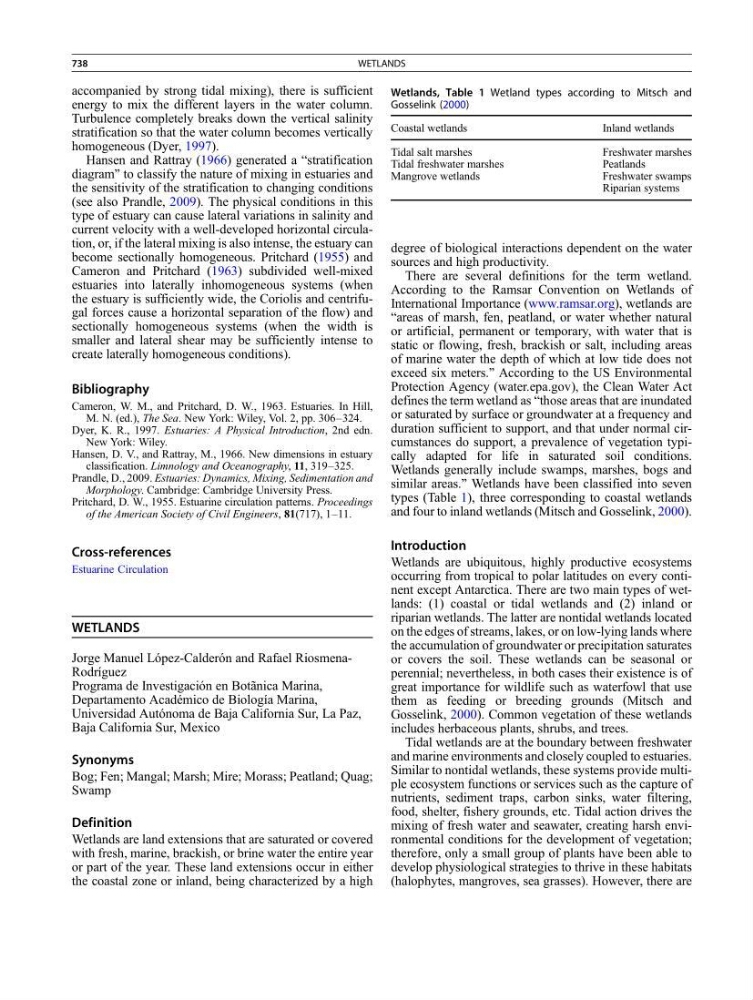
similar areas.” Wetlands have been classified into seven
types (Table 1), three corresponding to coastal wetlands
and four to inland wetlands (Mitsch and Gosselink, 2000).
Introduction
Wetlands are ubiquitous, highly productive ecosystems
occurring from tropical to polar latitudes on every continent except Antarctica. There are two main types of wetlands: (1) coastal or tidal wetlands and (2) inland or
riparian wetlands. The latter are nontidal wetlands located
on the edges of streams, lakes, or on low-lying lands where
the accumulation of groundwater or precipitation saturates
or covers the soil. These wetlands can be seasonal or
perennial; nevertheless, in both cases their existence is of
great importance for wildlife such as waterfowl that use
them as feeding or breeding grounds (Mitsch and
Gosselink, 2000). Common vegetation of these wetlands
includes herbaceous plants, shrubs, and trees.
Tidal wetlands are at the boundary between freshwater
and marine environments and closely coupled to estuaries.
Similar to nontidal wetlands, these systems provide multiple ecosystem functions or services such as the capture of
nutrients, sediment traps, carbon sinks, water filtering,
food, shelter, fishery grounds, etc. Tidal action drives the
mixing of fresh water and seawater, creating harsh environmental conditions for the development of vegetation;
therefore, only a small group of plants have been able to
develop physiological strategies to thrive in these habitats
(halophytes, mangroves, sea grasses). However, there are
Wetlands, Table 1 Wetland types according to Mitsch and
Gosselink (2000)
Coastal wetlands
Inland wetlands
Tidal salt marshes
Freshwater marshes
Tidal freshwater marshes
Peatlands
Mangrove wetlands
Freshwater swamps
Riparian systems
738
WETLANDS