

of water. How far down light penetrates through water
depends on many factors that change the light-attenuating
properties of the water column. Water clarity is reduced
by the presence of suspended and colloidal materials such
as clay, silt, finely divided organic and inorganic matter,
and plankton or other microscopic organisms.
Description
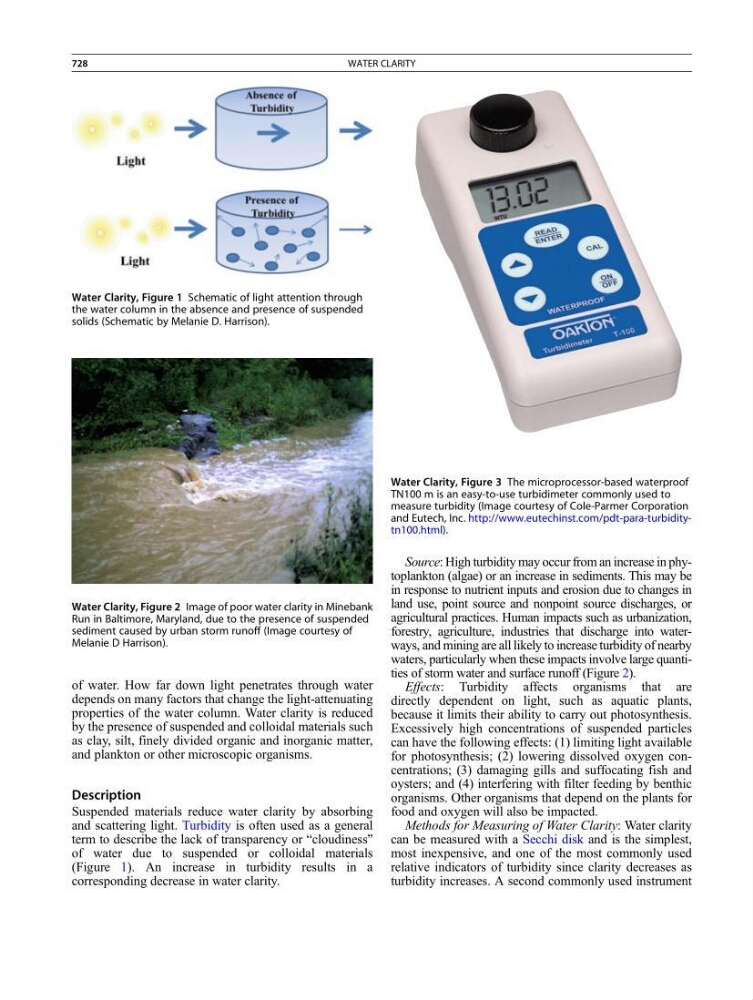
Suspended materials reduce water clarity by absorbing
and scattering light. Turbidity is often used as a general
term to describe the lack of transparency or “cloudiness”
of water due to suspended or colloidal materials
(Figure 1). An increase in turbidity results in a
corresponding decrease in water clarity.
Source: High turbidity may occur from an increase in phytoplankton (algae) or an increase in sediments. This may be
in response to nutrient inputs and erosion due to changes in
land use, point source and nonpoint source discharges, or
agricultural practices. Human impacts such as urbanization,
forestry, agriculture, industries that discharge into waterways, and mining are all likely to increase turbidity of nearby
waters, particularly when these impacts involve large quantities of storm water and surface runoff (Figure 2).
Effects: Turbidity affects organisms that are
directly dependent on light, such as aquatic plants,
because it limits their ability to carry out photosynthesis.
Excessively high concentrations of suspended particles
can have the following effects: (1) limiting light available
for photosynthesis; (2) lowering dissolved oxygen concentrations; (3) damaging gills and suffocating fish and
oysters; and (4) interfering with filter feeding by benthic
organisms. Other organisms that depend on the plants for
food and oxygen will also be impacted.
Methods for Measuring of Water Clarity: Water clarity
can be measured with a Secchi disk and is the simplest,
most inexpensive, and one of the most commonly used
relative indicators of turbidity since clarity decreases as
turbidity increases. A second commonly used instrument
Water Clarity, Figure 1 Schematic of light attention through
the water column in the absence and presence of suspended
solids (Schematic by Melanie D. Harrison).
Water Clarity, Figure 2 Image of poor water clarity in Minebank
Run in Baltimore, Maryland, due to the presence of suspended
sediment caused by urban storm runoff (Image courtesy of
Melanie D Harrison).
Water Clarity, Figure 3 The microprocessor-based waterproof
TN100 m is an easy-to-use turbidimeter commonly used to
measure turbidity (Image courtesy of Cole-Parmer Corporation
and Eutech, Inc. http://www.eutechinst.com/pdt-para-turbiditytn100.html).
728
WATER CLARITY