

Cross-references
Algal Blooms
Anthropogenic Impacts
Cyanobacteria
Density Stratification
Dissolved Oxygen
Estuarine Circulation
Eutrophication
Flushing Time
Macroalgae
Macroalgal Blooms
Nutrients
Oxygen Depletion
Phytoplankton
Phytoplankton Blooms
Residence Time
TRACE METALS IN ESTUARIES
Peddrick Weis
Department of Radiology, Rutgers – New Jersey Medical
School, Newark, NJ, USA
Synonyms
Heavy metals
Definition
A metal is defined as an element that can form a salt by
replacing the hydrogen (H
+ ) in an acid and form a base
when combined with the hydroxyl (ÀOH
À ) radical.
Description
A few metals rank among the most common elements
on earth (Fe, Al, Ca, Mg), but most are less or much
less abundant. These can be considered trace metals.
Since these comprise most of the elements in the periodic
table, we should define those of concern in estuaries as
those that are deposited from natural and anthropogenic
sources upriver. Typically, those of interest are of anthropogenic origin, since they tend to be more evident downstream of industrial outfalls or mine drainages.
Trace metals can be either essential for, or irrelevant to,
living organisms (i.e., nonessential). In regard to living
organisms, trace metals are typically defined as those that
are essential (Murray et al., 2009). However, in estuaries
both essential and nonessential metals should be included
in the definition since, in either case, they can be toxic in
minute quantities – nanomolar concentrations or less,
while those that are essential (micronutrients) are toxic
only when they substantially exceed metabolic needs –
typically, micromolar concentrations. These metals are
found in estuarine sediments, biota, and (to a lesser extent)
in the water column. Of these metals, two deserve special
attention. While most trace metals are found in living tissues (i.e., they bioaccumulate), Hg and As* are capable
of biomagnification. This latter term means that they
increase, typically by an order of magnitude, with each
trophic level in the food web. This occurs because these
metals are turned into organometals (carbon-containing
compounds) as a result of metabolic processes. Because
of the organic part of the molecule, an organometal can
passively cross the lipid bilayer that all cell membranes
are made of, rather than requiring an active metabolic process for uptake; they then are retained rather than excreted
and are passed on to the next trophic level.
Organomercury compounds are particularly toxic. Some
organoarsenicals are toxic, while others are relatively
innocuous – e.g., the metabolism of inorganic As to
trimethylarsine renders it less toxic (Reimer et al., 2010).
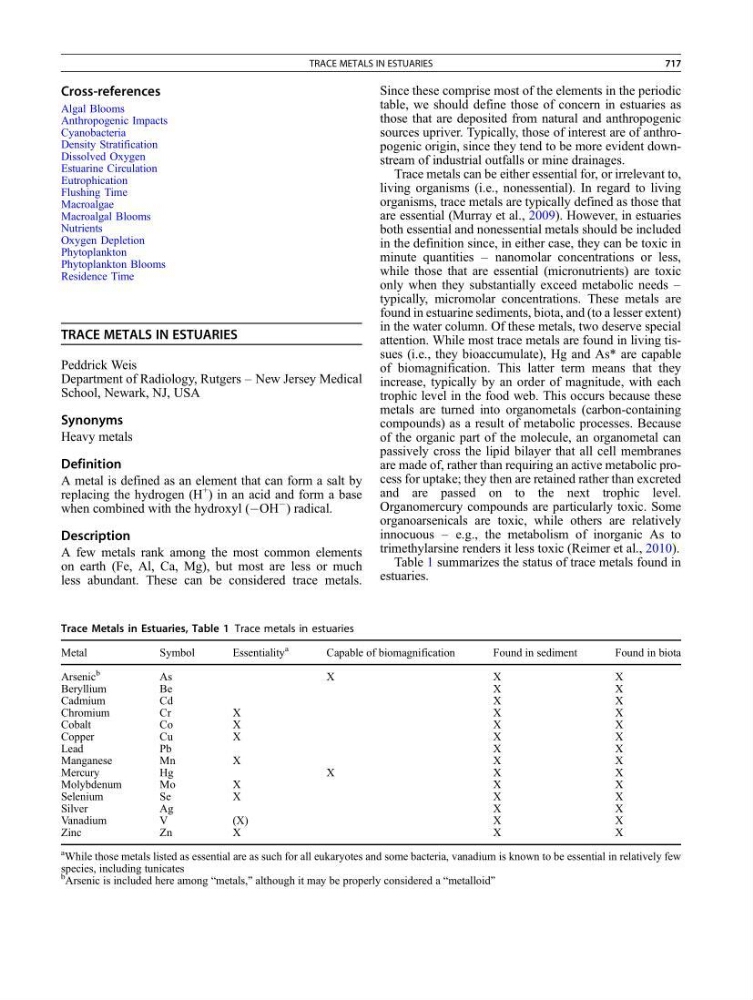
Table 1 summarizes the status of trace metals found in
estuaries.
Trace Metals in Estuaries, Table 1 Trace metals in estuaries
Metal
Symbol
Essentiality
a
Capable of biomagnification
Found in sediment
Found in biota
Arsenic
b
As
X
X
X
Beryllium
Be
X
X
Cadmium
Cd
X
X
Chromium
Cr
X
X
X
Cobalt
Co
X
X
X
Copper
Cu
X
X
X
Lead
Pb
X
X
Manganese
Mn
X
X
X
Mercury
Hg
X
X
X
Molybdenum
Mo
X
X
X
Selenium
Se
X
X
X
Silver
Ag
X
X
Vanadium
V
(X)
X
X
Zinc
Zn
X
X
X
a While those metals listed as essential are as such for all eukaryotes and some bacteria, vanadium is known to be essential in relatively few
species, including tunicates
b
Arsenic is included here among “metals,” although it may be properly considered a “metalloid”
TRACE METALS IN ESTUARIES
717