

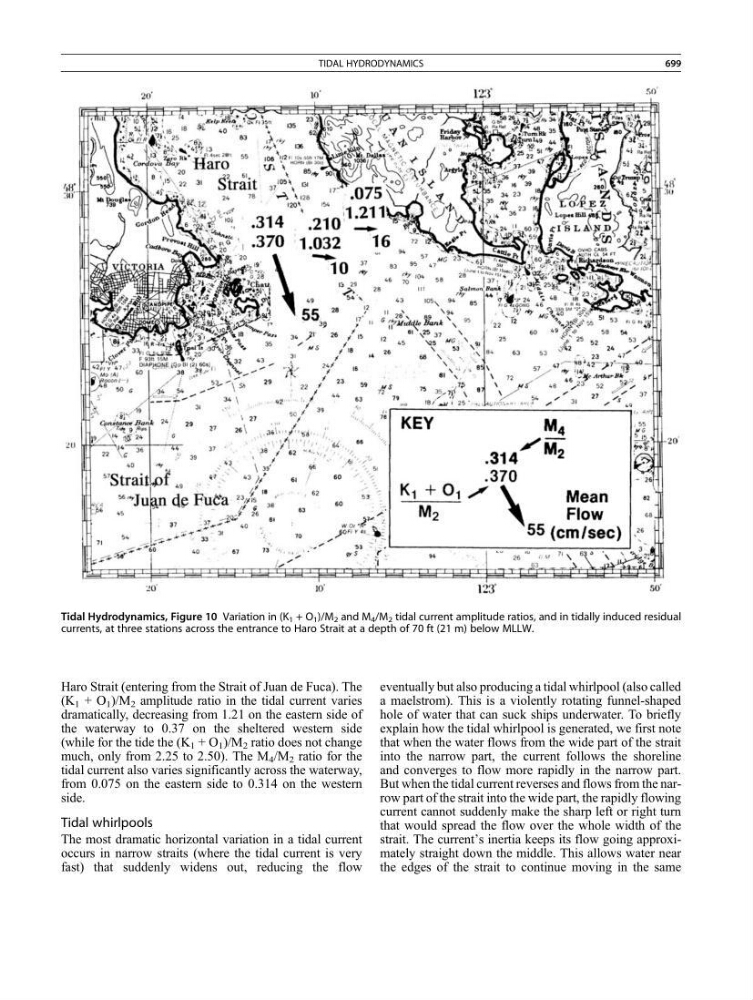
Haro Strait (entering from the Strait of Juan de Fuca). The
(K 1 + O 1 )/M 2 amplitude ratio in the tidal current varies
dramatically, decreasing from 1.21 on the eastern side of
the waterway to 0.37 on the sheltered western side
(while for the tide the (K 1 + O 1 )/M 2 ratio does not change
much, only from 2.25 to 2.50). The M 4 /M 2 ratio for the
tidal current also varies significantly across the waterway,
from 0.075 on the eastern side to 0.314 on the western
side.
Tidal whirlpools
The most dramatic horizontal variation in a tidal current
occurs in narrow straits (where the tidal current is very
fast) that suddenly widens out, reducing the flow
eventually but also producing a tidal whirlpool (also called
a maelstrom). This is a violently rotating funnel-shaped
hole of water that can suck ships underwater. To briefly
explain how the tidal whirlpool is generated, we first note
that when the water flows from the wide part of the strait
into the narrow part, the current follows the shoreline
and converges to flow more rapidly in the narrow part.
But when the tidal current reverses and flows from the narrow part of the strait into the wide part, the rapidly flowing
current cannot suddenly make the sharp left or right turn
that would spread the flow over the whole width of the
strait. The current’s inertia keeps its flow going approximately straight down the middle. This allows water near
the edges of the strait to continue moving in the same
Tidal Hydrodynamics, Figure 10 Variation in (K 1 + O 1 )/M 2 and M 4 /M 2 tidal current amplitude ratios, and in tidally induced residual
currents, at three stations across the entrance to Haro Strait at a depth of 70 ft (21 m) below MLLW.
TIDAL HYDRODYNAMICS
699