

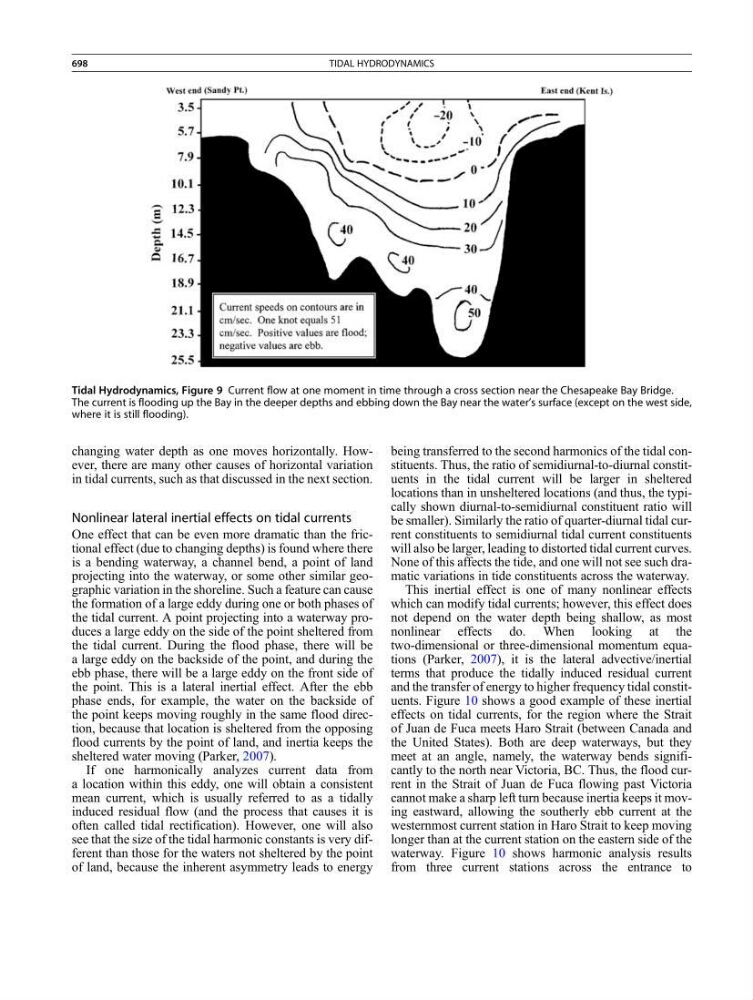
changing water depth as one moves horizontally. However, there are many other causes of horizontal variation
in tidal currents, such as that discussed in the next section.
Nonlinear lateral inertial effects on tidal currents
One effect that can be even more dramatic than the frictional effect (due to changing depths) is found where there
is a bending waterway, a channel bend, a point of land
projecting into the waterway, or some other similar geographic variation in the shoreline. Such a feature can cause
the formation of a large eddy during one or both phases of
the tidal current. A point projecting into a waterway produces a large eddy on the side of the point sheltered from
the tidal current. During the flood phase, there will be
a large eddy on the backside of the point, and during the
ebb phase, there will be a large eddy on the front side of
the point. This is a lateral inertial effect. After the ebb
phase ends, for example, the water on the backside of
the point keeps moving roughly in the same flood direction, because that location is sheltered from the opposing
flood currents by the point of land, and inertia keeps the
sheltered water moving (Parker, 2007).
If one harmonically analyzes current data from
a location within this eddy, one will obtain a consistent
mean current, which is usually referred to as a tidally
induced residual flow (and the process that causes it is
often called tidal rectification). However, one will also
see that the size of the tidal harmonic constants is very different than those for the waters not sheltered by the point
of land, because the inherent asymmetry leads to energy
being transferred to the second harmonics of the tidal constituents. Thus, the ratio of semidiurnal-to-diurnal constituents in the tidal current will be larger in sheltered
locations than in unsheltered locations (and thus, the typically shown diurnal-to-semidiurnal constituent ratio will
be smaller). Similarly the ratio of quarter-diurnal tidal current constituents to semidiurnal tidal current constituents
will also be larger, leading to distorted tidal current curves.
None of this affects the tide, and one will not see such dramatic variations in tide constituents across the waterway.
This inertial effect is one of many nonlinear effects
which can modify tidal currents; however, this effect does
not depend on the water depth being shallow, as most
nonlinear effects do. When looking at the
two-dimensional or three-dimensional momentum equations (Parker, 2007), it is the lateral advective/inertial
terms that produce the tidally induced residual current
and the transfer of energy to higher frequency tidal constituents. Figure 10 shows a good example of these inertial
effects on tidal currents, for the region where the Strait
of Juan de Fuca meets Haro Strait (between Canada and
the United States). Both are deep waterways, but they
meet at an angle, namely, the waterway bends significantly to the north near Victoria, BC. Thus, the flood current in the Strait of Juan de Fuca flowing past Victoria
cannot make a sharp left turn because inertia keeps it moving eastward, allowing the southerly ebb current at the
westernmost current station in Haro Strait to keep moving
longer than at the current station on the eastern side of the
waterway. Figure 10 shows harmonic analysis results
from three current stations across the entrance to
Tidal Hydrodynamics, Figure 9 Current flow at one moment in time through a cross section near the Chesapeake Bay Bridge.
The current is flooding up the Bay in the deeper depths and ebbing down the Bay near the water’s surface (except on the west side,
where it is still flooding).
698
TIDAL HYDRODYNAMICS