

When the water in the bay is forced to move up and down
by the tide at the entrance, it will freely oscillate (slosh up
and down and back and forth) with a natural period that
depends directly on the bay’s length and inversely on the
square root of its depth, namely, T ¼ l/(gD)
½ . If the basin
has the right combination of length and depth so that the
natural period is exactly the same as the tidal period, then
the oscillation inside the bay will be synchronized with the
oscillation at the entrance due to the ocean tide. In other
words, the next ocean tide will be raising the water level
in the bay at the same time that it would already be rising
due to its natural oscillation (stimulated by the previous
ocean tide wave), so that both are working together, thus
making the tide range inside higher. (In the real world,
friction keeps these resonating oscillations from being
infinitely large, by taking away some of the energy.)
In the above discussion, bottom friction was considered
minimal because of deep water, but bottom friction greatly
affects all hydrodynamics and is especially important in
shallow waters. Because of bottom friction, the tide wave
in real estuaries actually falls in between the two extremes
of the pure progressive wave and pure standing wave
described above. This is because friction reduces the
amplitude of the tide wave as it travels. Thus, the reflected
wave will always be smaller than the incoming wave,
especially near the bay entrance (since the reflected wave
has traveled longer to get all the way back to the entrance),
and the combination of these two frictionally damped progressive waves will not be a pure standing wave. There
will be no point of zero tidal range (no node), but only
an area of minimum tidal range (a quasinode). There will
be some progression of high waters and low waters up
the bay, but not as quickly as a pure progressive wave.
This progression will be faster near the entrance and
slowest near the head of the bay. Maximum flood or ebb
currents will not occur exactly halfway between high
water and low water. A basin one fourth of a wavelength
long will still produce the largest possible tidal range at
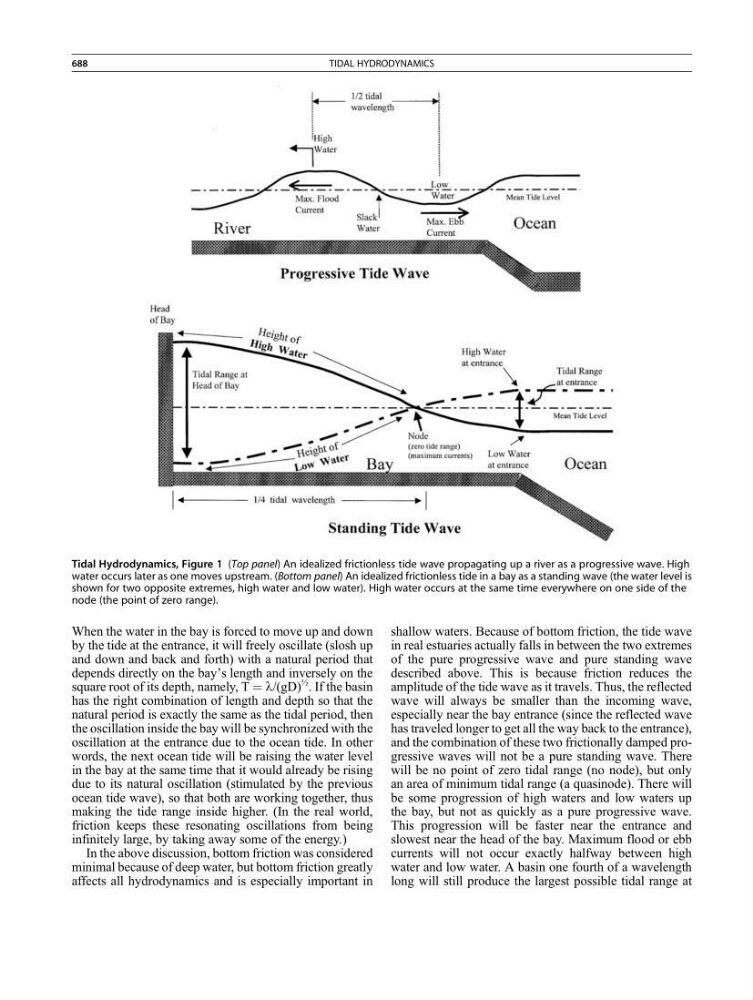
Tidal Hydrodynamics, Figure 1 (Top panel) An idealized frictionless tide wave propagating up a river as a progressive wave. High
water occurs later as one moves upstream. (Bottom panel) An idealized frictionless tide in a bay as a standing wave (the water level is
shown for two opposite extremes, high water and low water). High water occurs at the same time everywhere on one side of the
node (the point of zero range).
688
TIDAL HYDRODYNAMICS