

determine the extent that fluvial sediment will contribute
to the filling of an estuarine basin. It will also have
a particular effect on the sediments and stratigraphy of
facies that have become emergent (shoaled) and inhabited
by tidal and supratidal vegetation. The shoaled stratigraphy of estuaries in tropical humid climates, for instance,
may be capped by mangrove-vegetated mud, or at least
have a heavy imprint of vegetation bioturbation in tidal/
supratidal environments, and also contain a rich diversity
of shell benthos in lower tidal and shallow subtidal environments. The shoaled stratigraphy of estuaries in temperate humid climates or tropical humid climates may be
capped by peat, or by sand or mud, with a heavy imprint
of vegetation bioturbation in tidal/supratidal environments, and contain a relatively depauperate diversity of
shell benthos in lower tidal and shallow subtidal environments. The stratigraphy of estuaries in drier climates may
have less peripheral vegetation and tend to preserve sedimentary lamination. Also, if calcareous algae are present
in estuaries of drier climates, carbonate mud may become
a component of the lithologic suite.
Another major factor in determining the lithology, the
small-scale stratigraphy, and the large-scale stratigraphy
of estuaries is the coastal hydrodynamic setting of an estuary and the intra-estuarine hydrodynamics, i.e., whether
the estuary is river-dominated, tide-dominated, or
set along a wave-dominated coast. Internal to an estuary,
the hydrodynamics determined by how far tides penetrate
into the estuary, and the wind patterns and fetch particularly influence the array of estuarine facies that are
developed.
For incised valley systems, with an up-valley river
source, the stratigraphy is longitudinally graded because
of down-valley facies of estuaries, and this will be
a major factor in the development of the stratigraphic
architecture of an estuary. The nuances of ocean-side
facies development in the down-valley facies transition
will be determined by whether the oceanographic setting
is wave-dominated, tide-dominated, or mixed wave- and
tide-influenced. In wave-dominated environments, the
ocean-side environments will often develop a barrier,
which under strong wind conditions or coastal retreat conditions may transgress over the estuarine deposits
(Semeniuk 1985b). The geomorphic perforations in the
barrier are sites of flood-tidal deltas, with their specific
stratigraphic geometry and lithologic signature. During
storms, the barrier may be breached or overtopped to form
washover sediment fans or lobes that encroach into the
estuary prograding over deeper water lithofacies. In tidedominated environments, the ocean-side facies will often
develop tidally oriented shoaling sand bars. But while
there may be a recurring overall pattern to facies/stratigraphic architecture longitudinally along the whole of
estuary in both situations, the details of lithology in sitespecific environments are determined or influenced by
the local effects of climate and by the biodiversity and
abundance of the biota.
Outside of incised valley systems, the stratigraphy of
estuaries will be determined by the complexity of
the array and mosaics of environments within the estuary
as a consequence, in part, of the type of estuary,
e.g., shore-parallel estuarine lagoon, digitate/palmate
estuarine lagoon, meandering estuary on a coastal plain,
or compound estuary. The sedimentary facies in each of
these estuarine types will be determined by different
types of intra-estuarine processes such as wind-wave
development in relation to fetch, the depth of water, the
extent of shoaling, climate influences, and biota. These
types of estuaries provide the largest range of variability
of stratigraphic fills and architectural style of stratigraphic fills.
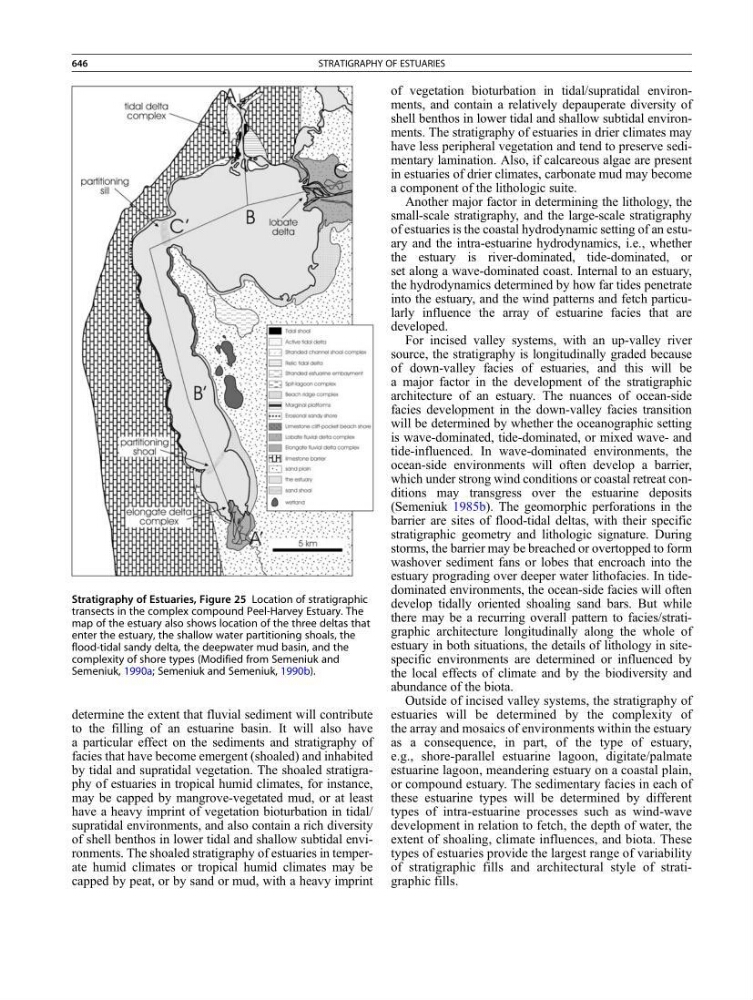
Stratigraphy of Estuaries, Figure 25 Location of stratigraphic
transects in the complex compound Peel-Harvey Estuary. The
map of the estuary also shows location of the three deltas that
enter the estuary, the shallow water partitioning shoals, the
flood-tidal sandy delta, the deepwater mud basin, and the
complexity of shore types (Modified from Semeniuk and
Semeniuk, 1990a; Semeniuk and Semeniuk, 1990b).
646
STRATIGRAPHY OF ESTUARIES