

calcareous algae are present in estuaries of drier climates,
carbonate mud may become a dominant or contributing
component of the lithologic suite.
Large-scale whole-of-estuary stratigraphy
Large-scale stratigraphic accretion within an estuary is
determined by the volume of sediment input. Using valley
tracts (as the receiving basin reservoir) as examples for
estuarine sedimentary fill, three types of sedimentary/
stratigraphic sequences can be identified: (1) largely
unfilled valley tracts and basins (wherein sedimentary
sheets and veneers occur), (2) partly filled valley tracts
and basins, and (3) fully filled valley tracts and basins.
The most significantly developed stratigraphic sequences
are developed in those estuaries that have large volumes
of sediment delivered by fluvial and marine sources and
a significant intra-estuarine sediment contribution. These
comprise the partly filled and wholly filled valley tracts
and basins.
Climate setting of the river drainage basin determines to
a large extent the amount of weathering and erosion of
source materials for the rivers and, hence, the volume
and types of sediment and particle sizes that may be delivered to the estuary. Estuaries that have low influx of riverine sediment will be sedimentologically depauperate, and
here the estuaries may consist of a rock-floored and rockwalled basins or may have only a veneer of modern sediment on the postglacial unconformity. Where there is little
sediment delivery from marine environments, then,
equally, the marine part of the estuary will also be sediment depauperate. In the sediment veneers, facies changes
will occur reflecting the environments from river to sea,
and the sediments of such estuaries will consist of a thin
sheet of riverine sediment, grading to sediment with an
estuarine signature, to that of marine sediment in a riverto-sea transect.
The stratigraphy of fully shoaled or nearly filled estuarine basin sequences has a common pattern: a pre-estuarine
stratigraphy representing Pleistocene deposits, palaeosols,
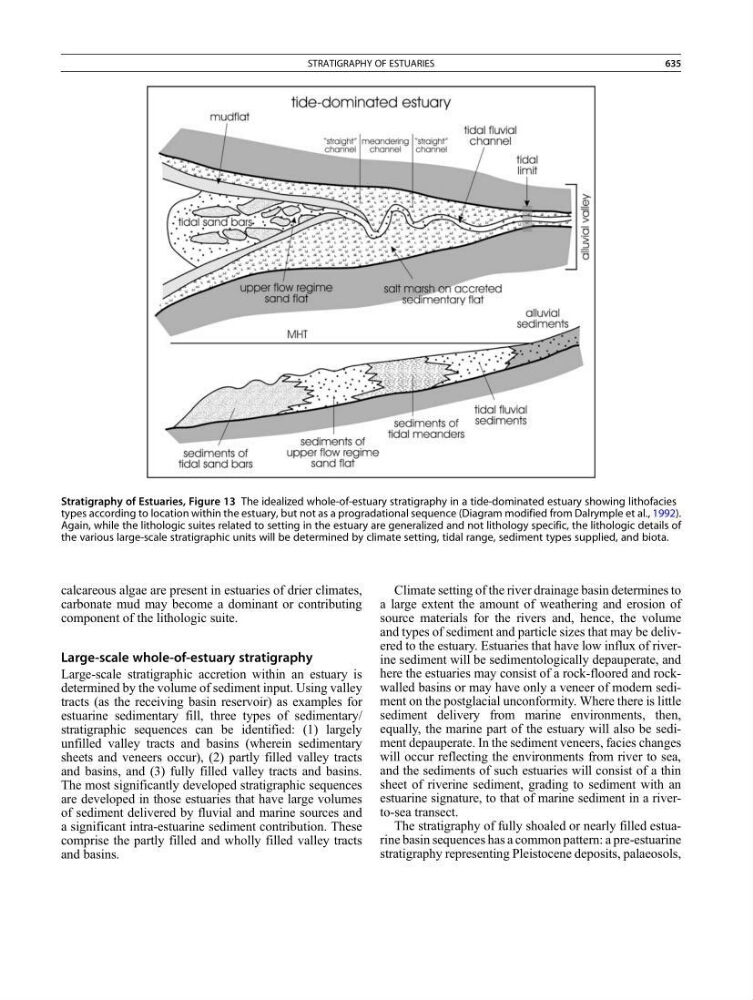
Stratigraphy of Estuaries, Figure 13 The idealized whole-of-estuary stratigraphy in a tide-dominated estuary showing lithofacies
types according to location within the estuary, but not as a progradational sequence (Diagram modified from Dalrymple et al., 1992).
Again, while the lithologic suites related to setting in the estuary are generalized and not lithology specific, the lithologic details of
the various large-scale stratigraphic units will be determined by climate setting, tidal range, sediment types supplied, and biota.
STRATIGRAPHY OF ESTUARIES
635