

The overall estuarine geometry, as well as more specifically the mid-estuary geomorphology and processes,
determines how facies within an estuary are formed and
how they are interrelated, are juxtaposed, or overlap at
the large scale. For instance, an estuarine basin that is
semi-closed or meandering, both with limited fetch, will
not generate intra-estuarine wind waves nor be subject to
ocean swell and waves that can penetrate into the estuary.
Such estuaries will be dominated by fluvial processes and
tidal processes, depending on whether tides are macrotidal
or microtidal and how far the tides penetrate into the riverine sector. However, estuaries with a large surface water
area, even though barred or semi-enclosed, if located in
a region of strong winds, can be wave-dominated internally because of the large intra-estuarine fetch. Estuaries
that are funnel-shaped and open to the sea in the appropriate orientation can be wave-dominated because they
receive swell and wind waves from the open marine environment that penetrate far into the estuary.
Small-scale stratigraphy at any given site is influenced
by the extent to which an estuary is river-dominated,
wave-dominated, or tide-dominated and where these environments occur. Figures 8 and 9 illustrate the idealized
small-scale sedimentary features that are diagnostic of
the different sub-environments of a wave-dominated and
a tide-dominated estuary, respectively, and the small-scale
sedimentary features of each where bioturbation has
become dominant.
Small-scale stratigraphy is also affected by the climate
setting of the estuary itself in that climate influences the
development of lithology, particularly in the tidal and
supratidal environments, where facies have become emergent (shoaled) to levels of the highest tide or to levels
above high tide (supratidal) by storm sedimentation and
inhabited by vegetation. The climate setting also can
determine, for instance, the biodiversity and abundance
of shell material contributed to the estuarine facies, and
the extent and type of marginal facies that will be developed and, thirdly, for stratigraphic sequences that have
shoaled to tidal and supratidal levels, whether the facies
that cap the sequences are peat (in humid climates), rootstructured lithologies formed in salt marsh environments,
such as root-structured and bioturbated sand, muddy sand,
or mud (in humid to subhumid climates), or rootstructured, bioturbated, desiccated sand, muddy sand, or
clay-mineral mud (in semiarid to arid climates). Also, if
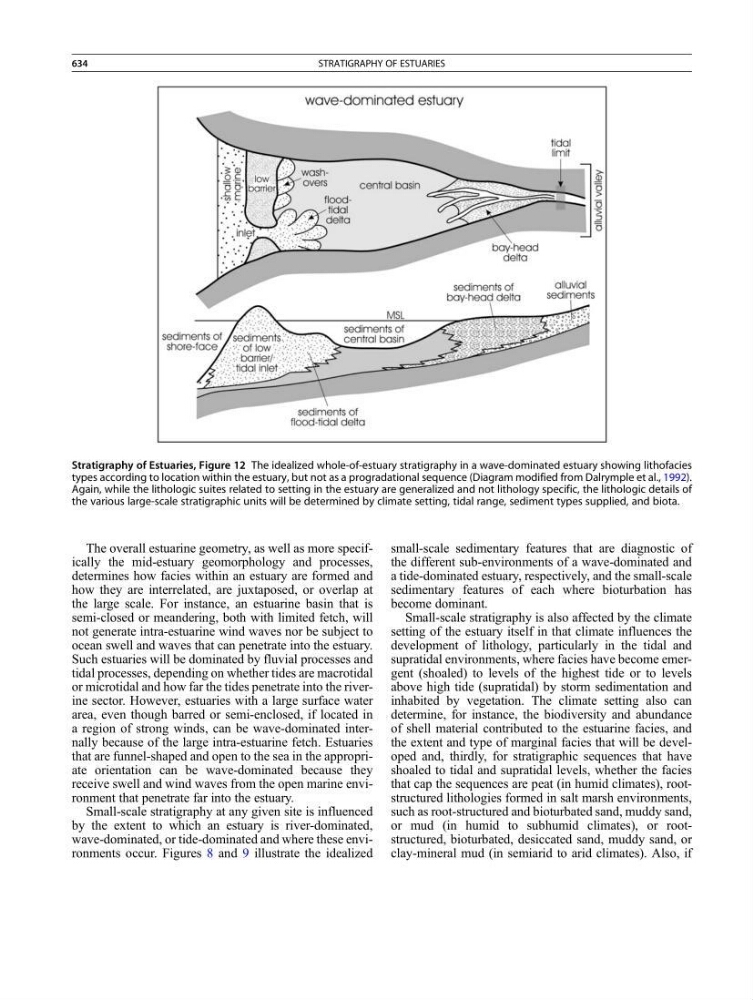
Stratigraphy of Estuaries, Figure 12 The idealized whole-of-estuary stratigraphy in a wave-dominated estuary showing lithofacies
types according to location within the estuary, but not as a progradational sequence (Diagram modified from Dalrymple et al., 1992).
Again, while the lithologic suites related to setting in the estuary are generalized and not lithology specific, the lithologic details of
the various large-scale stratigraphic units will be determined by climate setting, tidal range, sediment types supplied, and biota.
634
STRATIGRAPHY OF ESTUARIES