

endoskeleton production generating shell gravel, skeletal
sand, and biostromes and reefs, plant production, bioturbation, and biomediated mineralization) result in
a variety of sedimentary processes and products. These
include biogenic particles such as mud, sand, and gravel;
partitioning of grain sizes of particles of both exogenic
and intra-basinal origins; dispersal/transport of sediment;
shaping of bedforms and generation of sedimentary structures by wave action and tidal current; bioturbation and
root structuring; accumulation of sediment with its signature lithology for a given facies; and (with lateral
progradation and vertical accretion) development of
facies-specific stratigraphic packages.
A significant factor in the development of faciesspecific lithologies and their potential as diagnostic features in identifying environments is the extent to which
bioturbation may overprint primary sedimentary structures. Many primary sedimentary structures such as lamination, wavy lamination, flaser bedding, and climbing
ripple structures, among others, are diagnostic indicators
of hydrodynamic conditions and formative environments
(Reineck and Singh, 1980) and can be used to identify specific estuarine environments. However, bioturbation by
animals and/or plants can destroy the sedimentary structure evidence, reducing various individual diagnostic
lithologies to a similar appearance. Figure 5 shows the
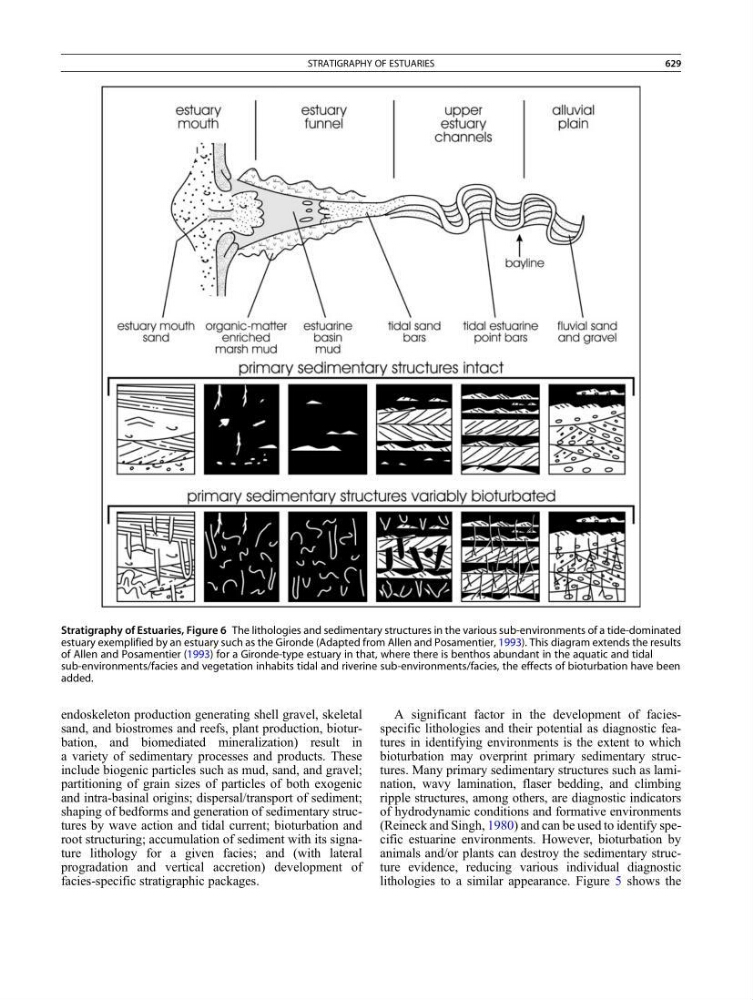
Stratigraphy of Estuaries, Figure 6 The lithologies and sedimentary structures in the various sub-environments of a tide-dominated
estuary exemplified by an estuary such as the Gironde (Adapted from Allen and Posamentier, 1993). This diagram extends the results
of Allen and Posamentier (1993) for a Gironde-type estuary in that, where there is benthos abundant in the aquatic and tidal
sub-environments/facies and vegetation inhabits tidal and riverine sub-environments/facies, the effects of bioturbation have been
added.
STRATIGRAPHY OF ESTUARIES
629